Clara’s Verdict
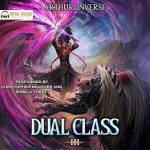
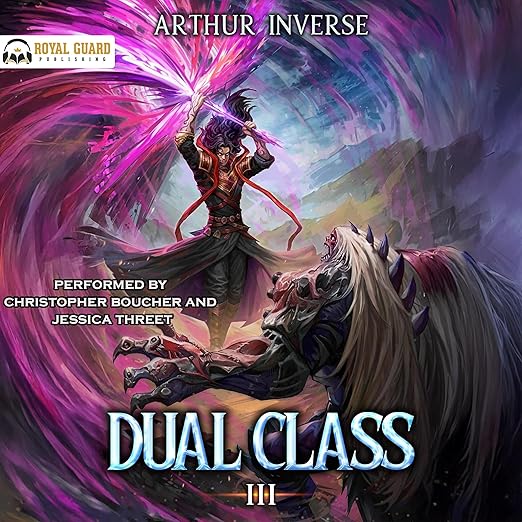
Book 3 of the Dual Class series by Arthur Inverse lands at 27 hours and 26 minutes – a substantial commitment, and one that prospective listeners should weigh carefully given the genuinely divided response this instalment has generated. I want to be straightforward about what the reviews say, because they are split in ways that are informative rather than merely contradictory, and they include a concern serious enough to state directly before any discussion of the book’s other qualities. The overall Audible UK rating of 4.6 stars from 758 listeners aggregates the series broadly, but the specific response to Book 3 is more complicated than that number alone suggests.
Published by Royal Guard Publishing LLC in March 2026 and narrated by Christopher Boucher, this third entry in the series asks a lot of a listener’s time. Whether it delivers proportionate value depends significantly on which qualities of LitRPG fiction you value most, and on your response to the content concerns that at least one reviewer raised with considerable emphasis.
About the Audiobook
The tutorial phase of Drake’s journey is complete. Having survived the System’s restructuring of Earth and established himself as a marked Forerunner – a designation that makes him of active interest to ancient Primordials who see him as both a potential threat and a source of entertainment – Drake must now navigate not just the mechanics of levelling up but the attention of beings whose concept of amusement is unlikely to be benign. The world-building of the Dual Class series operates on the familiar LitRPG framework of a system-altered Earth where survival and progression are inseparable, but Arthur Inverse has invested meaningfully in the political and social architecture of his world in ways that give it texture beyond pure combat and skill acquisition mechanics.
Book 3 expands significantly into town-building territory, raising the scope of Drake’s responsibilities from personal survival to something closer to community leadership and strategic development. One substantial criticism from readers is that this structural shift deprioritises the main character’s personal power progression in favour of ensemble and community development – three or four levels over the course of 27 hours, which frustrated readers whose primary interest was the escalating individual competence that characterises the more celebrated entries in the LitRPG genre. More seriously, one UK reviewer flagged a mid-narrative pivot to a harem-adjacent storyline involving characters described as under 16 years of age, which they found sufficiently concerning to stop reading entirely and award zero stars. That is a content concern rather than a quality judgment, but it is directly relevant to many potential listeners making their decision about whether to proceed.
The Narration
Christopher Boucher handles the extended runtime of this instalment with the technical fluency of an experienced genre narrator. At nearly 28 hours, the demands are considerable: consistent voice characterisation across a large and varied cast, maintaining energetic pacing through action sequences, and holding listener engagement through longer expository and town-building sequences that received criticism for pacing. Boucher’s performance is generally well-regarded by the series’ fanbase, and his ability to differentiate characters credibly across such a long runtime is one of the production’s clearest strengths. Whatever criticisms have been directed at this instalment are aimed at the narrative choices rather than the quality of the narration.
What Readers Say
The response to Book 3 is more sharply divided than the overall series rating suggests. On the positive side, one UK reader gave it five stars and praised the continuation with enthusiasm: magic, battles, betrayal, and pop-culture references, expressing eagerness for the next instalment. One US reader described it as an amazing book with wonderful characters. On the negative side: one UK reviewer awarded zero stars specifically due to the harem storyline involving underage characters, describing it as a perverse pivot from a previously well-developed series. A third reviewer at three stars found the main character’s progression deeply unsatisfying and described significant portions of the middle as tedious. The 27-hour runtime amplifies both the pleasures and the frustrations of a book that has clearly divided its existing readership.
The Dual Class series as a whole has attracted a dedicated readership that values Arthur Inverse’s approach to world-building and the way the System mechanics feel genuinely integrated into the narrative rather than bolted on for genre compliance. Those qualities are still present in Book 3, and readers who prioritised them in the earlier volumes will find them here. The disagreements about pacing and the content concern are both real, but they operate on different levels: one is a matter of narrative preference, the other is a matter of individual tolerance for content involving minors in romantic contexts, and each listener should weigh these separately in making their decision.
Who Should Listen?
Readers who have enjoyed Books 1 and 2 of the Dual Class series should be aware of the specific content concerns raised about this instalment before committing to nearly 28 hours. Listeners new to the series should begin at the beginning – the world-building, character investment, and emotional continuity do not transfer without the earlier volumes as foundation. If you are drawn specifically to LitRPG for personal power escalation and rapid individual progression, the town-building focus and slow level advancement in this volume may not deliver what you are looking for. Proceed with full awareness of what previous readers have reported. Listen on Audible UK