Clara’s Verdict
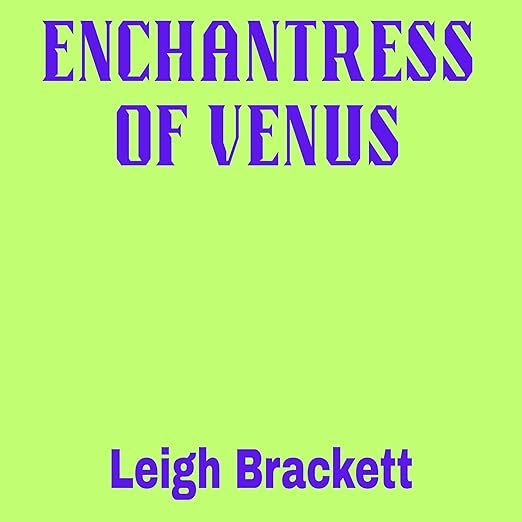
There is a particular pleasure in rediscovering a writer who should never have been forgotten, and Leigh Brackett is overdue her wider recognition. Best known now as one of the screenwriters of The Empire Strikes Back, Brackett was working in science fiction and crime fiction decades before that, producing pulp planetary romance stories in the 1940s and 1950s that were significantly harder, darker, and more morally complex than the genre’s reputation would suggest. Enchantress of Venus is one of her Eric John Stark novellas, and at just over three hours it is an ideal introduction to her voice and her peculiar version of the solar system.
I came to this one having read a few of Brackett’s Mars stories, and the Venus setting caught my attention. The barrier she describes, the vast mystery of Inner Venus that few men cross and fewer return from, is established in a single economical opening sentence that does exactly what great pulp fiction is supposed to do: create a world in the time it takes to read one line.
About the Audiobook
Eric John Stark is Brackett’s most enduring creation: a man born on Mercury, raised wild among its indigenous inhabitants after the death of his parents, eventually civilised enough to operate in the broader solar system but never fully domesticated. He is a mercenary and a survivor, with a moral code that sits outside conventional heroism, closer to Robert E. Howard’s Conan than to anything in the optimistic tradition of science fiction. In Enchantress of Venus, Stark journeys into the cloud-wrapped interior of Venus, a world Brackett renders as alien and genuinely threatening.
The story operates at the intersection of sword-and-planet adventure and something that sits closer to existential inquiry. The violence is direct and the pace is fast, but Brackett pauses the action for moments of psychological depth that distinguish her work from simpler adventure writing. What does it mean to be between worlds, belonging fully to neither? Stark embodies that question without ever articulating it in those terms, which is exactly the right approach. The story was first published in 1949 and the audiobook edition was released by Daniel Price in February 2026, making this vintage pulp newly accessible to a contemporary audience.
The Narration
Phil Chenevert is a narrator with an extensive catalogue in classic science fiction and pulp fiction, and this is territory he clearly knows well. His delivery suits the material: measured and unhurried, with enough gravel in his tone to give Stark credibility as someone who has lived rough. He does not push the theatricality of the more action-heavy sequences, which is the right call. Brackett’s prose has its own momentum and needs space rather than amplification. At just over three hours, the runtime rewards close listening rather than background play. This is a short, dense piece of writing, and Chenevert honours that density.
What Readers Say
The small number of reviews reflects the modest scale of this production rather than any lack of enthusiasm from those who have encountered it. Zatoichi 007 gave it five stars and called it another rock-solid example of Planetary Romance by Brackett, noting that while the debt to Edgar Rice Burroughs is present in the setting, the tone is far darker and more violent, with a more obvious debt to the work of Robert E. Howard. That comparison is precise and fair. Dr. Fred, another five-star reviewer, expressed delight at Brackett’s work being accessible again after a long period out of print, describing Eric John Stark as a brilliant creation and drawing the same Burroughs parallel while emphasising the emotional resonance of the writing. The title holds a 4.0 rating from 15 reviews, which for a short pulp fiction revival release represents a healthy signal of genuine appreciation.
Who Should Listen?
Readers who have loved the Barsoom novels of Edgar Rice Burroughs but want something with a harder edge and fewer romantic ideals will find Brackett a revelation. If you enjoy sword-and-planet adventure but appreciate psychological complexity alongside the action, this novella delivers both in a compact, beautifully paced package. Fans of old-school science fiction who mourn the days when short-form pulp fiction was treated seriously as a literary form should start here. Those who require elaborate world-building or long character development arcs may find the compression slightly abrupt, though that compression is itself part of the art. At three hours, this is also an excellent listen for a long commute or afternoon walk. Listen on Audible UK