Clara’s Verdict
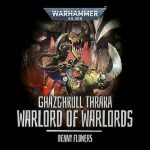
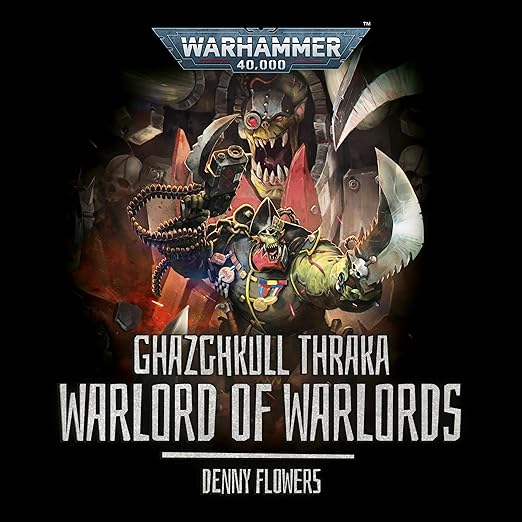
I should be transparent: Warhammer 40,000 fiction is not my usual territory. But I have reviewed enough Black Library titles over the years to know that the best of them do something genuinely interesting. They take the baroque, maximalist universe Games Workshop has built across decades and use it to tell stories that work as fiction rather than merely as extended commercial for the tabletop game. Denny Flowers has form in this space, and Ghazghkull Thraka: Warlord of Warlords makes a clever structural choice: it approaches the galaxy’s most famous ork warlord not from his own perspective but from the considerably more pressured vantage point of Slitta da Stabba, a newly elevated warboss trying to survive in Ghazghkull’s shadow.
That is a structural decision that says something genuinely interesting about power, legitimacy, and what it costs to serve a force of nature rather than to lead one. In a universe not typically associated with psychological complexity, Flowers is using the ork mindset to ask some moderately serious questions about authority, loyalty, and what survival requires when you are answerable to someone whose ambition operates on a galactic scale.
About the Audiobook
Slitta da Stabba has recently become warboss of the Blood Axes, an ork clan distinguished within Warhammer 40K lore by their relative tactical pragmatism compared to other ork factions. His elevation is immediately complicated by the fact that his new boss’s boss is Ghazghkull Mag Uruk Thraka, the greatest ork warlord in the galaxy, whose Waaagh! is currently consuming worlds and forcing every lesser power to either fall in line or be crushed in the stampede.
Ghazghkull has set his sights on the Blood Axe world of Gabal for a confrontation with the Black Templars Space Marines, and the build-up to this battle is anything but smooth. Slitta must navigate treacherous allies within the ork ranks, the vengeful intentions of the Black Templars on his doorstep, and the impossible demands of serving a being whose power and momentum are essentially unstoppable. The central tension is between survival through compliance and survival through independent agency, and the book is honest that neither option is comfortable or straightforward when the entity you are complying with or defying is Ghazghkull.
At nearly twelve hours, this is a substantial listen for the genre, and Flowers takes the time to develop ork society with real affection and detail. The internal politics, hierarchies, and cultural logic of a species that treats violence as its primary form of governance and advancement are rendered with a level of texture that rewards listeners who come with some knowledge of the lore. New readers will need patience with the terminology, but Flowers does not assume encyclopaedic background knowledge and provides enough contextual grounding to keep the story navigable.
The Narration
Harry Myers is the ideal narrator for this material. Ork dialogue in Warhammer 40K has a specific phonetic character, a deliberately fractured approximation of human speech that suggests an alien species working out language as it goes, and Myers renders it with commitment and considerable dark wit. The challenge of narrating fiction set in a universe with multiple factions, each with distinct vocal registers and cultural identities, is substantial, and Myers manages the differentiation convincingly. His performance has the energy the material requires: ork culture is loud, violent, and darkly comic, and the narration captures all three qualities without losing clarity or becoming exhausting over eleven-plus hours. The Black Templars sequences provide a useful tonal counterpoint, and Myers handles the register shift with ease.
What Readers Say
Ghazghkull Thraka: Warlord of Warlords carries a five-star rating from its single Audible UK review at the time of writing. Single-review ratings are statistically unreliable as quality indicators, but within the Warhammer 40K audiobook community, which is intensely engaged and vocal, a positive early response from the core audience is a reasonable signal that the title is delivering what fans expect. Black Library produces titles with remarkable consistency for their core audience, and Denny Flowers is well-regarded within that community for his ability to find the human, or in this case orkish, dimensions of a universe that can sometimes prioritise scale over interiority.
Who Should Listen?
Warhammer 40,000 readers who want to explore the ork perspective on the universe, and particularly the mythology surrounding Ghazghkull Thraka, will find this a detailed and entertaining instalment. The structural decision to follow Slitta rather than Ghazghkull himself is the book’s most interesting move: it provides a ground-level view of what it means to exist within the orbit of that kind of unstoppable power, which illuminates the Big Boss more effectively than a first-person account from the warlord himself might. Newcomers to 40K will find this rewarding if they are willing to do some background reading, but it is not an ideal series entry point. For listeners already inside the lore, it is a confident and enjoyable addition to the library.