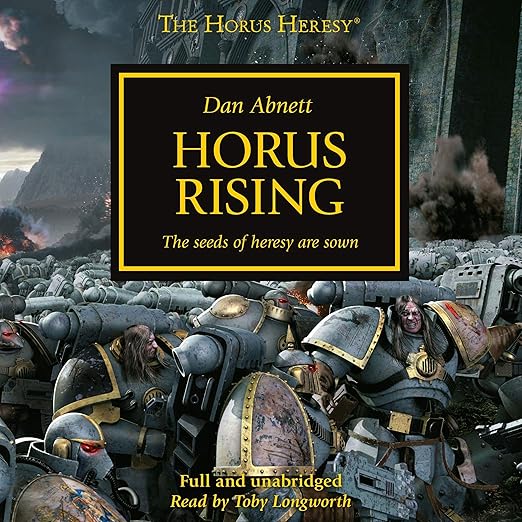
Clara’s Verdict
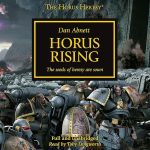
I was deeply sceptical the first time a colleague pressed Horus Rising on me. Military science fiction set in a universe built around a tabletop wargame struck me as exactly the kind of niche genre product that demands extensive prior investment in mythology to generate any emotional return. Dan Abnett changed my mind within the first hour. What he does in Horus Rising is not fan service: it is tragedy. And it works independently of any familiarity with the Warhammer 40,000 universe because it is built around a question that belongs to no single genre or mythology. What does it cost a man of genuine idealism to receive too much power, and what does it cost everyone around him?
The scale is genuinely imperial: the 31st millennium, humanity stretched across the galaxy under the Emperor’s benevolent authority, a golden age of discovery on the very edge of becoming something else entirely. And at the centre of it all, Horus, the Emperor’s favoured son, gifted with command of the Great Crusade at the exact moment when command is about to become a curse.
About the Audiobook
Published by Black Library in 2017 and running for 12 hours and 14 minutes, Horus Rising is Book 1 of The Horus Heresy, a series that has grown to over 60 novels and represents one of the most sustained pieces of collaborative universe-building in contemporary genre fiction. The series addresses the events that precede the grimdark present of the Warhammer 40,000 setting: a moment of optimism, an empire at its most expansive and idealistic, before corruption enters the story and changes everything that follows.
Abnett’s achievement in this opening novel is to make Horus genuinely sympathetic before the betrayal the title already implies. The idealism of the Warmaster, his belief in the Emperor’s vision, his loyalty to his brothers and his legions, is rendered with enough specificity that what follows in later volumes carries real weight. The novel also introduces Loken, a captain of the Luna Wolves, as its primary narrative anchor, and this choice is significant: Loken gives readers a perspective that is fully inside the universe but not yet fully corrupted by it, allowing us to experience the world as it was before everything broke.
The battle sequences are superbly paced, and Abnett is that rarest of military science fiction writers: one who understands that combat is most interesting when it reveals character. The philosophical questions the book raises about loyalty, duty, and the nature of empire are not incidental to the action but woven through it, making Horus Rising something more than a war novel set among the stars. It is a meditation on the conditions that make corruption possible in those who were formed for nobility.
The Narration
Toby Longworth is a strong and experienced choice for this material. His voice carries the gravitas the setting demands without tipping into pomposity, and he differentiates the extensive cast with enough consistency that the listener builds reliable associations between voice and character across 12 hours. The battle sequences benefit from his pacing, which accelerates and settles with the action without becoming breathless or losing the tactical clarity the writing requires. For a novel in which the prose is doing significant work to establish an entire cosmology alongside its human drama, the narration provides exactly the steadying authority the text needs without ever pushing the listener to reach for the sleeve notes.
What Readers Say
Horus Rising holds a 4.7 average across 8 Audible listeners. One reviewer, describing himself as relatively new to the Warhammer 40,000 universe, praised Abnett’s ability to make the magnitude of the Horus Heresy land emotionally for a reader without deep prior knowledge, calling it a testament to the powers of a great author. Another listener, who described having played only a few games of Warhammer in his entire life decades earlier, gave it five stars and called it excellent for all science fiction fans, noting that no familiarity with the game system is required to appreciate the novel on its own terms. The consensus among reviewers from outside the Warhammer community is clear: this is an entry point, not a barrier.
Who Should Listen?
Horus Rising is essential listening for any Warhammer 40,000 fan who has not yet made the journey into the Horus Heresy novels, and it is unquestionably the right place to begin that series. But it also works for science fiction readers with no prior connection to the franchise who are looking for epic military science fiction with genuine philosophical weight and strong character work. The series commitment ahead is significant, with over 60 novels following this first volume. But Horus Rising is complete enough as a standalone to justify the 12-hour investment on its own terms. Begin here and see whether the universe takes hold, as it has for millions of readers before you.