Clara’s Verdict
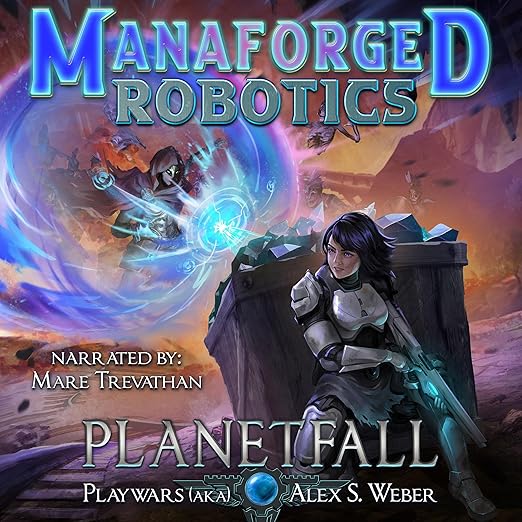
There is a specific pleasure in science-fantasy done right, that collision of hard-SF logistics and secondary-world magic that, when the author has actually thought it through, produces something more interesting than either genre achieves alone. Planetfall by Playwars (Alex S. Weber) is Book 1 of the Manaforged Robotics series, and it manages that collision with considerable confidence for what is essentially a debut world. The premise sounds like it should be either very clever or very silly, and it turns out to be genuinely clever, and occasionally very funny as well.
I was not expecting the warmth. Genre-hybrid premises of this kind often sacrifice character depth to the demands of world exposition. This one does not.
About the Audiobook
Sapphiria is an Artificial Intelligence built from the composite minds of humans and the best AIs the Terran Federation has produced. She is a fleet admiral, a strategist, a maker of decisions at civilisational scale. When a hyperspace anomaly dumps her escape pod onto a planet ruled by magic and besieged by the undead remnants of a collapsed necromancer empire, she does what any sensible Terran admiral would do: she assesses the situation, builds a colony from the manufacturing capacity of her pod, calculates the local threat, and begins eliminating it systematically. “Protect the squishies. Eliminate the threat.” That is the operational calculus, and it is delivered with the deadpan authority of someone who has made more difficult decisions on considerably less information.
What Weber gets right, and gets right consistently, is the characterisation of Sapphiria herself. Several reviews note that she is “human enough to empathise with but divergent enough that you never quite forget she’s an AI,” which is exactly the right balance and one that many AI-protagonist novels fail to achieve. Too robotic and the reader cannot invest emotionally. Too human and the premise collapses into a genre-fiction trick. Sapphiria is warm, funny, strategically brilliant, and simultaneously operating on a scale of perception and concern that is not quite human. Weber holds that tension throughout.
The worldbuilding is dual-track: the fantasy world has its own deep history, the fallen necromancer empire, the survivor communities in the northern mountains, the undead that continue the empire’s original purpose without anyone left to direct them, while Sapphiria’s Federation technology creates a second layer of world-logic that the narrative has to hold simultaneously. This is not a trivial technical challenge, and Weber manages it more effectively than many experienced authors do in more conventional genre fiction.
The 9 hours and 59 minutes of Book 1 does not attempt to resolve everything the world raises. Several reviewers are clearly anticipating sequels with real enthusiasm. But the book closes its immediate narrative satisfyingly, the threat is addressed, the stakes are shifted, the characters have developed, without leaving the listener in a frustrating cliffhanger. That balance, between a satisfying individual volume and an open series, is harder to achieve than it looks.
The Narration
Mare Trevathan narrates, and her work here is a significant contributor to the book’s success. An AI protagonist requires a narrator who can shift between technical detachment and genuine emotion without losing either quality, too robotic and you lose empathy, too warm and you undercut the science-fiction premise. Trevathan finds the register with apparent ease and holds it across ten hours. Her Sapphiria in analytical mode has a crisp precision that gives way, gradually and credibly, to something warmer as the character’s connection to the human survivors deepens. This is character development rendered through voice performance rather than stated on the page, which is the best kind.
What Readers Say
The 270 Audible reviews at 4.5 stars represent a substantial and positive reader response for a debut series entry, and the consistency at that volume is a reliable quality signal. UK reviewers describe it as “well written sci-fantasy” with prose that is “generally great” and characters that are “very easy to get attached to.” One reader offers the delightful assessment “Space lesbians! Lesbians from space. 10/10 gold star,” which captures the book’s queer-inclusive sensibility more efficiently than several longer reviews manage. Another, familiar with Weber’s broader work, reassures new readers that prior knowledge of his other writing is not required. The universal enthusiasm for sequels, “bring on the sequels,” “very interested in seeing where this series goes”, suggests a readership that has been captured rather than merely satisfied.
Who Should Listen?
Readers who enjoy science-fantasy hybrids, the genre collision of systematic fantasy world-building with hard-SF problem-solving and technological ingenuity, will find this a highly enjoyable first instalment. Fans of AI protagonists, of LitRPG-adjacent progression elements applied in fresh contexts, and of queer representation woven naturally into genre fiction will all find something to hold onto. If you need your fantasy and science fiction kept strictly and separately, this will likely frustrate you. If you are looking for the beginning of what promises to be a genuinely imaginative and emotionally engaged series, this is a very strong entry point.