Clara’s Verdict
I was commuting home on a wet Tuesday when I started Room 21, and by the time my train pulled into the station I had missed my stop by two. That is the kind of experience that makes reviewing a thriller slightly awkward, because it tells you something real and important about pace and momentum but very little about whether the underlying craft is genuinely sound. Jessica Huntley’s psychological thriller has a hook that works: an ordinary woman with a medical condition that makes her cautious and careful takes a job she is explicitly warned about, in a hotel that is obviously wrong in ways she cannot quite articulate, and she opens the door she promised not to open. What keeps you listening is not simply the mystery of what is behind Room 21 but the specific texture of Kimberley’s experience in a world that has consistently overlooked and underestimated her.
This is a novel about invisibility, and it uses its central character’s epilepsy and her professional position in service work as genuine narrative materials rather than decorative signals of diversity. That specificity is what separates Room 21 from the crowded centre of the domestic thriller market.
The Room at the End of the Corridor
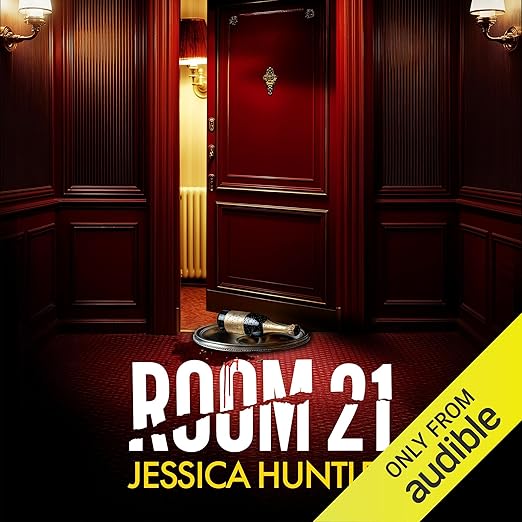
Published by Audible Studios in March 2026 and running eight hours and fifty-six minutes, Room 21 follows Kimberley, twenty-five years old, epileptic, accompanied by a seizure alert dog named Muffin, and employed as a senior housekeeper in a London hotel. She is used to being overlooked. She has built a version of safety and competence within that invisibility. When Jennifer Clifton arrives, rich, powerful, and eerily composed, and asks for Kimberley specifically before offering her a position at a private hotel in the Scottish Highlands at a salary that seems implausibly generous, the catch is established immediately: do not open the door to Room 21.
The Highland hotel is where the novel’s Eyes Wide Shut quality, accurately identified by one reviewer, comes into focus. The guests are wrong in ways that are difficult to specify at first encounter. The staff communicate in ways that are adjacent to normal but not quite. The hotel itself is beautiful in a way that feels like a particular kind of threat. Huntley is working in the territory of secrets-as-architecture: the story’s revelations concern not individual choices made in the moment but a system that has been operating around and beneath Kimberley’s awareness for longer than she realises.
Some readers find the plot’s final revelations stretch the internal logic of the world the novel has established further than the earlier chapters fully support. This is a fair assessment; the climax operates at a level of ambition that requires the listener to extend some good faith to the author’s choices. For those willing to follow the logic Huntley has constructed, the ending is committed and purposeful. For those who need every thread tied with complete internal consistency, it may feel like an overreach. Both responses are reasonable.
Charlie Albers and the Art of Careful Attention
Charlie Albers narrates, and this is casting that serves the book’s specific requirements well. Kimberley is a first-person narrator who is defined by her quality of careful attention; she notices things other people have dismissed or overlooked, and that capacity for noticing is both her survival mechanism and the narrative engine of the thriller. Albers renders that quality of precise, patient observation without making Kimberley seem anxious or neurotic, which would be the wrong register entirely. The multiple-perspective sections, where other voices enter to complicate and reframe the central narrative, are handled with clean differentiation. For a thriller that depends on atmosphere and slow-building unease rather than relentless plot momentum, the narration’s ability to sustain tension through pacing alone is critical, and Albers delivers it.
What Readers Say
Room 21 carries a 4.2 rating from three early listeners, a small sample that reflects the March 2026 release date. C.A. described it as hard to put down with an excellent ending, approaching it without prior experience of Huntley’s work. The listener writing as Amazon Customer gave four stars and highlighted the representation of chronic illness specifically, praising both the specificity of Kimberley’s characterisation and the care with which the epilepsy storyline was handled, and confirming with some relief that Muffin survives entirely unharmed throughout. Jim Edwards called it a real blockbuster with an extraordinary storyline and praised the sustained capacity of the twists to surprise. One reviewer gave three stars, finding the resolution insufficiently earned by the setup and noting that some plot elements stretched credibility beyond the world the novel had established in its earlier chapters.
Who Should Listen?
Listeners who enjoy the domestic-to-sinister register of Daniel Hurst, Freida McFadden, or Jane E. James will recognise the genre territory and find Room 21 a worthwhile addition to their listening. The representation of epilepsy and life with a seizure alert dog is handled with particular care and specificity, making this genuinely worthwhile for readers who rarely see chronic illness depicted with this degree of accuracy and respect in commercial fiction. The Scottish Highlands setting creates an atmospheric isolation that works particularly effectively in audio. Those who need their plot resolutions to hold up to close analytical scrutiny may find the final act frustrating. For everyone else, this is an atmosphere-first psychological thriller with a protagonist worth spending nine hours alongside, and a narrator who makes that time a pleasure.