Clara’s Verdict
I have a reliable test for military science fiction: does it manage to make me care about the soldier before it starts blowing things up? A surprising number of books in the genre fail this, throwing you into combat sequences before you have any emotional investment in who is shooting at what. Christopher Hopper and J.N. Chaney pass this test, just about, in the opening chapters of Ruins of the Earth. Patrick "Wic" Finnegan arrives on the page fully formed, weary, competent, deeply unimpressed with this final babysitting assignment before retirement, and, crucially, funny. That combination carries you through fifteen hours of escalating chaos at a genuinely propulsive pace.
R.C. Bray’s narration is a significant part of why this works. He is one of the best voices in the genre for exactly this kind of character: the gruff professional who gradually discovers that the world requires more of him than he had planned. Fans of his work on the Expeditionary Force series will be immediately at home.
About the Audiobook
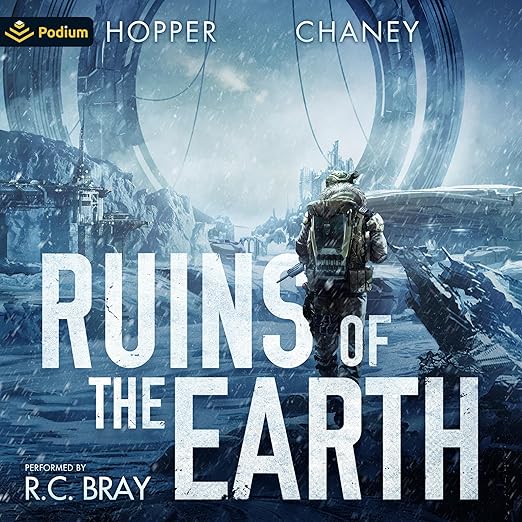
Ruins of the Earth opens with a military research team in Antarctica who have uncovered something extraordinary buried in the Ellsworth Subglacial Highlands. Wic is there under protest, a favour owed to an old friend, nothing more. What he finds changes everything. A portal opens. What comes through is merciless. And within a chapter or two, the story has expanded from Antarctic isolation to Manhattan streets as humanity scrambles to comprehend, and survive, contact with an alien force that does not appear to be interested in diplomacy.
The book is the first in the Ruins of the Galaxy series, and it functions well as an entry point. The authors establish the world-building and the ensemble cast without drowning in exposition, and the alien threat has enough internal logic to feel like more than a backdrop for action sequences. The publishers have accurately compared it to District 9 and Expeditionary Force in terms of tone: it shares that mix of dark comedy and genuine stakes that those properties do well, and knows better than to take itself entirely seriously. The winks to Stargate lore, noted by more than one reader, are the kind of touch that pleases genre fans without alienating newcomers.
The military jargon is dense. This is worth flagging for listeners who have not read widely in the genre: acronyms come thick and fast, and one reader felt it warranted a glossary. It does not derail the story, but it does require a certain tolerance for procedural specificity. Those who find this kind of shorthand entertaining, a feeling of being let into an insider world, will enjoy it. Those who find it alienating may struggle in the first couple of hours.
Where the book is less successful is in the dialogue, which occasionally tips into the slightly stilted register that military fiction of this kind sometimes produces, and in a protagonist who can feel, as one reader noted, "a bit too good to be true." Wic is very competent. Almost supernaturally so. This is a deliberate genre convention, but it does slightly dampen tension in the individual action sequences even as the macro-scale threat remains compelling.
What R.C. Bray Brings to the Room
R.C. Bray has made this genre his territory, and he brings his full expertise to bear. His characterisation of Wic is immediately convincing: the sardonic resignation of a career soldier who has seen too much and expected too little is audible in every line. He handles the ensemble cast with clean differentiation, which matters in a book that cycles through a fair number of secondary characters, and he manages the tonal shifts between dark comedy and genuine horror without losing the thread. At nearly sixteen hours, this is a commitment, and Bray makes sure it never feels like one.
What Readers Say
UK reviewers have given this a 4.3 overall, which reflects genuine engagement rather than uncritical enthusiasm. The most detailed positive response praised it as "an amazing mix of dark comedy and military sci-fi set in the midst of unimaginable horror and suffering, yet still managing to engage the imagination." Another called it "hard to put down, a real page turner." The critical voice raised fair points about the dialogue and the reliance on modern sci-fi references feeling, at times, self-congratulatory rather than affectionate. The 3-star review specifically noted that the ending did not generate urgency to continue to book two, which is worth bearing in mind if you are looking for something that hooks you hard into a long series.
Who Should Listen?
This is for fans of military SF who are happy to invest in a long series from the outset. If you loved Expeditionary Force or Craig Alanson’s broader work, or if R.C. Bray’s narration is itself a draw, this is confidently recommended. Less suited to readers who want character complexity over competence, or those who prefer their alien contact with more philosophical texture and less firepower.