Clara’s Verdict
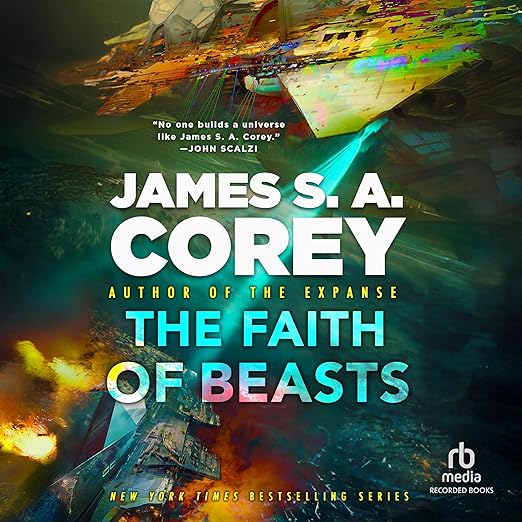
When James S. A. Corey completed the nine-book Expanse sequence, I expected them to rest. The series had sold twelve million copies worldwide, been translated into more than twenty languages, and provided the source material for a television adaptation that ran to six series. It was, by any measure, a finished thing. Instead, Corey returned with The Mercy of Gods, the first volume of The Captive’s War, and demonstrated that completing one thing had simply freed them to attempt something else with the same ambition. The Faith of Beasts, the second book in that new trilogy, published by Recorded Books in April 2026 at eighteen and a half hours, picks up exactly where the first left off and operates at the same level of controlled, carefully deployed scale. This is space opera written by people who understand that the genre’s power comes from its capacity to think seriously about power, survival, and what it costs to remain human under pressure that has no human scale.
About the Audiobook
The Carryx empire is one of the more genuinely alien constructs in recent science fiction. It is not a galactic dictatorship built in a human image with alien aesthetics applied on top; it is a civilisation built around a fundamentally different relationship to existence, one in which the test of usefulness is continuous and failure is simply terminal. Thousands of species are bound to the Carryx Sovran’s command in what the empire presents as an eternal, blood-soaked test: be useful in the endless conflict or be slaughtered. The logic is not cruel; it is structural, which is what makes it genuinely disturbing.
Dafyd Alkhor, the highest-ranking human within the Carryx hierarchy, occupies the book’s most morally complex position. Feared and despised by the very people he champions, he has carved out a niche for himself by becoming something his own species finds frightening. His apparent collaboration with the empire is the novel’s deepest ethical problem, and Corey handles it without resolving it prematurely. The question of whether Dafyd’s loyalty is what it appears to be runs through the book as a sustained ambiguity rather than a mystery to be solved in the final chapters.
The Swarm, the agent of the Carryx’s deathless enemy embedded among the human slaves, provides the book’s second major perspective. Its slow contamination by proximity to humanity, the gradual erosion of its certainty that it is simply a weapon to be deployed, is the kind of science fiction idea that resonates long after the plot mechanics are forgotten. Corey has always been interested in how identity is formed and deformed by circumstance, and the Swarm plotline is their most precise exploration of that interest.
The scope expands considerably in this volume. Where The Mercy of Gods was partly about establishing the scale and character of the Carryx world, The Faith of Beasts moves human characters across multiple battlefronts of empire, giving Corey room to show what Carryx power looks like in practice across different contexts. Readers who have not read the first volume should start there. This book does not accommodate new arrivals.
The Narration
Jefferson Mays is one of the most decorated audiobook narrators in the industry, with a range that encompasses both intimate literary fiction and large-scale genre work. He has narrated all of The Captive’s War to date, which means he arrives at this second volume with a full command of the characters, their registers, and the tonal demands of Corey’s prose. His handling of the Carryx voices, inhuman without becoming simply alien or cartoonish, is particularly impressive. For eighteen and a half hours he maintains the kind of attentive, differentiated performance that makes a long science fiction audiobook feel like a privilege rather than a commitment.
What Readers Say
No Audible UK reviews are available ahead of the April 2026 release. The response to The Mercy of Gods was enthusiastic and critically strong, with Publishers Weekly awarding it a starred review and describing it as space opera at its best. Adrian Tchaikovsky, whose own work in the field is among the most ambitious of the decade, described Corey as always one of the most engaging voices in the genre. The audience is substantial and primed.
Who Should Listen?
Expanse veterans who have already made the transition to The Captive’s War and want the next movement of the argument. Science fiction readers with a tolerance for moral complexity and an appetite for empires that function according to genuinely alien logic. Literary fiction readers drawn to ideas about identity, the ethics of collaboration with oppressive systems, and what it means to remain yourself under conditions designed to unmake you: this trilogy is a serious and rewarding entry point into the genre. Start with The Mercy of Gods.