Clara’s Verdict
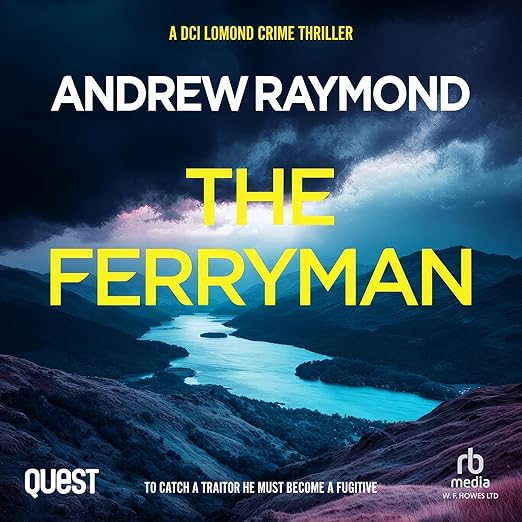
Glasgow crime fiction has produced a distinctive tradition, Ian Rankin’s Rebus, Denise Mina’s Garnethill trilogy, William McIlvanney’s Laidlaw novels that started it all, and Andrew Raymond’s DCI Lomond series has been earning its place in that company over five previous instalments. The Ferryman is the sixth, scheduled for April 2026, and it arrives with a premise that is both classic and, in Raymond’s hands, capable of genuine contemporary friction: a police mole operating under the name the Ferryman has been feeding intelligence to Glasgow’s most brutal crime boss for years. When DCI Lomond closes in on the mole’s identity, the Ferryman’s response is to frame Lomond as the leak.
No listener reviews exist yet for this pre-publication title, but Raymond’s track record from The Bonnie Dead and the preceding Lomond books provides a reliable baseline for what to expect. Angus King narrates.
About the Audiobook
The narrative engine here is beautifully calibrated: Lomond is framed by the person he is hunting, hunted by his own team, and forced to conduct a rogue investigation from outside the institutional structures that normally protect him. This is the cop-goes-off-the-reservation thriller in its purest form, a setup that has been used many times in Tartan Noir but that Raymond has the craft to make feel specific to Lomond’s character rather than generic to the subgenre. The Glasgow setting matters: the detail about a gangland shooting at a Govan supermarket killing innocent civilians grounds this in the real social geography of the city in a way that more atmospheric Edinburgh crime fiction sometimes avoids.
The antagonist, Frank Gormley, is presented as Glasgow’s most brutal crime boss, which in a literary tradition that includes characters of considerable menace is a strong claim. What makes the Ferryman dynamic compelling is that the antagonist’s power operates through institutional corruption rather than direct violence. The mole working within Police Scotland has systematically undermined every attempt to bring Gormley to justice, which means Lomond’s fight is not just with criminals but with the compromised systems that should stop them. This is the richest vein in contemporary crime fiction, and Raymond mines it with evident focus.
At seven hours and three minutes, The Ferryman is efficiently paced for the genre. Raymond is compared on the cover to JD Kirk, Ian Rankin, and Val McDermid, a combination suggesting something tonally somewhere between Kirk’s wry police procedural humour and Rankin’s darker moral weight. Whether the "breathtaking final moments" claim is borne out will be confirmed by April 2026 listeners. QUEST from W. F. Howes is a reliable crime and thriller audio imprint, which provides some production quality confidence for those unfamiliar with the series.
For new readers, a note: this is the sixth book in the DCI Lomond series. It may read as a standalone in terms of plot mechanics, but listeners new to the series will benefit from starting earlier to understand the relationships and institutional dynamics that The Ferryman exploits and subverts. Arriving at book six without prior context is possible but will cost you some of the emotional leverage Raymond has been building across the series.
The Narration
Angus King’s narration suits Scottish crime fiction. The ability to handle Glasgow register, distinct from Edinburgh, from the Highlands, from any of the other Scottish voices that crime fiction requires, without flattening or caricaturing it, is not something every narrator manages. King’s casting in this series has presumably been consistent across the Lomond books, and listeners coming from the earlier instalments will know whether his performance of Lomond’s specific qualities is established and sustaining. For new listeners, the sample will give the clearest indication of whether the vocal match works for them.
What Readers Say
No reviews are available for this pre-publication title. Raymond’s previous Lomond novels have attracted strong reader loyalty, and the comparative framework on the cover, Rankin, McDermid, JD Kirk, indicates the publisher understands the audience well. The April 2026 release date means this review is necessarily forward-looking; listeners should sample and monitor the review profile as it develops post-publication. The setup is strong and the publisher reliable; everything else awaits the listening public’s verdict.
The title itself carries some of the book’s thematic weight. The Ferryman in Greek mythology is Charon, the figure who transports souls across the river Styx to the underworld: a character who exists in the spaces between worlds, between the living and the dead, between the legitimate and the criminal, taking payment in exchange for passage. Raymond’s choice to give his mole this name suggests an interest in threshold figures and institutional corruption that goes beyond the procedural framework, and it is the kind of naming decision that rewards the reader who notices it.
Who Should Listen?
Crime fiction readers with an appetite for contemporary Scottish procedural, particularly those who have found Ian Rankin’s Rebus novels compelling, should find this rewarding territory. New listeners to the Lomond series are advised to sample the first book before committing to the sixth. Those who enjoy the police-under-internal-threat narrative will find the Ferryman premise particularly well-suited to their tastes. Watch for the April 2026 release and the accumulating reviews that will follow.