Clara’s Verdict
The synopsis of The Glass Horizon will be immediately legible to anyone who has spent time in the post-apocalyptic science fiction space. A subterranean society, three centuries of manufactured fear, a single curious individual who pulls at the thread and unravels everything: it is, in broad strokes, familiar territory. Robert Meridien is conscious of this; the book’s marketing explicitly courts fans of Silo, The Maze Runner, and Avatar, which is either disarmingly honest or a signal that what follows leans heavily on those established properties.
What distinguishes The Glass Horizon is its bio-terraforming conceit. The Phage, a world-rewriting agent that has rendered the surface genuinely dangerous in ways entirely different from the lie the Silo’s architects told, is a bold idea. And the decision to give protagonist Kaelen Thorne a unique biological relationship with the transformed planet pushes the book away from straight dystopian thriller and towards something with more mythic ambition. Whether that ambition is fully realised across three hours and forty minutes is a question I will address below, but the imaginative premise is the book’s genuine strength.
About the Audiobook
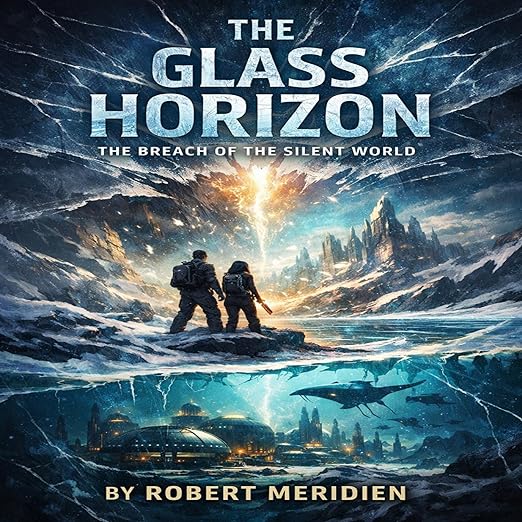
Kaelen Thorne is a structural analyst in Silo 1, a subterranean community that has lived for three hundred years on the belief that the surface is uninhabitable. When he discovers a hidden journal from the Silo’s original architect, he uncovers the truth: the danger sensors are fabricated, the air above is clean, and humanity has been imprisoned by a lie. Kaelen triggers the blast doors and steps outside for the first time in three centuries of human history.
The planet he finds has been transformed by the Phage, a bio-terraforming agent that has made jungles predatory and has begun to affect human physiology in disturbing ways. Kaelen’s golden antigen, a biological quirk that allows him to communicate with the planet itself, gives him a role in what follows: he must build an unlikely alliance of Silo refugees, high-altitude sky-flyers, and warlords to resist a new enemy. The war for the surface is not a comfortable liberation story but a fight against something far more active and hostile than the comfortable underground lie.
Meridien writes action at pace, and the plot moves efficiently across its running time. The worldbuilding is inventive if not always fully developed. The Phage in particular is more evocative concept than rigorously realised ecology, and some readers coming from the meticulous internal logic of Hugh Howey’s Silo series may find the world-rules here somewhat looser. The characterisation is functional rather than deep; Kaelen is a satisfying protagonist but not a complex one. As a high-concept adventure listen, it delivers what it promises: momentum, escalating stakes, and a central mystery with genuine imaginative energy.
The Narration
Robyn Green handles the material with energy and clarity. The narration suits the book’s register: this is action-forward science fiction that benefits from a propulsive delivery, and Green provides it without sacrificing legibility. In a short listen driven by plot rather than atmosphere, the narrator’s job is essentially to maintain forward momentum and keep the world-building elements distinct and trackable. Green manages this effectively, differentiating the various factions and environments without over-dramatising a text that is already reaching for considerable scale. A clean, professional performance that does not draw attention to itself and allows the story to move.
What Readers Say
The Glass Horizon has not yet accumulated listener reviews on Audible UK at the time of writing. Published in March 2026, this is a newly released title and the absence of ratings is simply a function of its recency. Given the clear comparisons made in the marketing to established properties in the dystopian science fiction space, it will likely find its audience among listeners already familiar with the genre who are looking for a shorter, self-contained alternative to longer series commitments. The book’s publisher name on the listing suggests an independent publication, which can sometimes mean a slower build-up of reviews even for well-written titles.
Who Should Listen?
If you enjoyed Hugh Howey’s Silo series or the early instalments of The Maze Runner and are looking for a shorter, faster listen that plays in similar thematic territory, The Glass Horizon offers a self-contained story with a distinctive bio-terraforming angle that sets it apart from the most direct comparisons. At under four hours, it is a manageable commitment and a satisfying single-session listen on a long commute or a lazy Sunday afternoon. Listeners who require fully realised secondary worlds or deep character development may find it a little lean; for action-first science fiction with a strong central idea and a willingness to take its premise seriously, it earns its runtime.