Clara’s Verdict
EMP apocalypse fiction occupies a specific and devoted corner of the science fiction and thriller market, and it has done so with considerable persistence for the better part of three decades. The premise – an electromagnetic pulse destroys the electrical grid, society collapses within days as supply chains fail and communications die, and ordinary people must find ways to survive without the infrastructure they’ve spent their entire lives depending on – is a near-future scenario with genuine scientific plausibility and considerable documented interest from defence analysts and emergency preparedness planners. It generates a particular kind of story: immediate, practical, morally urgent, and deeply concerned with the gap between who people think they are and who they discover themselves to be when the systems supporting them disappear overnight.
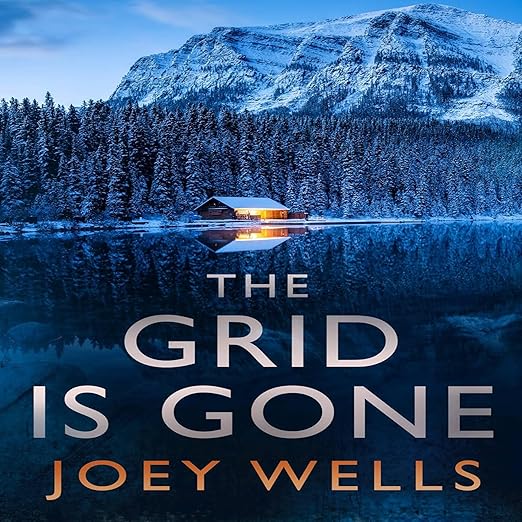
The Grid Is Gone by Joey Wells is the first entry in the EMP Survival in a Powerless World series, published by DBS Publishing LLC in March 2026. At just under seven hours, it’s a tightly paced opening chapter in what appears to be a longer survival narrative built around a protagonist named Holly, who watches the world fall out of the sky and must make immediate decisions with incomplete information and no help coming from anywhere.
About the Audiobook
The synopsis is brief but well-constructed. Holly watches cars fail, phones go dark, and help never come – trapped between a collapsing town and a forgotten homestead. The binary she faces is the one the entire genre is built around: survive alone on her own terms, or die waiting for a system that no longer exists and will not return. The framing is elemental, and the best EMP fiction uses this scenario to ask serious questions about community, mutual dependency, and the fragility of the social contract that keeps ordinary civil life functioning – questions that feel considerably less hypothetical in 2026 than they might have done twenty years ago, given the accumulation of infrastructure disruption events across multiple continents.
The available review describes a full-fledged apocalypse story with dedication and hard work, one that will leave you wanting to read more about the heroes and heroines – plural – suggesting that while Holly is the central figure, an ensemble develops across the narrative. This is typical of the genre’s most successful entries: survival stories are fundamentally about the improvised communities that form in the absence of institutional support, and the character dynamics within those communities are where the real storytelling and the real moral questions live.
The Narration
Jess Trepanier narrates. For survival fiction with a female protagonist, the casting of a female narrator is the right call – it aligns the listening experience with the perspective the story is built around and avoids the distancing effect of a narrator reading a character whose gender experience differs substantially from their own. Trepanier brings the urgency the material demands without tipping into panic or overperformance: EMP fiction is, at its core, about decisions made under pressure with incomplete information and no safety net, and narration that conveys that pressure without becoming frantic or melodramatic is doing exactly what it should. The pacing across nearly seven hours holds the tension that survival plots rely on.
What Readers Say
The Grid Is Gone carries a 4.5-star average from 144 ratings on Audible UK – a healthy count for a very recently released title, suggesting strong early discovery among the EMP and post-apocalyptic fiction community on the platform. The available review describes the story as generating genuine investment in its characters alongside the standard survival mechanics, which is the meaningful distinction in this genre: the technical survival content is table stakes; the character work is what separates the entries people return to from the ones they finish and forget.
Who Should Listen?
The Grid Is Gone is the right starting point for listeners new to the EMP apocalypse genre who want a character-driven entry into the format that doesn’t sacrifice story for technical survival detail, as well as for devoted fans of the subgenre – One Second After by William Forstchen, Lights Out by David Crawford, and related series – who are looking for new sequences to follow with a distinctly different protagonist perspective. The female lead and the specific tension between community survival and individual isolation suggest a different emotional emphasis from the more conventionally masculine end of the genre. Approach this as Book 1 of a series and be prepared to continue from there: the strong early reception indicates there is more story worth following.
One note on the metadata: the series number appears as 144 in some catalogue listings, which is clearly an error. Based on the content description and the framing of the synopsis, this is Book 1 of the EMP Survival in a Powerless World series. Begin here and follow the series in order from this starting point.