Clara’s Verdict
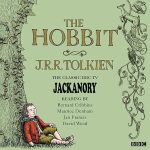
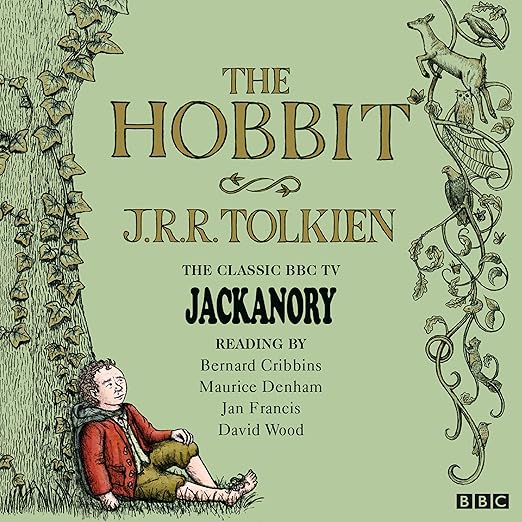
I first encountered this recording not through nostalgia but through research, and I found myself genuinely startled by how well it holds. This is the BBC Television soundtrack from the 1979 Jackanory broadcast — ten episodes transmitted over two weeks to mark the programme’s 3,000th instalment. That context matters enormously. This is not a straightforward audiobook narration of Tolkien’s novel. It is an archival theatrical reading, a cast performance lifted from television, complete with music and sound design that locate it firmly in its era. At two hours and twenty-seven minutes, it covers the full sweep of Bilbo’s journey, but condensed and dramatised rather than read complete.
What you are buying into here is something quite specific: a piece of British broadcasting history that doubles as a genuinely lovely way into Tolkien. The rating of 4.6 from over a hundred listeners reflects that most people who find this recording know exactly what it is and love it for precisely those reasons. The Jackanory name will trigger immediate recognition in British listeners of a certain age; for international listeners, it was the BBC’s flagship storytelling programme, running from 1965 to 1996, through which generations of British children encountered literature for the first time.
About the Audiobook
Tolkien’s 1937 novel follows Bilbo Baggins, a comfort-loving hobbit of the Shire, who is recruited by the wizard Gandalf to join a company of thirteen dwarves led by Thorin Oakenshield. Their quest: to reclaim the Lonely Mountain and its hoard of treasure from the dragon Smaug. Along the way, Bilbo encounters trolls, goblins, the wood-elves of Mirkwood, and in what became one of literature’s most famous encounters, a wretched, riddling creature called Gollum, from whom he acquires a certain small gold ring.
The Jackanory production, broadcast in 1979 and now released through BBC Audio, preserves that reading with its original cast and soundtrack intact. It is a children’s adaptation in the truest sense: accessible, brisk, performed with real warmth. Listeners should be aware that the format is a dramatised reading rather than a full unabridged narration. The runtime of two hours and twenty-seven minutes, as against the roughly eleven hours of a modern unabridged production, tells you everything about the degree of compression. Parents or educators wanting the complete text will want a different edition. For family listening, shared car journeys, or introducing a reluctant young reader to Tolkien’s world without the commitment of a full production, however, this is something rather special.
The Narration
Bernard Cribbins was one of the great voices of British children’s broadcasting, and this recording catches him in his element. His Bilbo is warm and slightly flustered, exactly right for a domestic creature being dragged into improbable heroism. Jan Francis, Maurice Denham and David Wood fill out the ensemble with characteristic BBC Radio professionalism; there is a period style to the delivery that some modern listeners may find formal, but it reads as of its time rather than stiff. The theatrical framing, with music between episodes and sound effects anchoring key scenes, gives the whole thing a storytelling energy that single-narrator audiobooks rarely achieve.
Reviewers consistently single out Cribbins as the highlight, one calling him the voice of their childhood. The music that marks the end of each episode also receives specific praise as providing natural pause points for young listeners to absorb and discuss what they have heard before continuing. For a recording this old, the audio quality is more than serviceable; there is warmth to the BBC archival sound that lends the production an atmosphere that modern studio recording does not always replicate.
What Readers Say
The reviews split neatly between listeners rediscovering a childhood memory and parents using it with young children today. One reviewer describes missing the final television episode in 1979 because of Brownies on a Friday and spending pocket money on the book to find out what happened — the kind of detail that tells you exactly what this recording meant to a generation. More recently, a parent reports playing it in the car for a five-year-old who became engrossed in the characters and asked for something similar for Lord of the Rings. The natural episode breaks, marked by music, receive particular praise as a way of pacing the listen for younger audiences. A third reviewer describes it as a faithful telling of the text delivered very much in the way they had always imagined Tolkien intended, which is perhaps the highest compliment a dramatised adaptation can receive.
Who Should Listen?
This recording is ideal for families with children roughly aged five to twelve, for adults who remember the original 1979 broadcast, and for anyone who wants a brief, beautifully performed introduction to Tolkien’s world. If you are expecting a full unabridged reading, look elsewhere. It is also worth noting that the BBC audio quality is of its era; there is warmth and richness to it, but listeners expecting contemporary production values should calibrate expectations. As an archival document of British children’s broadcasting at its most affectionate and skilled, this recording is irreplaceable.