Clara’s Verdict
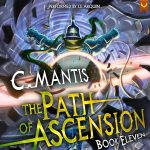
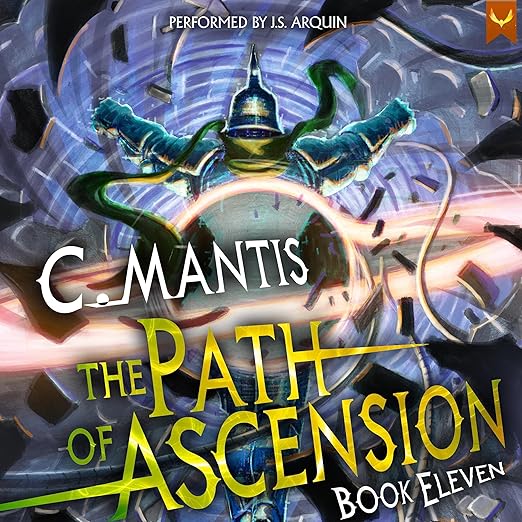
I should be straightforward about my relationship with LitRPG as a genre: I came to it late and somewhat sceptically, having spent too long reading summary descriptions that made the whole enterprise sound like a spreadsheet with dialogue. What changed my view was encountering series where the progression mechanics were actually in service of something – character investment, genuine stakes, a plot that was not simply a delivery mechanism for power-number inflation. The Path of Ascension, across eleven books, is that kind of series. C. Mantis has been building a war arc since the early instalments, and Book 11 is where it arrives in force.
This is not an entry point. It is emphatically, categorically not an entry point. Arriving at Book 11 without prior investment in the series would be like watching the final movement of a symphony you have never heard before and wondering why it does not make immediate sense. But for existing readers, this is a significant and rewarding instalment.
About the Audiobook
Published by Aethon Audio in April 2026, this 23-hour instalment finds the Ascenders – Matt, Liz, and Aster – a century into a war against an empire that, even with all its structural advantages, is slowly losing ground. As the Ascenders work overtime alongside their peers Light and Shadow to stem the tide, their enemies finally make a decisive move that changes the strategic calculus entirely. The extended action sequences that follow are the book’s defining quality, and they land because the emotional investment in the characters is already established across ten prior volumes.
The series’ author describes the hybrid methodology as “a car that looks like a LitRPG with dungeons and skills, but the interior and engine are all Xianxia” – meaning the progression system draws from Chinese cultivation fiction rather than Western RPG conventions, even when the surface presentation resembles the latter. The magic system and power progression are logically and internally consistent, which is more important than any particular genre label. Readers of web fiction in the LitRPG or xianxia traditions will recognise the conventions; readers coming from neither will find them transparent enough to learn within the first book.
The war narrative structure that Book 11 inhabits is one that LitRPG and xianxia series handle with varying success. The genre’s typical challenge is that extended combat sequences can become numbing when the power differentials are well-established and the stakes feel theoretical. Mantis’s solution has been consistent across the series: keep the protagonists in genuine jeopardy despite their growing capabilities, and ensure that the emotional relationships at the centre of the story remain under pressure even when the tactical situation is temporarily resolved. Book 11 extends this logic into a war-scale conflict that requires the Ascenders to think about logistics, alliance politics, and the sustainability of a campaign rather than simply the resolution of individual encounters. The shift in scale produces a qualitatively different kind of tension from the dungeon-diving and tournament arcs of earlier volumes.
The Narration
J.S. Arquin narrates, and his performance has been a consistent element of the series’ audio identity across multiple instalments. The challenge in LitRPG narration is maintaining listener engagement through both dense system-exposition and extended action sequences, both of which require different register from character interaction. Arquin handles these transitions competently, and his growing familiarity with the ensemble cast – which has expanded considerably across eleven books – shows in the clarity of character differentiation across the 23-hour runtime.
What Readers Say
The Audible listing shows a very high early rating from a small sample – the series’ established readership is clearly tracking audio releases close to publication. Alex McPherson wrote that “the increase in power doesn’t mean the main characters feel out of danger, which makes for an exciting read,” identifying precisely the series’ core structural achievement: power escalation without the loss of stakes that typically afflicts progression fiction. Another reviewer praised the transition from the slower, ability-building middle books to the sustained action of Book 11, noting that “the war is now fully in swing” and calling it a “can’t miss book of the series.” The single 1-star review came from a reader who bounced off the action-to-story ratio at 10% through – an honest response that actually functions as useful guidance: if extended action sequences without significant narrative pause are not your preference, Book 11 is not where to find out. Seth Brenner’s US review offered the most accurate benchmark: “they aren’t so overpowered that you don’t feel like there isn’t any risk.”
Who Should Listen?
Existing readers of the Path of Ascension series who have reached Book 10. Anyone else should start at Book 1 and assess from there – the LitRPG/Xianxia hybrid is an acquired taste that pays off substantially for readers who commit to the long arc. If you have never read LitRPG before, this series is one of the genre’s better starting points, but only if you begin at the beginning.