Clara’s Verdict
I should say upfront that LitRPG is not the genre I grew up with. My formative reading was Byatt and Fitzgerald, not dungeon systems and skill trees. But I have been reviewing audiobooks long enough to know that genre loyalty is a distraction, and when a third entry in a LitRPG series is pulling 4.7 stars from 459 Audible listeners, something is genuinely working. The Stubborn Skill-Grinder in a Time Loop 3 is the kind of audiobook that its fans describe in the language usually reserved for experiences rather than books: devoured, addictive, impossible to stop at a sensible hour.
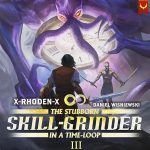
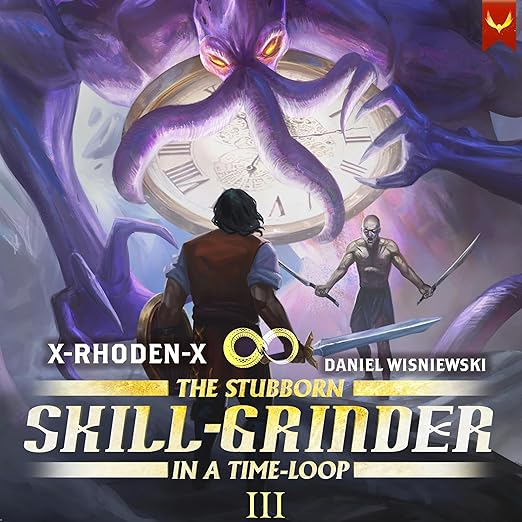
X-RHODEN-X is the author, a pen name that carries the genre’s deliberate playfulness with identity and authorship. The series follows Orodan, a fighter trapped in time loops who must improve himself against increasingly impossible odds. Book 3, published by Aethon Audio in February 2026, escalates that premise to cosmic scale and changes the rules of the game significantly.
What Changes at the Third Loop
By book three, Orodan has awakened what the text calls a Celestial-rarity skill, and the consequences are immediate and severe. Otherworldly factions send their champions across dimensions to capture him. Worse, his habit of being transparent about the time loops has drawn the attention of beings who understand precisely what that means. The loop is no longer a safe space for iterative improvement; true death, meaning death that persists across all resets, has become possible. For a story whose core mechanic has always been the relative safety of failure followed by restart, introducing genuine existential stakes to the reset cycle is a significant structural move.
The series moves into cultivation territory in this volume, drawing on Xianxia conventions: the Celestial hierarchy, the cosmic politics of competing factions, the logic of power measured in units that exceed ordinary comprehension. This sits alongside the established LitRPG architecture of skill trees, system notifications, and detailed progression systems. Some readers will find the combination of these genre strands enormously satisfying; the cultivation aesthetic gives the power fantasy a different flavour from purely Western dungeon-crawler convention.
At 28 hours and 51 minutes, this is a substantial commitment. Aethon Audio, which specialises in progression fantasy and LitRPG, produces consistently solid audio, and the production here is clean and well-paced. The synopsis notes “a heroic character you can’t help but root for,” and based on the reviewer response, that appears to be a fair description rather than publisher marketing language.
Daniel Wisniewski Carries the Loop
Daniel Wisniewski has become a reliable presence in the LitRPG and progression fantasy audio space, and he handles the specific challenges of this genre competently. The particular skill required here is differentiation: system notifications and skill readouts must sound distinct from narrative prose; combat sequences need pace without losing clarity; the protagonist must feel like a real, specific person even when surrounded by the vocabulary of game mechanics. Wisniewski manages these requirements with evident ease.
His voice for Orodan has the combination of stubborn determination and dry wit that the character requires. The “time loop regression” element of the series creates repeated scenes that need to land differently on each iteration, a subtle performance challenge that Wisniewski navigates well. One dissenting reviewer raised a legitimate craft point: the author’s frequent use of the words “utter,” “pure,” and “raw” in combat sequences becomes repetitive across nearly 29 hours, and in audio the repetition is harder to skim past than in print. This is a writing issue rather than a narration issue, but it is worth flagging for listeners with sensitivity to stylistic tics.
What Readers Say
Four hundred and fifty-nine Audible reviews giving 4.7 stars is an unusually strong signal for a progression fantasy title, even in a genre with an enthusiastic review culture. Mr. Rory I. McDonald called it “by far one of, if not the best LitRPG series I have ever read,” praising the pace, character work, and consistency of internal logic. Nicolas was specifically excited by the Xianxia-influenced mid-book section and the ending’s escalation. Xavier Noe, reviewing at a point when four books were available, declared the series his most favourite. The one substantive dissent, from Theodor Spann at two stars, raised real concerns about repetitive word choices, limited protagonist character growth despite years of accumulated loop experience, and a narrative scope that has grown to an unwieldy scale. That critique is worth reading before committing to 29 hours. The majority disagree with it emphatically, but the concerns are not frivolous.
Who Should Listen?
Start with Book 1 of this series. That is not optional; the world-building, system design, and character context are all established there and cannot be meaningfully compressed into a synopsis. If you have already completed Books 1 and 2 and enjoyed them, Book 3 will deliver the escalation those books were building toward and push the stakes considerably higher. If you are new to LitRPG and curious about the genre, this series is regularly cited as one of the better entry points, but it remains emphatically not a standalone.
Not for readers who require literary realism in the conventional sense. Very much for readers who want elaborate systems, relentless forward momentum, cultivation-flavoured cosmology, and a protagonist who meets every impossibly stacked situation by charging at it again.