Clara’s Verdict
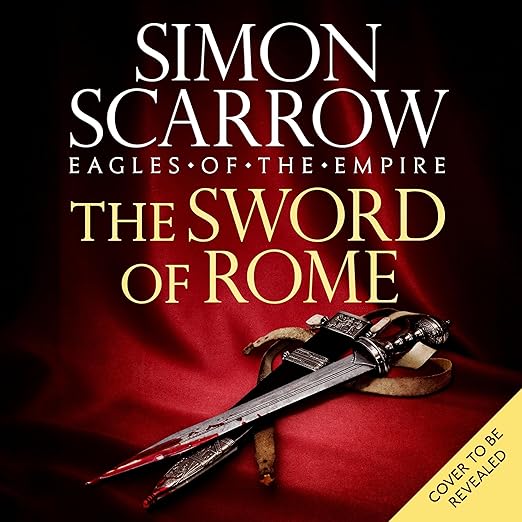
Twenty-five books. I have been following Cato and Macro since Simon Scarrow sent a raw legionary recruit and a battle-hardened centurion into Roman Britain at the very beginning of this century, and The Sword of Rome arrives as both a celebration of that longevity and a genuine test of what the Eagles of the Empire series can still do in its twenty-fifth entry. The good news is that Scarrow has not simply delivered a greatest-hits exercise. He has sent his two principals to a setting the series has never visited before, complicated the stakes in a way it has not previously attempted, and produced a book that functions as a proper anniversary event rather than a maintenance instalment. Due from Headline in November 2026 at thirteen hours, this is Scarrow writing with the confidence of someone who has nothing left to prove to his readership and can therefore take risks.
About the Audiobook
Twenty years have passed since Cato faced Macro on the training ground as a raw recruit. The weight of those years shows in how Scarrow describes both men: scarred veterans of the Roman army’s most demanding conflicts, carrying the accumulated cost of campaigns across Britain, the eastern Mediterranean, and beyond. It is precisely that history that makes them Corbulo’s first choice when he needs soldiers capable of operating without institutional support at the very edge of Nero’s imperial reach.
The mission takes them more than a thousand miles from Rome to the northern coastline of the Euxine Sea, the Black Sea, where a city faces massacre at the hands of an expanding Scythian empire that is pushing back hard against Roman ambitions. The setting is a genuine departure for the series, which has historically operated in more familiar Roman territories, and Scarrow uses the unfamiliarity productively. The journey alone is described as punishing enough to break lesser men. What awaits them is worse: carnage, approaching famine, and a Scythian army vastly superior in numbers to the Roman force that has arrived to intervene.
The structural masterstroke of this entry is the hostage situation back in Rome. Cato’s wife and son, and Macro’s wife, are held against the success of the mission. That detail transforms what might otherwise be a military adventure into sustained psychological pressure. Every tactical decision Cato makes carries the weight of people he loves, and Scarrow deploys that weight with skill rather than melodrama, giving the action sequences a moral urgency that routine military fiction rarely sustains across a full novel’s length.
The scope of the Scythian threat, an empire asserting itself along a frontier that most readers will not know well, provides a geopolitical context that feels authentically unfamiliar. Scarrow’s research into the period is consistently strong across the series, and the specificity of the setting reflects that thoroughness. This is not an entry point for the series: begin with Under the Eagle, Book 1, and follow the sequence forward to understand what this twenty-fifth book is actually asking of its characters.
The Narration
No narrator is credited in the available metadata ahead of the November 2026 release, almost certainly a pre-publication placeholder rather than a production gap. Headline has consistently paired this series with narrators capable of sustaining the dual register of action and character across substantial runtimes. Check Audible UK closer to the release date for confirmed casting, particularly if narrator continuity with earlier volumes matters to you.
What Readers Say
Advance reader responses cited in the synopsis describe the series in terms its long-term readership would recognise: exciting action scenes, hard to put down once started, action and drama and comedy and trauma all present. These are not generic marketing phrases; they reflect two decades of consistent engagement from an audience that has shown up for Cato and Macro through twenty-four previous campaigns. Pre-publication appetite for Book 25 is genuine and substantial.
Scarrow has maintained a notably consistent quality standard across a very long series, which is rarer in military historical fiction than the genre’s commercial success might suggest. The Eagles of the Empire books have attracted criticism over the years for formulaic plotting, which is not an entirely unfair observation, but the formula works because Scarrow understands his characters and his setting with unusual depth. The Sword of Rome arrives with exactly the kind of structural innovation, the Euxine setting, the hostage mechanism, that suggests he has thought carefully about what a twenty-fifth book needs to do differently.
Who Should Listen?
Dedicated Eagles of the Empire series readers who have followed Cato and Macro through twenty-four previous entries and want to see what Scarrow has constructed for the twenty-fifth. Military historical fiction listeners who enjoy procedurally rigorous campaigns in unfamiliar ancient settings. Series newcomers are warmly encouraged to start at the beginning: the emotional stakes of this book accumulate from everything that has come before it and cannot be understood in isolation.