Clara’s Verdict
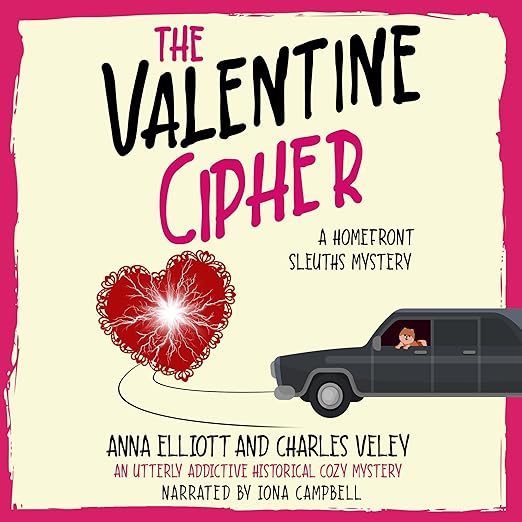
There is something I find reliably comforting about a well-constructed wartime cosy mystery. The genre requires its author to perform a kind of narrative sleight of hand – maintaining genuine tension about a murder investigation while also delivering the warmth, character continuity, and satisfying social world that cosy readers come for. Anna Elliott has been doing this with considerable skill across the Homefront Sleuths series, and The Valentine Cipher, the eighth book in the series, demonstrates a writer fully in command of her material.
I listened to the last third of this on a grey Saturday morning, properly settled in with tea going cold on the desk, and it delivered everything the genre promises: a clever plot, characters whose relationships have accumulated real weight over eight books, and a final act that earns its resolution. Iona Campbell’s narration is a significant part of why this works so well on audio.
About the Audiobook
Published by Wilton Press and released in March 2026, The Valentine Cipher runs to twelve hours and fifty-four minutes – a generous length for the genre that allows Elliott to develop both the mystery plot and the personal storylines without either feeling rushed. Set in wartime England, the book takes place in and around the fictional village of Crofter’s Green, where seven couples are preparing to marry in a Valentine’s Day ceremony whose guest list includes someone described only as "the most famous woman in the world" – a detail that signals immediately that the stakes are not entirely local.
The inciting mystery is the death of the village curate, discovered just days before the ceremony. What initially appears to be a robbery – a church relic has been taken – begins to unravel when Harry investigates and finds evidence that the curate had been troubled by irregularities in the marriage records. Meanwhile, in London, Evie and Nigel intercept a Norwegian spy’s cipher, and the curate’s name appears within it. The plot branches across multiple locations and involves Land Girls, wartime bureaucracy, a wedding planner with an unusually suspicious eye, and a conspiracy that, if successful, could affect the course of the war.
Elliott manages the dual narrative – the romantic subplot involving Evie and Nigel runs parallel to the mystery – with assurance. The Valentine’s Day setting is not merely decorative: the question of what long-term commitment means in wartime, when survival itself is not guaranteed, gives the personal storyline its proper emotional resonance. For fans of Agatha Christie and Jacqueline Winspear – names the book’s marketing explicitly invokes – this is territory that will feel both familiar and fresh.
The Narration
Iona Campbell narrates the series, and by book eight she is so thoroughly inhabiting these characters that the performance feels less like narration and more like company. Her handling of the wartime English setting is assured – accents, registers, and the social distinctions of 1940s Britain land without feeling like pastiche – and she calibrates the comedy and the tension with the skill of someone who has spent considerable time in this world. The cast of recurring characters, each with their own vocal signature, is managed with clarity. At nearly thirteen hours, the performance sustains engagement throughout; Campbell never lets the pacing sag in the middle sections where lesser narrators would lose the thread.
What Readers Say
With a rating of 4.6 from a small but telling sample, the reviews for The Valentine Cipher capture the particular affection series fans bring to a long-running cosy. UK reviewer T. R. Palmer noted that while it works as a standalone, starting from book one is strongly advisable: "the characters get more interesting with each book, relationships grow and change as WW2 continues." KM offered a detailed plot summary and noted specifically the intelligence of the central mystery’s construction – the church relic, the marriage records, the Land Girls administrator’s growing suspicion – while also praising the spy subplot. Sally A., noting with good humour that some descriptions "are more American than English," nonetheless called it a really good series. The consistent thread across all reviews is genuine affection for the characters and confidence in Elliott’s plotting.
Who Should Listen?
If you have already spent time with the Homefront Sleuths series, this is everything you want from book eight and more. New listeners would benefit from starting at the beginning – the character relationships, particularly between Evie and Nigel, have an accumulated history that book eight draws on significantly. Fans of Christie, Winspear, or any of the well-populated wartime cosy subgenre will find this series worth committing to. For those who enjoy mysteries where the setting is as important as the plot, and where character development accumulates meaningfully across a long series, Elliott is doing excellent work, and this series deserves considerably wider recognition than it has yet received.