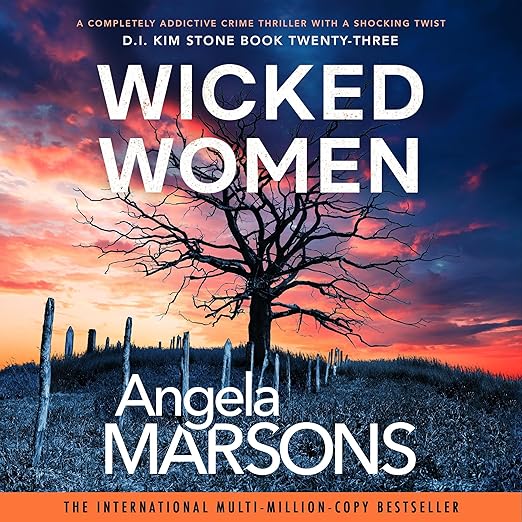
Clara’s Verdict
Twenty-three books into a series is an extraordinary achievement, and Angela Marsons has pulled off something that very few crime writers manage at that stage: maintaining genuine tension. The Kim Stone series could easily have calcified into formula by now – established detective, established team, familiar territory – but Marsons keeps finding ways to disturb the reader’s complacency, and Wicked Women opens with a scene that establishes its stakes immediately. A woman lies dead from a single stab wound, her killer having waited to ensure she was gone. It is a detail that changes the register of everything that follows: this is not impulsive violence, it is deliberate, considered, and ideological.
The title signals the thematic territory – a killer who has appointed themselves judge of women deemed morally deficient – and Marsons handles this with the seriousness it deserves. This is not a pulpy premise played for entertainment; it is an examination of how moral judgment becomes lethal when it is privatised and absolutised. The victims here are not randomly selected. They have been evaluated and found wanting by someone who believes, with complete certainty, that they deserve what happens to them.
About the Audiobook
The central investigation follows DS Kim Stone as she connects three murders that, on the surface, seem to target women with compromised reputations: Ashley Reynolds, a social worker accused of tearing families apart; Nadine, a honey trapper whose work destroyed marriages; and a third victim whose apparent blamelessness shatters the pattern and forces the team to rethink its assumptions entirely. The broadening of the killer’s frame – from the obviously judgeable to the seemingly innocent – is where the book becomes genuinely unsettling.
Marsons is particularly skilled at building the structural logic of her antagonists. The killer here is not irrational; they are operating within a coherent, if monstrous, moral framework, and watching Kim and the team work backwards from the framework to the identity requires the kind of sustained lateral thinking that distinguishes the best procedural crime writing. The revelation that the worst danger is still ahead – which the synopsis deliberately withholds specifics on – ensures the tension does not resolve at the point where many readers might expect it to.
A note for newcomers: Marsons confirms that this can be listened to as a standalone, and the mechanics of the investigation are self-contained. But the Kim Stone series rewards long-term listeners with a depth of character context that cannot be fully replicated in a single book, and returning readers will bring an accumulated understanding of the team’s dynamics that enriches the experience.
The Narration
Jan Cramer has been the voice of the Kim Stone series for several books now and has developed a genuine identification with the material. Her Kim Stone is sharp, impatient, and driven – all without tipping into caricature – and she handles the ensemble cast with clear differentiation. The Black Country setting benefits from her vocal specificity, and her pacing through the investigation sequences is well-calibrated to sustain momentum over eight hours.
What Readers Say
Published in April 2026, this title has not yet accumulated public ratings on Audible UK. The wider Kim Stone series, however, has a vast and loyal following, and Marsons’ track record across twenty-two previous instalments is strong. Fans of the series who have accompanied Kim from the beginning will need no persuasion. New listeners are well-served by the standalone framing, though they will miss the series’ accumulated emotional texture.
Who Should Listen?
Established fans of the Kim Stone series, first and foremost. Beyond that readership, this is a strong choice for listeners who enjoy British procedural crime with a serious engagement with motive and moral psychology – readers of Karin Slaughter or Val McDermid, as the publisher suggests, will be at home here. Those who find serial killer fiction gratuitously unpleasant may find the subject matter uncomfortable; Marsons earns her darkness through character depth rather than exploitation, but the premise is genuinely disturbing. Listen on Audible UK