Clara’s Verdict
I came to the Wraithwood Botanist series late, through a recommendation from a listener who assured me that the LitRPG genre had moved considerably beyond the level-grinding, stat-sheet narration, and protagonist-as-gaming-avatar that had put me off earlier examples. She was right, at least as far as this series is concerned. Little Lynx has built something in the first two instalments that Book 3 is clearly trying to honour: a protagonist whose primary skill is herbalism and plant-based magic in a genre that typically celebrates combat ability and physical power above all else, and a world in which that unconventional power set creates genuine and interesting narrative problems rather than being quietly retconned into a conventional fighting capability the moment things get serious.
Book 3 tests that premise hard. The results are mostly worth the journey, with caveats that matter.
Mira at the Crypt
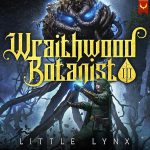
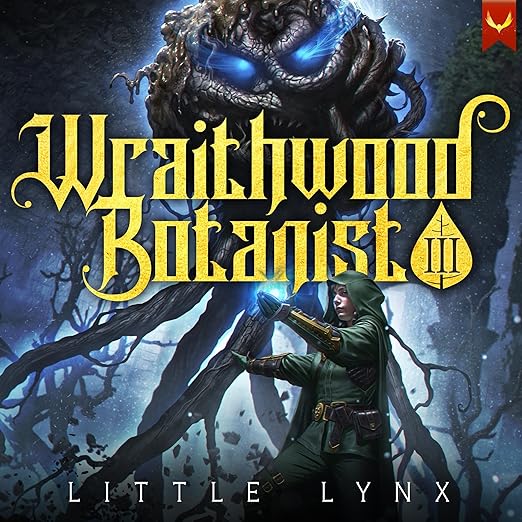
Published by Aethon Audio in April 2026 and running thirteen hours and fifty minutes, the third instalment of the Wraithwood Botanist series carries a strong rating of 4.6 from 607 listeners, which is a substantial and meaningful base for an independent LitRPG title. The series occupies the darker, more psychologically grounded end of the Apocalyptic LitRPG subgenre rather than the lighter, more gamelit-adjacent end.
In this instalment, Mira is attempting to qualify as a guardian by completing a trial at Tranea Crypt, a location specifically designed to teach soulmancy to those willing to risk their souls to learn it. The stakes are explicitly and structurally all-or-nothing: success means continuing the legacy of Brindle and evolving her soul core, failure means her soul is devoured by the forces that occupy the crypt. The trial structure gives Book 3 a clearer central spine than many middle-series instalments manage, though honest reviews suggest that the shift toward soulmancy and away from the botanical skill set that defined and distinguished the earlier books creates a tension that some readers find genuinely frustrating. The series is moving progressively further from its premise with each instalment, and that movement is worth knowing about before you commit thirteen hours to the journey.
A note that appears in multiple reviews and deserves direct mention: Book 3 contains noticeably more copy-editing errors than the earlier volumes, including wrong names attributed to dialogue, mixed pronouns, and missing words in ways that occasionally confuse the reader about who is speaking or what is happening. These are manuscript-level issues rather than narration problems, and they are consistent enough to appear across several otherwise enthusiastic responses. The story itself remains strong, and the world-building continues to expand, but the editorial polish is uneven in ways that were not present to this degree in the earlier books.
Reba Buhr and the Weight of a Trial
Reba Buhr narrates, and her performance is one of the series’s consistent strengths across all three books. Buhr has a particular facility with female protagonists in action-oriented fantasy, and she navigates the tonal range of the Wraithwood Botanist world with ease, moving between the quiet, methodical concentration of plant-working sequences and the urgency of the crypt’s more dangerous passages without jarring or unmotivated shifts. The multi-register quality of the narration holds even when the manuscript gives her difficult material: pacing challenges in the soulmancy learning sequences, which some readers find harder to visualise than the earlier plant-working content, are managed with consistency and care. Aethon Audio’s production values are reliable throughout.
What Readers Say
At 4.6 stars from 607 listeners, the audience response is strongly positive overall. A UK reader praised the natural character growth, the pacing, and the notable absence of the third-book slump that afflicts so many series at this stage, noting specifically that they lost sleep because the book was too compelling to put down. Genevieve Croft gave three stars and was notably specific in her critique: the world-building continues to expand in interesting directions, but the absence of alchemy scenes and the increasing dominance of combat over botany represented a drift away from the original distinctive premise. She also flagged the structural question of why Mira’s patron god keeps sending her to locations she is not yet prepared for. Stu gave five stars while clearly identifying the editorial problems, calling the story itself excellent but the copyediting less careful than earlier books, and suggesting that a brief recap of previous events at the opening would help listeners returning after a gap between releases. The balance between very enthusiastic praise and pointed craft criticism reflects a readership that is genuinely invested in the series rather than simply rating on impulse.
Who Should Listen?
Start with Book 1. This is not a point of entry into the series and assumes full familiarity with the characters, relationships, and world-building established across two preceding volumes. Listeners who have already completed the first two books will find Book 3 a satisfying continuation, with the clearly stated caveat that the botanical emphasis has been diluted in favour of soulmancy and combat sequences. If the original premise of a herbalist protagonist navigating LitRPG stakes was the central appeal of the series for you, it is worth knowing the series is evolving away from that in ways that may or may not match your investment. For existing fans, Reba Buhr’s narration is a reason to continue regardless.