
A finished audiobook sounds effortless: one voice, hours of unbroken story, not a stumble to be heard, whether the whole performance lasts twelve minutes, like the fable The Selfish Giant, or runs past thirty four hours, like The Running Grave. That effortlessness is manufactured. Between the manuscript and your ears sits a production process with distinct stages, specialist roles and an entire craft of invisible correction. I spent my publishing life watching manuscripts become printed books, a transformation most readers can roughly picture. Almost nobody can picture this one, so let me walk you through how it actually works.
Before anyone presses record
Casting the voice
It starts with casting, and casting decides more of the outcome than any other single choice. The publisher or producer looks for a voice that fits the material: the right accent, the right age and register, the range to carry an entire cast of characters, sometimes with the author’s input. For memoirs and celebrity titles the author often records their own book. For fiction, an experienced professional is usually the safer pair of hands. Quite how much hangs on this decision is an essay of its own, and I have written it: why narrators make or break audiobooks.
The homework
Then comes preparation, and good narrators treat it with the seriousness of the recording itself. They read the whole book before speaking a word of it. They build a character list with notes on how each person sounds, so that a minor figure introduced in an early chapter still has the same voice when she returns fifteen hours later. They research the pronunciation of names, places and technical terms, querying the author or publisher wherever the text leaves room for doubt. Decisions made on day one are binding for the rest of the production, which is exactly why the homework matters.
Inside the booth
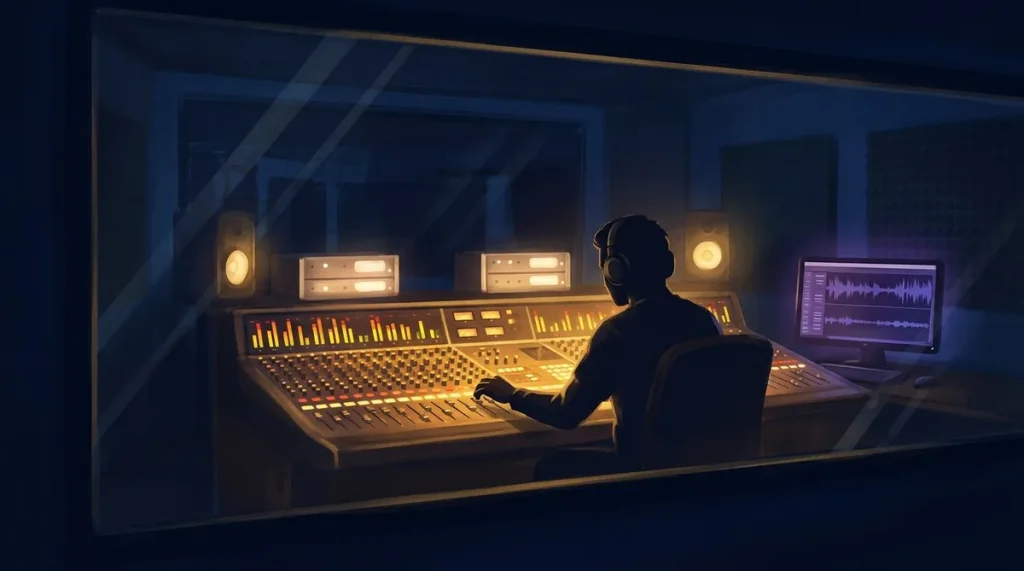
Recording happens in a small, acoustically treated space designed to strip out echo and outside noise: a purpose-built studio booth, or increasingly a professionally treated home studio. The narrator works at the microphone with the manuscript on a silent screen, because a turning paper page is precisely the sort of sound the microphone loves and the listener does not. An audio engineer monitors the session, and on many productions a director listens in as well, guiding interpretation, catching misread lines and keeping an ear on pace and consistency. Plenty of experienced narrators also work alone and direct themselves, which is its own quiet discipline.
Punch and roll
When a line goes wrong, and lines go wrong constantly, most productions rely on a technique called punch and roll. The engineer rolls back to the last clean sentence, plays it into the narrator’s headphones, and drops back into record at exactly the right moment, so that the narrator picks up the thread mid-flow. Done well, it keeps tone and rhythm seamless and saves enormous amounts of editing later. Done well enough, you will never find the joins at all, which is rather the point.
Every smooth hour you hear was assembled from imperfect minutes you never will.
The hidden hours
Time in the booth always exceeds the finished runtime, because every stumble, doubled word, noisy plosive and passing siren means stopping and going again. Narration is also physically demanding work. Sessions are kept to a few hours at a stretch to protect the voice, with water close at hand and careful microphone discipline throughout. A very short piece might be captured in a single sitting. A long epic means day after day of sessions, sustained across weeks of a narrator’s calendar. At the far end of the scale, a compilation such as the True Crime Case Histories collection runs past sixty five hours of finished audio, which gives you some sense of the commitment hiding behind a single play button.
Proofing: the pass most listeners never hear about
Once recording wraps, the audio goes to a proof listener, sometimes called a QC editor, who follows the recording against the text line by line. They are hunting for misread words, skipped sentences, mispronunciations that slipped through, chair creaks, mouth clicks and character voices that have quietly drifted. Every error is logged with a timecode. It is painstaking, unglamorous work, and it is the reason a thirty hour performance can be trusted from its first minute to its last.
Pickups and the invisible join
The narrator then returns to record pickups: corrected lines that must match the originals in tone, energy and pace so closely that the joins become inaudible. This is harder than it sounds. A sentence recorded on a different day, in a different mood, through a slightly tired voice, can stick out like a patch on a jumper. Narrators and engineers take real care to blend them, and the truest measure of their success is that you have never once noticed a repair.
Mastering and delivery
Finally the edited audio is mastered. Loudness is made consistent from the first chapter to the last, the noise floor is brought down, and breaths and gaps are tidied without sanding the humanity out of the voice. The book is split into properly labelled chapter files, opening and closing credits are added, and the whole package is checked against the technical standards retailers require before it goes on sale. Only then does it reach your library, wearing its effortlessness like a well cut coat.
Why any of this matters when you press play
Once you know the craft, you hear it everywhere: in the consistency of a character’s voice across a whole series, in the clean silence behind the narration, in corrections you cannot find because they were blended too well. The gap you sense between a superb production and a merely adequate one is real, and it is made of preparation, proofing and patience. None of it shows, and all of it tells.
So the next time a voice carries you through a story, spare a thought for the booth, the proof listener and the invisible stitches holding your listen together. If you would like to hear the state of the art for yourself, you can try Audible UK free for 30 days and put a brand new production through its paces. I promise it will sound effortless. Now you know why.