Clara’s Verdict
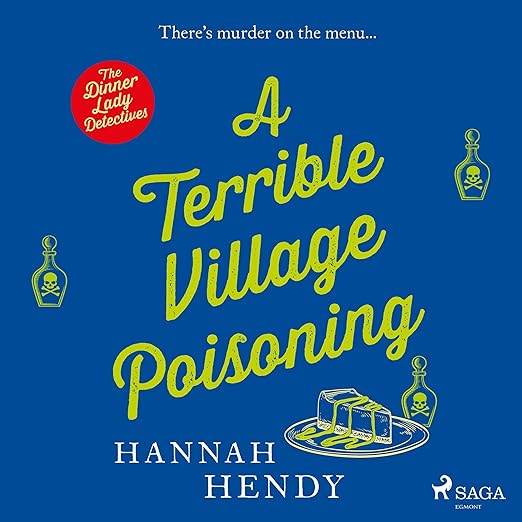
Hannah Hendy’s Dinner Lady Detectives series has found its niche with commendable precision: cosy British mystery with a lesbian couple at its heart, generous comic energy, and the kind of plot that makes the process of solving the crime feel like a pleasure rather than a puzzle. A Terrible Village Poisoning, Book 3 in the series, takes Margery and Clementine Butcher-Baker out of their usual school dinner ladies’ context and deposits them in an idyllic English village, which naturally begins poisoning its residents almost immediately.
Hendy’s authorial voice – warm, witty, with a particular gift for the eccentric minor character – is well-established by this point in the series, and the results are consistently entertaining. She writes cosy mystery in the proper British tradition: the violence is mostly offstage and the emotional temperature is maintained at comfortable warmth even during the most dramatic revelations. This is the kind of audiobook you listen to on a sunny afternoon and feel pleasantly cheerful about afterwards.
About the Audiobook
The village of St-Martins-on-the-Water has a history. Previous poisonings, now the stuff of local legend, hang over the community, and when the mayor drops dead at dinner on Margery and Clementine’s first night in the hotel, the Poisoner narrative takes immediate hold. Suspicion falls on the strangers in town – our heroines – which gives the investigation its personal urgency alongside the purely altruistic one.
Hendy is good at the architecture of the cosy mystery: the village community that seems idyllic until you start pulling at threads, the cast of eccentric locals each with reasons to want the status quo disrupted, the investigative duo whose different personalities produce complementary forms of insight. Margery brings the practical intelligence; Clementine brings an unfiltered directness that cuts through social niceties and occasionally through diplomatic relations with the locals.
The village setting allows Hendy to construct the kind of closed-community mystery that has been a British staple since Agatha Christie, with the added pleasure of the historical poisoning plot running beneath the contemporary investigation. The timing of the investigation – framed around Mrs Smith’s approaching hen party – gives the book both a countdown and a comic subplot. At eight hours, the pacing is generous without feeling padded, and Hendy’s comic sensibility keeps the darker material from ever becoming genuinely grim.
The Narration
Jenny Funnell narrates for Saga Egmont, and she has clearly developed an affectionate understanding of Hendy’s world across the three books. Her delivery captures the slightly absurdist register that the series operates in – not quite pantomime, but with a quality of heightened reality that keeps the comedy alive – while ensuring that Margery and Clementine remain sympathetic and dimensional rather than mere comic figures.
Funnell is particularly good with the eccentric supporting cast that Hendy populates her villages with, differentiating characters clearly without resorting to parody. At just over eight hours, the recording maintains consistent energy, and the Saga Egmont production is clean and well-mixed. For listeners already familiar with the series, Funnell’s voice will feel like returning to comfortable company.
What Readers Say
The series has accumulated nearly nine hundred Audible ratings at an average of 4.3/5 from 883 listener ratings, which indicates a genuinely devoted readership. Amy, writing after Books 1 and 2, praised Hendy’s progressive storytelling – noting that while the book works as a standalone, the series rewards being read in order. Seoulsista offered an affectionate assessment: “We Brits do have a pleasing knack of creating dotty characters and turning them into sleuths” – and noted that anyone together for forty years deserves recognition.
Sylvia Back reported simply enjoying the series immensely, while S.F. Canfield’s three-star review – “really good characters but the storyline gets a bit elongated” – represents the principal reservation of dissenting readers. This is a fair observation: Hendy’s strengths lie in character and atmosphere rather than tight plotting, and some readers want the latter more urgently than others.
Who Should Listen?
The series has been particularly well-received within the LGBTQ+ community for its quiet normalisation of Margery and Clementine’s relationship – neither making it the point of the books nor pretending it does not exist. For readers who have grown weary of cosy mysteries in which the default assumption is a heterosexual protagonist, the Dinner Lady Detectives offer a refreshing alternative without making the identity politics the foreground of the narrative. The mysteries are the point; the relationship is simply the context in which they happen.
Ideal for fans of cosy British mystery who want diversity represented naturally rather than as a selling point – Margery and Clementine’s long-term relationship is simply part of who they are, not the subject of the book. Also recommended for readers who enjoy the village-mystery tradition – Christie, Osman, Richard Osman’s Thursday Murder Club comparisons are accurate and fair – but want something with a more contemporary sensibility.
Best enjoyed in series order, though each book stands alone. Find it on Audible UK.