Clara’s Verdict
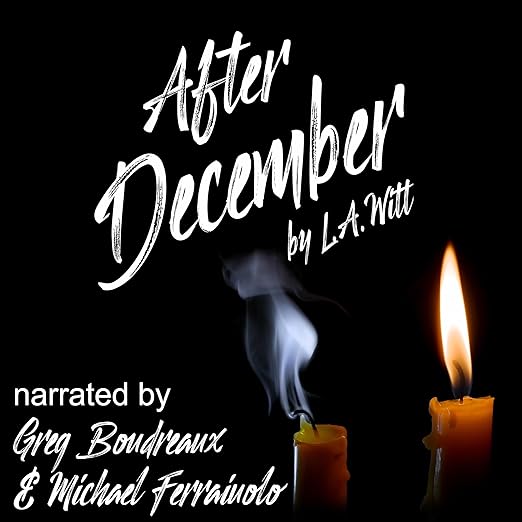
I tend to be wary of grief narratives in romance fiction. The genre has a habit of treating loss as a plot device, a convenient backstory that gets tidied away once the love interest appears. L.A. Witt does something harder and more honest in After December. Grief here is not background noise. It is the whole atmosphere. It shapes how Tim and Alex speak, how they move through a room, how cautiously and then how recklessly they begin to trust someone new. This is a 120,000-word standalone gay romance novel, and Witt uses every one of those words without waste.
I listened to this over a couple of long evenings, and there were moments where I had to set the headphones down. Not because the writing was overwrought, but because it was uncomfortably precise. The portrait of a man eighteen months out from losing his husband, still not sure what shape his days are supposed to take, rang true in ways I did not entirely expect from the genre. This is, above everything else, a novel about what it means to survive a person you loved.
About the Audiobook
Tim Davis knew he would likely outlive his older husband. What he did not anticipate was that their final years together would be consumed by a prolonged and gruelling battle with cancer. Eighteen months on, he is still finding his footing, testing the edges of a life that no longer fits. Alex Ouellette, meanwhile, is stuck in the moment his world stopped, cycling through grief and survivor’s guilt without any obvious way forward. A friend nudges Alex toward a widowers’ retreat in a cabin in the woods. Neither man expects anything from it beyond the vague comfort of shared experience.
Witt is shrewd about the architecture of that retreat setting. It gives Tim and Alex a reason to be in the same space without forcing them together artificially, and it gives the novel room to let friendship develop at a pace that actually feels earned. The spark of attraction that arrives is powerful precisely because both men are so resistant to it. There is something quietly radical about a romance that acknowledges how complicated it is to want someone new when you still love the person you lost. Witt does not resolve that tension cheaply, and she does not resolve it quickly.
The dual perspective structure alternates between Tim and Alex with sufficient differentiation that each man’s grief feels specific rather than interchangeable. Tim’s loss is shaped by the particular exhaustion of a long illness, the way caregiving changes you and then leaves a silence when the caring is over. Alex’s is shaped by the sudden violence of a loss that left no time to prepare. These are different griefs, and the novel knows that.
The Narration
Michael Ferraiuolo narrates, and the performance is well-suited to the material. He keeps the emotional register honest without pushing it toward sentimentality. Where some narrators in grief-heavy fiction lean into every moment of sadness until the listener feels manipulated, Ferraiuolo mostly trusts the writing. The result is that the moments of genuine pain land harder because they have not been telegraphed in advance. He differentiates Tim and Alex clearly enough that you never lose track of whose interiority you are in, which matters considerably in a dual-perspective structure across twelve-plus hours. The quieter scenes, particularly the ones in which both men sit with their grief rather than moving through it, are handled with real care.
What Readers Say
Listeners who have experience of bereavement in their own lives respond to this novel with particular intensity. One reviewer described it as the first book they had ever read that “describes that pain and loss and even moving forward so perfectly,” adding that the story of Tim and Alex moved them deeply. Another called it “emotional and beautiful,” noting that despite being a hard listen at times, there was genuine warmth and joy alongside the sadness, as well as scenes that were genuinely steamy. A more measured reviewer, while acknowledging that the grief was handled sensitively and the characters were well-drawn, felt the emotional impact did not always land in the way she expected from L.A. Witt, writing that she did not fully feel the love. That honest dissent is worth flagging. The novel earns a 4.3 rating from 175 listeners, suggesting a broadly positive reception with a minority who found the pacing uneven in the middle sections.
Who Should Listen?
This is for readers who want their romance to do real emotional work. If you have experienced bereavement, approach with some care, but also with the knowledge that this novel treats grief with more intelligence than most books in the genre. It is a standalone, so no prior knowledge of L.A. Witt’s catalogue is required, though fans of her character-driven work will be immediately at home. Not for readers looking for a light or fast listen. At over twelve hours, this is a sustained emotional commitment, and it rewards the investment.