Clara’s Verdict
I have a rule about technology books: I will not read them unless I trust the author has been inside the room, not just reporting from outside it. David Pogue has been covering Apple for longer than most of its current employees have been alive. He reviewed products for the New York Times for over a decade, has written the best-selling Missing Manuals series on Apple software, and has watched the company from its scrappy Cupertino garage mythology through to its position as the most valuable corporation on earth. When he says he has conducted new interviews with 150 key people, including Steve Wozniak, Jony Ive, and John Sculley, I believe him. And when he narrates this 23-hour account himself, that proximity to the subject becomes something you can actually hear.
I finished the final hours of this one on a long train journey back from Edinburgh, watching the countryside turn grey outside the window and feeling slightly stunned by how comprehensively Pogue covers five decades of corporate, creative, and cultural history. This is a serious piece of work, not a hagiography, though it is not without admiration for what Apple has achieved.
About the Audiobook
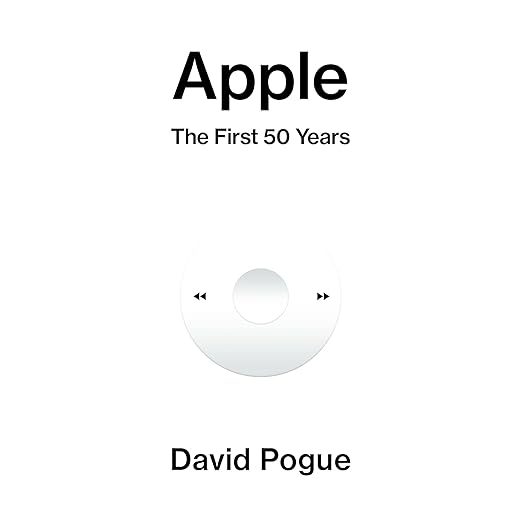
Apple: The First 50 Years traces the company from its founding on 1 April 1976, when Steve Jobs and Steve Wozniak set out to bring computing to ordinary people, through to the present day. Pogue covers the full arc: the early idealism and the revolutionary introduction of the mouse and graphical interface; the wilderness years and Jobs’s exile; the extraordinary return and the iPod, then iPhone, then iPad sequence that reshaped global culture; and the post-Jobs era under Tim Cook, with its tensions between innovation and institutional scale.
What distinguishes this account from the many Apple books that have preceded it is Pogue’s access and his willingness to address the failures alongside the successes. The Lisa and Apple III get proper treatment. MobileMe, the notorious cloud service that Jobs reportedly excoriated at an internal all-staff meeting, is examined honestly. The book also benefits from Pogue’s journalist’s instinct for the telling detail. He reports the frenetic all-nighters and the engineering obsessions without losing sight of the broader cultural and business context. Figures that most Apple accounts treat as myths, Wozniak, Sculley, Ive, are given genuinely fresh interview material here, which is no small feat given how many times those people have been asked the same questions.
The book is described as lavishly illustrated in its print form, and it is worth noting that some of that visual apparatus does not transfer to the audio edition. Reviewers of the physical book have commented on print quality issues, which is irrelevant to the audiobook experience, but signals this was conceived with a visual component in mind. For the audio listener, Pogue’s narration compensates with scene-setting and description.
The Narration
Pogue narrating his own book is the correct decision here. His voice is relaxed and confident, with the dry wit of someone who has spent decades translating complex technology for general audiences. He does not perform the text so much as deliver it with the authority of a journalist who was actually there for many of the moments he is describing. The 23-hour runtime passes without fatigue in the delivery. Pogue keeps the pace brisk through the historical sections and slows appropriately when he reaches the interview material or the more analytically demanding passages about Apple’s competitive challenges going forward. Released by Simon and Schuster Audio UK in March 2026, this is a timely and well-produced release.
What Readers Say
Reviews divide interestingly along lines of expectation. Will Mayall, an early Apple insider who appears in the book and knows many of the people Pogue interviewed, gave it five stars and called it one of the most comprehensive and accurate accounts of Apple’s history available, praising not just the breadth but the texture of the storytelling. Eric van Beest, who describes himself as growing up with Apple, praised its colourful account of the company’s highs and lows, though noted Pogue might have been more critical of Apple’s more significant failures. A. Matthews, a long-term Apple user from the Apple II era, called it epic and in-depth. The book holds a 4.4 rating from 78 reviews on Audible UK, which is a strong score for a major non-fiction release of this kind.
Who Should Listen?
Anyone with a genuine interest in how modern technology culture was shaped will find this rewarding, not just Apple users. If you own an iPhone and have ever wondered how the company that made it came to exist and what it cost to get there, this is the most comprehensive single account available in audio form. Business readers interested in product strategy, design culture, and the tension between creative vision and corporate scale will find rich material throughout. Those who want a more critical or adversarial take on Apple may find Pogue’s broadly admiring stance limiting, though he is not uncritical. Listen on Audible UK