Clara’s Verdict
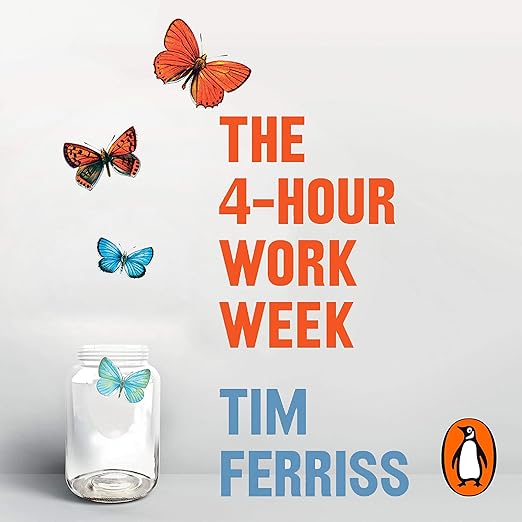
Timothy Ferriss published The 4-Hour Work Week in 2007, and it has been both celebrated and pilloried with remarkable consistency ever since. My honest assessment, after revisiting it in audio form: the philosophy is deliberately provocative and the specifics are sometimes far-fetched, but the underlying challenge – to question whether the structures of conventional working life are either necessary or desirable – remains genuinely valuable. Ferriss is better as a provocateur than as an instruction manual, and listeners who engage with the book on those terms will find considerably more to take away than those who come expecting a practical toolkit. Ray Porter’s narration makes it eminently listenable.
About the Audiobook
Ferriss built his case on a simple, audacious premise: the standard 9-to-5, five-days-a-week career model is an arbitrary social construct rather than a natural law, and most of what fills that time is either waste or misapplied effort. Drawing on Pareto’s 80/20 principle and Parkinson’s Law – work expands to fill the time allotted to it – he argues that the vast majority of productive output can be compressed into a fraction of conventional working hours.
The book is structured around Ferriss’s DEAL framework: Definition (redefining your goals and the ‘new rich’ lifestyle), Elimination (cutting 80 per cent of your tasks using selective focus), Automation (outsourcing and delegating wherever possible), and Liberation (untethering yourself from a fixed location and conventional career path). The case studies – readers who doubled their income or started location-independent businesses using these principles – are real, if selectively presented.
This expanded edition adds more than fifty practical tips from readers, updated tools and techniques, and material on applying the framework in economically uncertain times. At thirteen hours, it’s a properly thorough listen.
The Narration
Ray Porter narrates, and he’s an excellent choice for this kind of material – energetic, clear, and able to sustain Ferriss’s sometimes breathless pacing without losing precision. Porter has narrated a substantial number of successful audiobooks and his craft is evident throughout. The thirteen-hour runtime passes with minimal friction.
What Readers Say
Rated 4.2 stars from 665 listeners – polarising by design. The enthusiasts are genuinely evangelical: one UK reviewer called it the best book they’d ever listened to; others describe specific, measurable changes to their working patterns. The critics are equally pointed: the outsourcing recommendations are culturally dated, some examples feel aspirational to the point of absurdity, and the “new rich” framing grates for readers who find its assumptions about lifestyle desirability rather narrow. Both camps have a point. The most useful summary comes from a sceptical reviewer who still extracted several “brilliant hints” from a book he otherwise found “quite far-fetched.” That’s probably the right frame.
Who Should Listen?
Best suited to entrepreneurs, freelancers, and anyone in a role with significant autonomy over their own schedule who is looking to reconsider their relationship with time and productivity. It is less useful for people in fixed-hours employment, though the underlying mindset shifts are broadly applicable. Approach it as a philosophical provocation rather than an operational blueprint, and the thirteen hours will be well spent. Worth pairing with Cal Newport’s Deep Work for a more rigorous take on a similar problem.
Available now on Audible UK – listen to The 4-Hour Work Week by Timothy Ferriss.