Clara’s Verdict
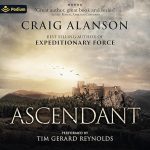
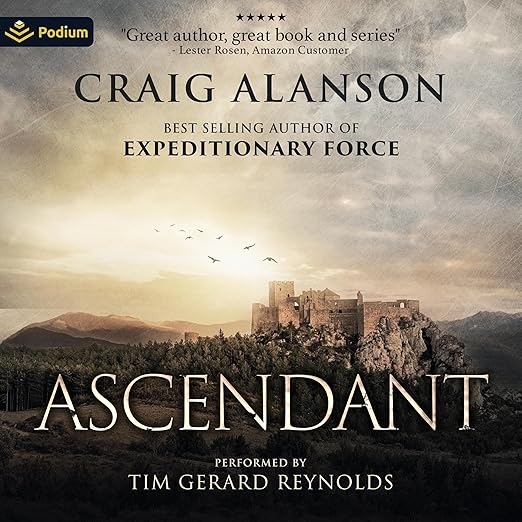
Craig Alanson is best known in the UK audiobook market for the Expeditionary Force series — military science fiction with a comedic edge and a devoted following, largely built on the quality of Joe Zoderling’s narration. Ascendant is a different proposition: a young adult fantasy trilogy that Alanson published in 2017, with Tim Gerard Reynolds narrating for Podium Audio. I came to it expecting something light and uncomplicated — a YA fantasy by a genre entertainer, narrated by a reliable voice — and found instead a novel with a more interesting relationship to the coming-of-age formula than I anticipated.
About the Audiobook
The premise is clean: Koren Bladewell, a young man in the kingdom of Tarador, has been labelled a jinx by his village — responsible for the bad things that happen around him. The truth, which the Wizard’s Council knows and withholds, is that he is a wizard who cannot control power he does not know he has. Crown Princess Ariana, meanwhile, is watching her weak-willed regent mother allow an ancient enemy to threaten the kingdom through indecision and diplomatic paralysis. The two young people, when they find each other, are collectively what Tarador needs — and the adults who should be helping them are, through cowardice or self-interest, the primary obstacle.
The novel’s most interesting structural choice is making the adults the antagonists, not through villainy but through the kind of bureaucratic protectiveness that substitutes for wisdom. The phrase “they know what is best for him” is used pointedly and repeatedly in the text, each time ironically. Alanson is making an argument about autonomy and institutional cowardice, and the argument gives the novel a moral seriousness that sits alongside its adventure plotting.
One reviewer compared it to “Game of Thrones meets Lord of the Rings without GOT’s rude bits,” which gives you a sense of the ambition and the register. Another noted that “the system of magic is well thought out” — a meaningful compliment in a genre where magical systems can feel arbitrary or convenient, deployed when the plot needs resolution rather than built with internal logic. This is Book 1 of a trilogy, and it sets up the continuation with enough unresolved threads to make the second volume feel necessary.
The Narration
Tim Gerard Reynolds is, alongside RC Bray, one of the dominant voices in genre audiobooks for Podium Audio. His range is wide, his pacing instinctively good, and his ability to voice both the earnest sincerity of Koren and the more politically calculating world of Ariana without losing either character is evident throughout. For a young adult fantasy, Reynolds’s warmth is exactly right: he communicates the genuine stakes without making them feel crushing, and his delivery of the moments where the institutional cowardice of the adults becomes most apparent carries a dry, restrained anger that serves Alanson’s argument well.
What Readers Say
Jackie Nettleton praised the novel specifically for resisting the common YA tendency to resolve everything too conveniently: “finally a coming of age book where everything doesn’t just fall into place right when the author needs to get the story going.” She also noted the emotional openness of the characters, which she found refreshing. Nic M, who called it “quite unputdownable,” found the worldbuilding credibly ambiguous — uncertain whether the setting is a distant future after civilisational collapse or a parallel world entirely, and finding that uncertainty part of the interest. One reviewer recommended all three volumes once you have read the first. Across one Audible rating, it holds 4.4 — a small sample, but the written reviews are consistently substantive and positive.
Who Should Listen?
This is squarely for readers of young adult fantasy who want a magic system that makes sense, protagonists who develop rather than simply triumph, and an antagonist structure more interesting than straightforward villainy. Alanson fans from the Expeditionary Force series will find a different register here — quieter and more emotionally earnest — but the same underlying intelligence about systems and institutions and the people who operate them. Plan to listen to the trilogy rather than stopping at Book 1; the review record and the internal logic of the story suggest it earns its continuation.