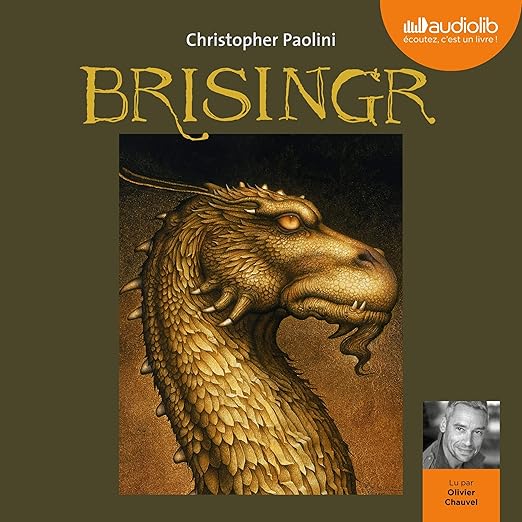
Clara’s Verdict
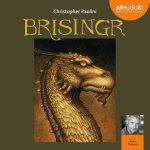
The publisher’s description promises listeners one devastating death, and I respect the nerve of saying so up front. Brisingr is the point in the cycle where promises, in every sense, come due: Eragon has sworn to help his cousin Roran rescue his beloved Katrina, he owes the Varden his service, and Galbatorix is working ruthlessly to crush him or twist him into a weapon. The pleasure of this third book lies in watching those obligations collide, and Christopher Paolini is refreshingly unsentimental about what keeping your word actually costs.
My reservation is girth. At twenty-nine hours and thirty-four minutes this is an enormous audiobook, and the stretches of manoeuvring between the set pieces will test listeners who came purely for dragon and Rider. Committed fans will call that immersion. The uncommitted may call it homework.
What This Edition Is and Who It’s For
This is the third book of The Inheritance Cycle, published in audio by Penguin Audio in April 2009 and read by Gerard Doyle. It opens in the aftermath of a battle of colossal scale against the Empire’s warriors, with Eragon and Saphira having escaped with their lives and precious little else resolved, which tells you exactly what kind of volume this is: the one where the board is rearranged and the true cost of rebellion is counted.
It is emphatically not an entry point. The story assumes you know who the Varden are, why Katrina needs rescuing and what Eragon owes to whom, so newcomers should begin at the start of the cycle. Returning listeners get nearly thirty hours of consequence for their patience, including choices that carry Eragon across the Empire and beyond, towards sacrifice on a scale the earlier books only hinted at.
Gerard Doyle’s Long Ride
A performance of this length is a feat of stamina before it is anything else, and Gerard Doyle’s task is consistency: keeping a sprawling cast distinct at hour twenty-eight just as crisply as at hour two. Epic fantasy narration lives or dies on that reliability, along with the unglamorous craft of making invented names and places sound inevitable rather than effortful.
Expect a delivery built for the long haul rather than for showy moments: steady pacing through battlefield and council chamber alike, and enough vocal differentiation to keep cousins, kings and dragons from blurring into one another. For a saga about endurance, the approach fits the subject.
What Readers Say
This listing carries a 4.7 average from a modest 11 ratings, and I would read that honestly: the sample is small, so treat the number as a promising signal rather than a settled verdict. It does lean the way third books in a beloved cycle tend to lean, though, because by this stage the audience is self-selecting and largely delighted. No written listener reviews are attached here, so the aggregate is all we have to go on.
Who Should Listen?
Listen if you are already invested in Eragon and Saphira and want the saga’s middle act at full scale. If you have a long commute, a marathon training block or a fortnight of household chores to soundtrack, the running time turns from obstacle into gift, and older children and teenagers who devoured the earlier books will be well served, which is precisely where the children’s and young adult shelving points.
Skip it if you are new to the cycle, if twenty-nine hours sounds like a sentence rather than an invitation, or if you need stories that resolve neatly by teatime. And if the promise of one devastating death gives you pause, believe it.
For the faithful, this is the volume where the cycle grows up, and it earns its hours more often than not.