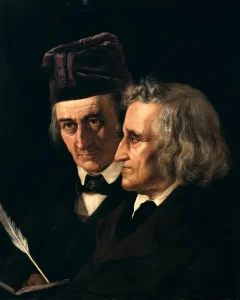
The Brothers Grimm – Jacob, born in 1785, and Wilhelm, born a year later – were German academics, linguists and cultural researchers whose work effectively founded the modern study of folklore. Born in Hanau and raised in Steinau, they were educated in Kassel and at the University of Marburg, where they developed a lasting fascination with medieval literature and German cultural history.
Their first collection of folk tales, Children’s and Household Tales, appeared in 1812, gathered largely from educated, urban acquaintances. They revised and expanded it throughout their lives, growing it from 86 stories to more than 200 by 1857, and in the process popularised Cinderella, The Frog Prince, Hansel and Gretel, Rapunzel, Rumpelstiltskin and Snow White. They were formidable scholars beyond the tales too, publishing studies of legends and language history and beginning, in 1838, a definitive German dictionary so ambitious it remained unfinished at their deaths. Their methods for documenting oral tradition set standards folklorists still work by.


 13 minutes