Clara’s Verdict
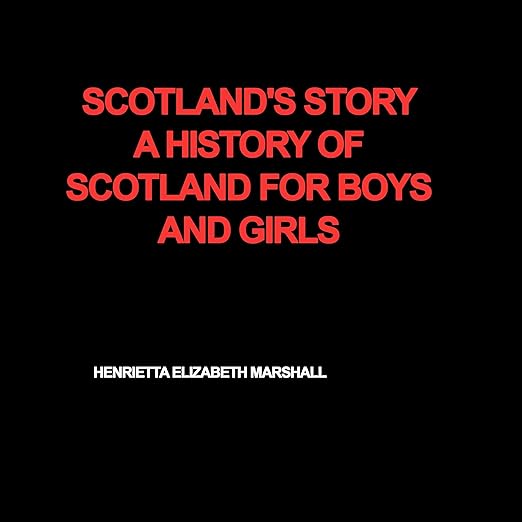
Henrietta Elizabeth Marshall’s Scotland’s Story was first published in 1906 as part of the same tradition of children’s national history writing that produced Our Island Story, her better-known account of England. These are books from a specific moment in British educational culture — the early twentieth century, when history for children was written with the explicit aim of producing national feeling alongside factual knowledge. Understanding that context is useful before deciding whether this is the right listen for your household or classroom in the present day.
No Audible ratings exist for this edition at the time of writing. The book was released in February 2026 by Emberlight Press, a small publisher that specialises in producing audiobooks of public domain texts. The lack of ratings is common for this category of release and does not indicate poor quality — it simply means the audience has not yet had time to accumulate around a new recording of an older work.
About the Audiobook
Marshall begins with the legend of Prince Gathelus — a semi-mythological figure from Scotland’s pre-Christian past — and proceeds through the historical record to King George IV, concluding with her own observation that Scotland has no more a story of her own, reflecting the political reality of the 1707 Act of Union. The scope is therefore vast: over a thousand years of material, moving from legend and myth through mediaeval kingship, the wars of Scottish independence, the Reformation, the Stuart line, the Jacobite risings and into the early modern period. At twelve hours and four minutes, the production is impressively comprehensive in its ambition for a book written for younger readers.
For young listeners, the interweaving of legend with historical narrative is part of the book’s charm and part of its limitation. Marshall does not always signal clearly where legend ends and documented history begins — this is characteristic of early twentieth-century popular history for children, which prioritised narrative coherence and emotional engagement over historiographical precision. A parent or educator listening alongside a child will want to supply that contextualising frame themselves, particularly for the earlier legendary material.
The Narration
James R. Hedrick’s reading is clear, measured and appropriately stately for Marshall’s prose, which was written in the declarative, slightly elevated register characteristic of its era. The narration does not attempt to modernise or dramatically interpret the text beyond what is on the page — this is straightforward, respectful reading rather than a performed reimagining. For educational listening of this kind, that approach is generally preferable; the text should speak clearly without theatrical distortion that might confuse younger listeners about what is narration and what is dramatisation. The Emberlight Press production appears clean and professionally recorded.
What Readers Say
No Audible reviews are available at the time of writing. Given that this is a newly recorded edition of a public domain text from 1906, the audience is necessarily specific — parents looking for accessible Scottish history for children, educators seeking read-aloud material, or enthusiasts of the early twentieth-century children’s educational canon. The sample on the Audible listing is the most reliable tool available for assessing whether Hedrick’s reading and Marshall’s prose style serve your purpose, given the current absence of listener feedback to triangulate against.
Who Should Listen?
Scotland’s Story in this edition is best suited to children aged roughly eight to twelve with an interest in Scottish history, to parents who want accessible historical narrative for family listening, or to adults with a specific affinity for Marshall’s writing or for the tradition of popular children’s history it represents. Those looking for a modern, critically aware account of Scottish history will find this too rooted in its 1906 perspective — the assumptions of the era are present throughout, including the rather melancholic framing of Scotland’s post-Union position. As a document of how Scottish identity was being constructed for young readers at the turn of the twentieth century, it is historically interesting in a dimension quite separate from its stated subject matter.