Clara’s Verdict
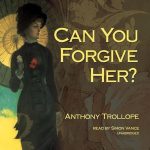
I first attempted Trollope at university, was told by a well-meaning tutor that he was the sensible alternative to Dickens, and promptly ignored the advice for fifteen years. Coming to Can You Forgive Her? now, via audiobook during a particularly demanding week, feels like a small act of belated self-correction. What struck me immediately was how contemporary the novel’s central anxiety feels: a woman who cannot decide between the life she is supposed to want and the life that would ruin her. Alice Vavasor, caught between the upstanding John Grey and the violent, ambitious George, is not vacillating out of weakness. She is struggling with the impossible position of being a clever, morally serious woman in a society that has almost no sanctioned outlet for those qualities.
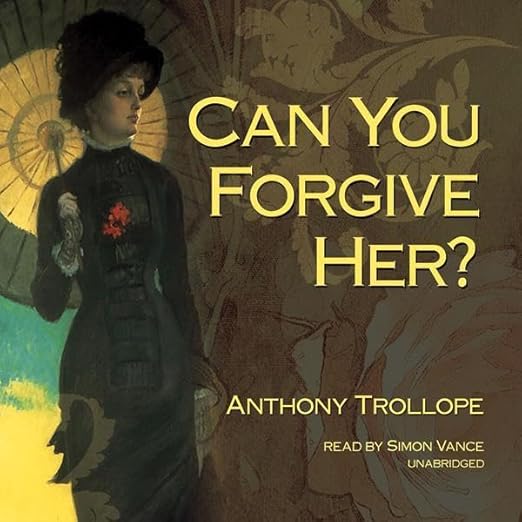
At 27 hours and 33 minutes, this is a substantial commitment. Simon Vance’s narration makes it a rewarding one, and Blackstone Audio’s production is clean and consistent throughout.
About the Audiobook
This is the first of Trollope’s six Palliser novels, and it establishes the world and the characters that will carry through the entire sequence. The primary plot follows Alice Vavasor’s matrimonial indecision, but the more interesting thread involves Lady Glencora Palliser, forced by family into marriage with the ambitious politician Plantagenet Palliser when she loves the dissolute Burgo Fitzgerald. The contrast between the two women is pointed: Alice has freedom of choice and cannot use it; Glencora has no freedom and knows precisely what she wants. Trollope finds more tragedy in Alice’s paralysis than in Glencora’s constraint, and he is right to do so.
Trollope’s method is patient and ironic, accumulating detail and motive with what one reviewer rightly called “painstakingly detailed analyses of the characters’ feelings and emotions.” He is particularly good on the internal experience of women in a social world that demands their compliance while judging their choices. One reviewer here compares him favourably to Dickens, noting that his female characters are never simply good or simply monstrous: “He is especially good in his realistic portrayals of women — there are no sickeningly sweet females.” That is accurate, and it is part of what makes the novel so pleasurable to inhabit over twenty-seven hours.
The political material — parliamentary election, the mechanics of Victorian public life — sometimes slows the pace. One reviewer’s observation that the first two hundred and fifty pages could be compressed is not entirely wrong. But the rewards of persistence are considerable, particularly as Lady Glencora comes into focus as one of Trollope’s great creations. One reviewer noted that she “lights up every scene she appears in,” and by the end of the novel, you understand why she carries the rest of the Palliser sequence on her back.
The Narration
Simon Vance is among the most reliable narrators of Victorian fiction working today. His approach to Trollope is measured and precise, with a clear understanding of where the comedy lies and where the irony is meant to cut. The large cast of characters — Alice, George, Grey, Lady Glencora, Plantagenet — are each given distinct registers without tipping into caricature. At nearly twenty-eight hours, Vance sustains the performance with impressive consistency. For a novel this long, that steadiness is not a minor achievement; it is the thing that makes the commitment feel manageable rather than arduous.
What Readers Say
Didier, writing from the United Kingdom, called the novel “impressive” and noted that if the subsequent five Palliser volumes match this quality, “that would be nothing short of amazing.” He draws the comparison with the Barsetshire Chronicles and finds Trollope consistent across both sequences. Alison praised Trollope’s realistic portrayals of women, drawing on his biographical background — raised by a mother who supported the family through writing — as a possible explanation for his unusual sympathy with female experience. One dissenting voice, RobW, felt the opening two hundred and fifty pages could be compressed, though he acknowledged that Lady Glencora “lights up every scene she appears in.” Another reviewer called the novel “wonderful” and said they “couldn’t put it down.” Across 920 ratings, the novel holds a 4.1 average — a solid signal for a Victorian novel of this length and complexity.
Who Should Listen?
The ideal listener here is someone who has already developed an affection for Victorian fiction and wants to explore beyond the usual Dickens or Eliot. If you have read and enjoyed Middlemarch, or Gaskell’s Wives and Daughters, Trollope is the natural next step: warmer than Eliot, more politically engaged than Gaskell. Approach the early chapters with patience. The novel takes time to assemble its world, and the payoff is a sustained and intelligent pleasure. This is also an excellent audiobook for long commutes or extended journeys — the pace suits the format well. Plan to continue into the Palliser sequence; Lady Glencora is a character worth following through the next five volumes.