Clara’s Verdict
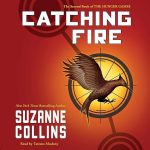
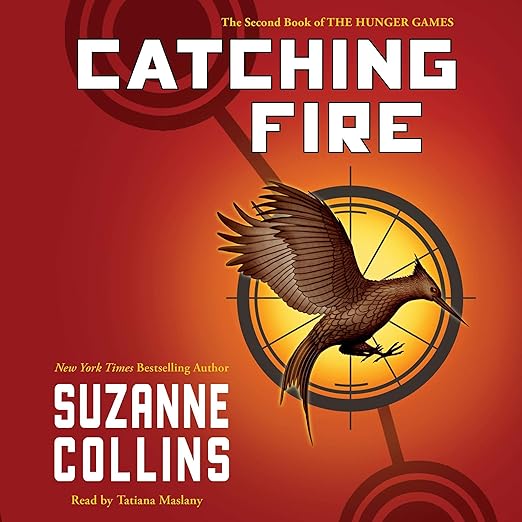
I was halfway through a long train journey from London to Edinburgh when I realised I had stopped watching the landscape and was sitting rigidly upright, listening to Tatiana Maslany deliver the tribute parade scenes in Catching Fire. That is what Suzanne Collins does to you in the second Hunger Games book: she takes everything you thought you understood about Katniss Everdeen’s world and turns it inside out, then raises the stakes once more. Published by Scholastic Audio Books and carrying a 4.7 rating from 74 Audible UK listeners, this is the middle instalment of a trilogy that many readers cite as the series’ single strongest volume. It is also the book that transforms the Hunger Games from a survival narrative into an explicitly political one, and that transformation is handled with more sophistication than the genre’s reputation for adolescent dystopia would suggest.
About the Audiobook
Katniss Everdeen returns to District 12 after winning the 74th Hunger Games, only to find that the victory she and Peeta achieved, surviving together rather than killing each other, has lit a fuse she cannot extinguish. The Capitol wants an example made. The districts are watching. And President Snow makes very clear, in a private conversation that opens the book with controlled menace, exactly what compliance will look like and what its absence will cost.
Collins’ plotting in Catching Fire is her most formally disciplined. The Victory Tour section, in which Katniss and Peeta must perform the role of star-crossed lovers convincingly enough to prevent a rebellion from escalating into a massacre, is one of the most politically acute passages in the series. It is built on the specific tension between performance and sincerity in a surveillance state, between what you feel and what you must be seen to feel, and Collins never lets that tension become comfortable. Every smile in every district square carries the possibility of catastrophic failure.
The Quarter Quell twist, which arrives at the novel’s structural midpoint, is one of the more audacious moves in recent popular fiction aimed at young readers. Collins introduces the premise of a new novel, builds to what feels like a mid-book act break, and then tears the floor away entirely. The decision sends Katniss and Peeta back into the arena, but the arena of this Quell is a different kind of problem from the first Games, and the alliances it forces require Katniss to extend her trust in ways that do not come naturally to her.
The romantic triangle, often cited as a weakness of the series, is considerably less foregrounded here than in the surrounding books. Katniss’s feelings for both Gale and Peeta are real but secondary to her political situation, which is as it should be. A girl trying to prevent a massacre probably should not be prioritising her love life, and Collins’ decision to keep the triangle subordinate to the political narrative is one of the things that makes Catching Fire the strongest of the three books.
The Narration
Tatiana Maslany is an exceptional choice for Katniss, and this audiobook demonstrates why. Best known to British audiences for her work in Orphan Black, Maslany has precisely the quality that Katniss requires: a controlled emotional surface beneath which you can hear the current running. She never overplays the trauma, which would make the character a passive victim; she never underplays it, which would make her simply competent and cold. The performance calibrates itself to Collins’ prose moment by moment, matching the text’s own tonal range from the grim procedural of arena preparation to the rare, unguarded moments of genuine connection. It is one of the better YA audiobook narrations currently available on the UK platform.
What Readers Say
UK listeners rate this 4.7 across 74 reviews, reflecting genuine and sustained enthusiasm. One reviewer, who had read the entire trilogy three times, wrote that most trilogies would be undeniably dull by the third read, but not this series, and certainly not Catching Fire. Another described an excitement so immediate upon receiving the book that dinner and phone calls barely interrupted the reading. The one qualified response, a four-star review, praised the trilogy warmly while rating the original Hunger Games as the strongest single entry. That view is defensible, but it is not universal.
Who Should Listen?
Listeners who completed the first Hunger Games and want to follow Katniss into the political consequences of her survival. Readers who encountered the story through the films and want to experience the source material’s depth, particularly the complexity of the Victory Tour sequence and the moral weight of the Quell’s structure. Not a starting point: the Quarter Quell revelation requires the first book’s groundwork to land with its full force. For those who have done that groundwork, this is the series at its most formally ambitious.