Clara’s Verdict
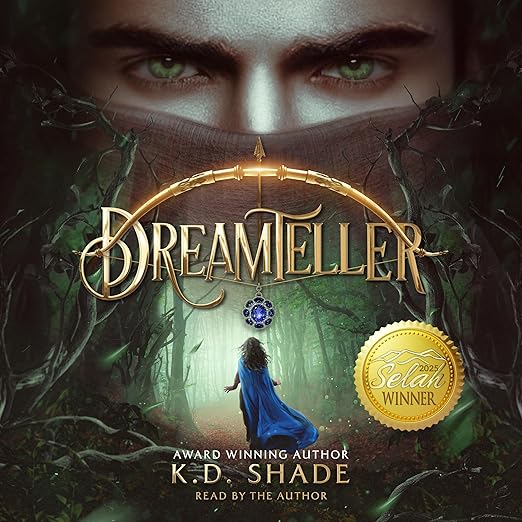
I keep a mental list of debut novels that arrive with the confidence of a writer several books into their career. Dreamteller belongs on that list. K.D. Shade has built something genuinely accomplished here: a court fantasy with real political teeth, a protagonist who is more than capable of carrying a complex plot, and a story structured with the kind of patience that most debut authors have not yet learned to trust. She has also narrated it herself, which is either brave or entirely natural depending on how you look at it, and from the evidence of the listening experience, it is entirely natural. The voice and the story belong to the same person, and it shows.
With 256 Audible UK ratings averaging 4.8 stars, this is not a book that needs my endorsement. But I want to say something specific about what makes it work, because the reviews are enthusiastic in ways that deserve unpacking rather than simply echoing.
About the Audiobook
Lady Shannyn was raised to rule the kingdom of Megara, and the opening of Dreamteller establishes her secure, if not entirely comfortable, position with economy. But Shannyn possesses a gift: the ability to see visions of the past, the dreamtelling of the title, and when a dream uproots a buried betrayal, her certainties begin to collapse. Spies in the corridors, assassins in the shadows, rebellion brewing behind silk-draped smiles: the court intrigue is layered and deliberately disorienting, keeping the listener uncertain about who to trust for pleasingly long stretches of the story.
The arrival of a masked archer, a man whose identity and motives are carefully withheld, provides both a source of potential alliance and a test of Shannyn’s judgement. The relationship between them develops in a way that several reviewers describe as genuinely surprising: this is not a romance that unfolds according to formula, and the mystery surrounding the archer is maintained with real discipline. Shade is clearly comfortable letting her readers sit with uncertainty for longer than is typical in the genre, and the patience pays off in a final act that delivers its revelations with impact precisely because they have been withheld carefully.
What strikes reviewers most consistently as distinctive is the worldbuilding approach: detailed enough to be immersive, restrained enough to avoid the information dumping that burdens many debut fantasies. Megara feels like a place with genuine history and internal logic, and the court’s social architecture, who holds power, who wants it, and what rules govern the competition for influence, is rendered with a specificity that makes intrigue plots actually work. The dreamtelling gift is not merely decorative: the ability to see past events becomes central to the plot’s resolution in ways that reward listeners who have been paying attention from the opening chapters.
At nearly seventeen hours, this is a substantial commitment, and the pacing holds it together without significant sagging. The middle section manages the delicate balance of advancing both the political plot and the central relationship without either feeling rushed or neglected. The final act delivers the plot twists that reviewers mention repeatedly, and the resolution is earned rather than convenient.
The Self-Narration
K.D. Shade narrating her own work is a decision that can go badly wrong, and here it goes entirely right. Shade’s voice has the precise quality her protagonist requires: intelligent, controlled, with a current of emotion running beneath the surface that emerges at exactly the right moments. She knows where the tension lives in each scene because she put it there, and that knowledge produces a narration with unusual authority and precision. The court scenes have a brittleness to them; the more intimate passages carry genuine vulnerability. Across sixteen hours, the consistency is remarkable. This is not a reading performance cobbled together from an author’s goodwill; it is a genuinely accomplished piece of audio work that earns the runtime it asks for.
What Readers Say
The response to Dreamteller is exceptional and worth quoting at length. India called it an absolute rollercoaster of emotions with a plot layered with intrigue and a world that drew her in completely, noting that just when she thought she had things figured out, the story shifted direction convincingly. Hayley, also reviewing in the UK, was struck by the worldbuilding and wrote that she was completely lost in Shade’s world, praising the author’s ability to bring Megara to life without overwhelming the reader with exposition. Miss E. described it as a fantastic read and found it difficult to believe this was a debut. Nicola, giving four stars, offered the only substantive reservation, noting that she wished for more character development in the opening chapters, though she stayed up far too late reading regardless. This is an unusually articulate and consistent set of early reviews for an independent debut.
Who Should Listen?
Fans of court fantasy, particularly readers who enjoyed Leigh Bardugo’s Grisha trilogy or Sabaa Tahir’s work, will find much to love in Dreamteller. The combination of political intrigue, a morally intelligent protagonist, and a central mystery that resists easy resolution is well-executed, and the self-narration adds a dimension that outside readings of this story would lack. If you are relatively new to the fantasy genre and looking for a debut that does not ask you to wade through dense exposition to reach the story, this is a particularly good starting point. At nearly seventeen hours, it is a full-length commitment, but the payoff across those hours is substantial.