Clara’s Verdict
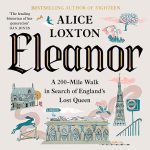
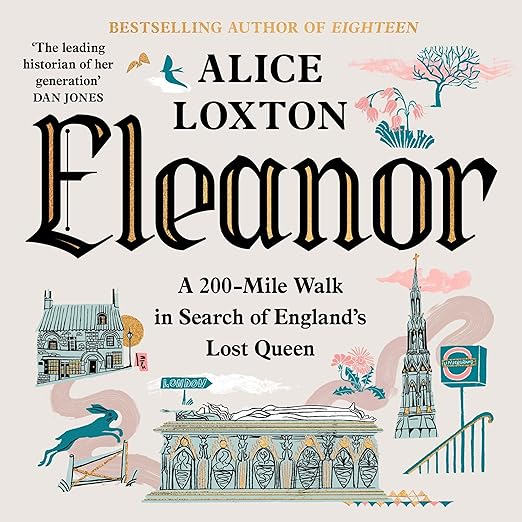
There are many ways to write a history book, but only a handful of historians have the courage to make the writing itself part of the argument. Alice Loxton is one of them. Eleanor is ostensibly the story of a 13th-century queen and the funeral procession that immortalised her name in stone across England. In practice, it is also the story of a young historian walking 200 miles in November and December, following in history’s footsteps on the corresponding dates – the same cold, the same short days, the same route from Lincoln to London that Eleanor of Castile’s body travelled in 1290.
The result is one of the most genuinely original history audiobooks I’ve encountered in some years. It was a Sunday Times bestseller on publication in November 2025, and Dan Snow calls Loxton “the star of her generation.” Both assessments seem to me correct. This is a book that earns its ambition, and Loxton reading it herself makes it something very close to unmissable.
About the Audiobook
Eleanor of Castile was the wife of King Edward I of England, and by all historical accounts a woman of formidable character and considerable political agency – unusual enough in the 13th century to merit serious attention. When she died in November 1290 at Harby in Nottinghamshire, Edward was reportedly devastated. He commissioned a solemn procession to carry her body the 200 miles to Westminster Abbey, and at each of the twelve places where her cortege rested overnight, he eventually erected a stone cross: the Eleanor Crosses. Twelve were built; three survive today.
Loxton walks the route over the same weeks in winter, and her account of the journey is woven together with the history of Eleanor’s life, the story of the crosses, and a meditation on what it means to follow someone’s path across seven centuries. She writes about the tension between the warmly human Edward commemorated in the crosses and the political Edward who fought the Welsh and Scots – a contradiction that, as one reviewer notes, she handles with both honesty and care.
The book is also, more quietly, about what walking does to thinking. Loxton’s observations about the English landscape – ancient paths, modern motorways, the archaeology visible at the surface of the land – give the journey a texture that pure archival history cannot provide. Philippa Gregory, in a jacket endorsement, notes that Loxton “has the novelist’s skill of seeing the world through her characters’ eyes, and the historian’s accuracy of vision.” It is an apt description.
The Narration
Loxton reads this herself, and the effect is precisely what it should be. The audiobook description notes this explicitly, and it matters: this is personal, embodied history, and a detached professional narrator would have drained it of exactly the quality that makes it distinctive. Loxton’s voice carries the journey with her – the cold is audible in the energy of certain passages, the wonder in others. At nine hours and thirty-six minutes, it is an ideal length for a book that moves at a walker’s pace. You arrive in London feeling as though you’ve come some distance yourself.
What Readers Say
The response has been exceptional: 4.7 stars from 215 reviewers, with five stars the overwhelmingly dominant score. “This is one book that I’ll read again,” wrote one UK listener. “I’m not usually a history fan so I’m not sure why this book drew my fancy. I’m SO glad that I read it.” A self-confessed non-history reader converted by sheer quality of writing – that is what good popular history achieves. Several reviewers mention the Canterbury chapter on Becket as particularly arresting. Others describe it as “spellbinding,” “captivating,” or simply “extraordinary.” Kate Mosse called it “a modern-day pilgrimage” and praised its “beauty, elegiac quality, honesty and compulsion.” There are very few books I’d describe as genuine gifts to the reader, but this qualifies.
Who Should Listen?
This is for anyone interested in British history, medieval England, or the history of the landscape itself. It will also appeal strongly to readers who love the genre of walking memoir – Robert Macfarlane’s readership will find a natural companion here – and to those interested in the inner lives of historical women who have been largely written out of the record.
You need no prior knowledge of Eleanor of Castile or the Eleanor Crosses; Loxton builds everything you need from the ground up. Available on Audible UK, Kobo, Scribd, and Storytel. Listen to Eleanor on Audible UK – one of the finest history audiobooks of 2025, without question.