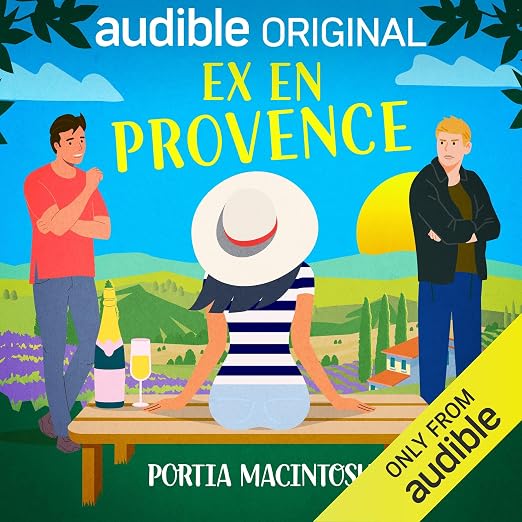
Clara’s Verdict
There is a particular kind of summer novel that knows exactly what it is doing and does it without apology, and Ex En Provence belongs squarely to that tradition. A crumbling chateau, a vineyard, an unexpected French inheritance, an impossibly attractive vineyard manager and, arriving at the worst possible moment, the ex-husband. Portia MacIntosh is not attempting to surprise you with the ingredients. The pleasure lies entirely in the assembly.
Seven hours and thirty-six minutes, an Audible Original released on 23 July 2026 and charting on Audible UK almost immediately, which for a title less than a week old tells you something about the size of MacIntosh’s readership. The listing calls her a “million copy selling sensation” and, on the evidence of how quickly this one has moved, that is not publicity inflation.
About the Audiobook
Sophie is stuck. She works in film, surrounded by call sheets and constructed worlds, and none of it feels real to her. Then comes a call telling her that a French ancestor she never knew existed has died and left her a share of an estate. That is startling on two counts, the second being the discovery that she has French ancestors at all. She packs immediately.
Provence then delivers what Provence is contractually obliged to deliver: sun, wine and the crumbling Chateau Lavande, which she falls for on sight, along with Thibault, who manages the vineyard. As the lawyers’ meeting approaches she runs into Mark, the ex-husband she married as a teenager and divorced twelve years ago. What was shaping up as a blissful summer becomes, in the listing’s words, “a tangled mess of dodgy property developers, fake relationships, and old feelings that she had sworn off for good.” A secret then forces the choice the whole book has been building towards: claim what she has been left and the life that comes with it, or give it all up for the chance at something else entirely.
I will note, gently, that the listing copy is rougher than it ought to be, with at least one sentence that appears to have lost a word or two somewhere in production, and a synopsis that breaks off mid-thought just before the choice is spelled out. None of that reflects on the novel itself. It does mean that if you are trying to judge this book from its description alone, you are working from a slightly damaged copy.
The Narration
Arty Froushan carries the whole thing alone from first minute to last, and the job is harder than a sunlit rom-com sounds. Three things have to work at once. The comedy has to land, which in MacIntosh’s writing means dry self-deprecation delivered at speed rather than jokes with visible setups. The two men have to be genuinely distinguishable, since the entire plot depends on the listener feeling the pull of both. And the French has to be right.
That last point is not a small one. A book set among French characters, on a French estate, with a French love interest, becomes actively uncomfortable when the accents are approximate or the place names are mangled, and there is a long and unhappy tradition of English-language audiobooks getting this badly wrong. Froushan handles the French material with care rather than caricature, which keeps Thibault a person instead of a fantasy accent. The comic timing is the stronger achievement, though, particularly in Sophie’s interior commentary, where he resists underlining the jokes and simply reads them and lets them go. Since no listener has yet written a word about this recording, take the above as one critic’s assessment rather than a settled view.
What Readers Say
Nothing to report, and it would be dishonest to pretend otherwise. Released on 23 July 2026, Ex En Provence carries neither a star rating nor a single written response at the time of writing, which is entirely normal for a title six days old. The only signal currently available is the author’s existing readership, and the listing’s claim of a million copies sold across her books is a reasonable proxy for what her regular audience expects from her and keeps on getting.
For what it is worth, my own reservations are ones I would expect the eventual reviews to echo. The property developer subplot is the weakest strand and exists largely to give the third act a deadline to run towards. The fake relationship device arrives late and resolves quickly. And Mark, the ex-husband, is written with more charm than the plot ultimately allows him to use, which left me faintly frustrated on his behalf. Against all that, the Chateau Lavande material is lovely, Sophie is genuinely good company for seven hours, and the book is funnier than its premise promises. Check back in a month and there will be several hundred opinions to weigh against mine.
Who Should Listen?
Sunshine, vineyards and a crumbling chateau are a reliable combination and this is a well-executed example of the form. It suits anyone who wants a warm, funny, low-stakes escape with a proper romantic dilemma at its centre, and it suits a holiday particularly well, since seven and a half hours is roughly two poolside afternoons or the outbound and return legs of a decent journey. The single-narrator production keeps it intimate, which is right for a first-person comic voice.
Anyone allergic to the conventions will find them all present and correct, from the meet-cute to the misunderstanding to the grand gesture. If predictability in a romantic comedy irritates you rather than comforting you, this will not convert you to the cause. Read as what it is, a sun-soaked, well-timed piece of escapism from a writer who has done this many times and knows precisely where the pleasure lies, it is thoroughly good company.