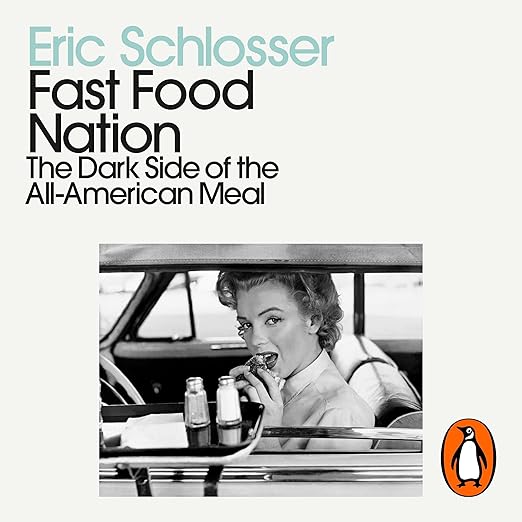
Clara’s Verdict
The first thing I noticed about this listing is a date, and it is worth pausing on before anything else. This audio edition is dated 15 September 2026, which places it ahead of me as I write. The reviews attached to it, meanwhile, run back to 2010. The 4.4 average from more than 2,400 ratings is therefore a judgement on Eric Schlosser’s book across its long published life, not on this recording, which nobody has heard yet. I would rather tell you that than let a strong-looking number do work it has not earned.
What the number does tell you, reliably, is that this is a piece of investigative journalism that has held up long enough to be reissued and re-rated by successive waves of readers. That is not nothing. Books of exposure age badly as a rule, overtaken by the reforms they provoke or by the industry simply moving on. This one has kept its readers for fifteen years and more, and the reason is visible in the reviews: at least one reader here describes changing their behaviour after finishing it, which is a much rarer outcome than describing having enjoyed it.
About the Audiobook
The subject is the American fast food industry and what it has done to the country that built it. Schlosser’s argument, as the publisher sets it out, is that this is a study of corporate power first and a study of food second. The claim is that the industry has altered the American landscape, widened the gap between rich and poor, fuelled an epidemic of obesity and transformed food production across the world. That is an enormous set of claims, and the book’s method is to earn them one location at a time rather than assert them from a height.
Three strands are named in the publisher copy, and they give a fair idea of how the twelve hours are spent. There is the transformation of the American diet, taking in the origins of the drive-through and the specific question of why the fries taste the way they do. There is the meatpacking chapter, a journey into the plants of the High Plains and into the safety record and labour practices behind the beef in an ordinary burger. And there is the obesity material. The publisher’s third bullet is cut off mid-sentence on the listing, which is a small thing but the kind of small thing I prefer to name.
Twelve hours is a substantial commitment for reportage, and I think the length is the right call for this particular structure. The argument only works cumulatively. A shorter version would give you the shocking anecdotes without the connective tissue that turns them into a case, and the connective tissue is where Schlosser is strongest. What the copy promises is not a polemic but an invitation to look beneath the surface of the food system and think for yourself, which is a more modest pitch than the material would license, and a more durable one.
One practical note: the meatpacking and fast-food detail is American throughout. British listeners will find the mechanics recognisable rather than identical, and the value lies in the model of how a food system reorganises itself around volume.
The Narration
Twelve hours of investigative non-fiction, and the page will not tell me who reads it. That blank matters here more than it usually would. Reportage of this type asks something quite specific of a reader. The material is inherently inflammatory, and the writing deliberately is not, which means the performance has to resist the temptation the content keeps offering. A voice that leans into the outrage turns a carefully built case into an editorial, and an audience that came to think for itself will feel handled.
One of the reviewers puts the tonal question better than I could. Schlosser, the reviewer writes, “writes in quite a controlled, scientific manner” and “isn’t dogged by some of the more excitable hyperbole of Michael Moore”. That control is the book’s central rhetorical asset. The right narrator here reads the meatpacking material at exactly the temperature of the passage on why the fries taste as they do, and lets the reader supply the reaction. The wrong one signposts.
The second demand is stamina across register changes. Reportage of this kind moves between corporate history, technical explanation, on-the-ground interview and statistical summary, and a reader who runs all four at one speed will lose you somewhere in the middle. With the credit absent, treat a sample as essential.
What Readers Say
The reviews here are responses to the book rather than to this recording, which is unavoidable given the dates, but they are unusually consistent about what the reading experience does to you. One five-star reviewer calls it “a highly affecting book, not just emotionally, but behaviourally as well”, and then supplies the evidence: they had eaten the occasional burger before reading it and have not since. That is a stronger claim than most books earn: not admiration, but an altered shopping habit.
A four-star response is more measured and, I think, more useful as a buying guide. It frames the book as a brief history of fast food in the United States and its spread worldwide, adding that it also “explains the environmental, economic and social impacts of these consumption patterns”, and notes the film that drew on it. That reviewer’s recommendation is aimed at people who want to understand preparation and quality standards and how their own choices register. A third reviewer, giving five stars in a couple of lines, simply calls it essential reading and a horror story about corporate America.
What I do not find anywhere in the pool is a substantive dissent, and I want to be careful not to invent one for the sake of balance. The shown reviews are uniformly positive. What is genuinely missing is any assessment of the audio, and until this edition has been out for a while, nobody can give you one.
Who Should Listen?
Anyone who eats, which is the glib answer, but let me be more precise. This is for readers who want the machinery behind an everyday transaction made visible, and who can take twelve hours of accumulating detail without needing a narrative hero to follow. If you have enjoyed the long-form investigative tradition where a single reporter takes an industry apart from the supply chain up, you are in exactly the right place. Readers with an interest in labour conditions, food policy or the mechanics of corporate consolidation will find the meatpacking material the most substantial thing here.
Give it a wide berth if you are squeamish about processing detail, because the meatpacking pages soften nothing, and think twice if you want current data specifically. The reviews stretch back sixteen years, and while the argument has aged well the particulars belong to the period in which they were reported. Treat it as the foundational account rather than the latest one. Anyone hoping for a British perspective on the same industry will need to look elsewhere.