Clara’s Verdict
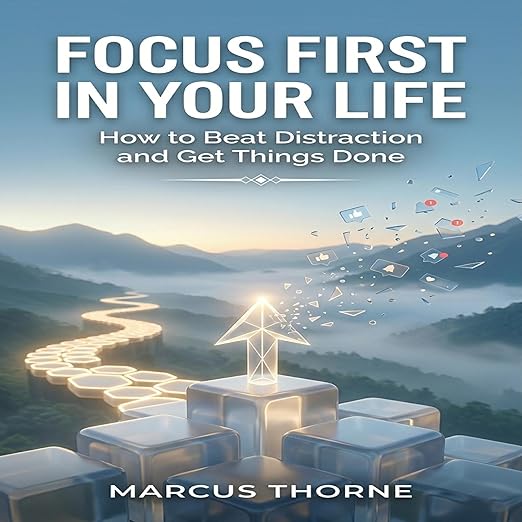
At one hour and one minute, Focus First in Your Life falls into a category of productivity audio that I think of as the espresso format: concentrated, quick, and designed to be consumed in a single session rather than stretched across a week of commutes. Marcus Thorne’s guide to reclaiming attention in a distraction-saturated world covers ground that will be familiar to anyone who has spent time with Cal Newport’s Deep Work, Jenny Odell’s How to Do Nothing, or the substantial and growing shelf of focus-and-productivity literature published over the past decade. That familiarity is not a disqualifying problem. There is genuine value in a shorter, more accessible synthesis of ideas that have previously been presented at full book length, if the synthesis is clear and the framing is practical rather than aspirational. The challenge for any book in this format is whether sixty minutes can deliver something genuinely actionable or whether it simply reminds you of a problem without getting you any closer to solving it.
The answer in this case is: just about, provided you arrive knowing what you need and are not expecting a comprehensive methodology to emerge from a single hour of listening. What this guide offers is a structured map of the problem and a set of initial tools, not a complete solution to a habit that most people will need weeks or months of practice to genuinely embed.
Mapping the Attention Economy
Published in March 2026 and running sixty-one minutes, Focus First in Your Life describes itself as a practical, no-fluff guide, and the structure reflects that commitment. The book moves through a connected sequence of ideas at a pace that prioritises breadth over depth, which is appropriate for the format and honest about its limits. The core arguments are clearly established: multitasking is not merely inefficient but biologically impossible, in the sense that the brain serial-processes rather than parallel-processes and the apparent multitasking behaviour most people experience is actually rapid context switching with significant cognitive cost. That cost, the attention residue that remains when you move between tasks, is one of the more useful frameworks in the current productivity literature, and Thorne presents it accessibly without reducing it to slogan.
Practical recommendations cover environmental design to reduce incoming distraction, strategies for building concentration rituals that reliably trigger deep work states, frameworks for declining commitments without damaging professional relationships, and the reframing of FOMO toward what Thorne calls JOMO, the joy of missing out, which is the shift from anxiety about what you might be missing to clarity about what you are choosing. These are established and well-supported ideas, and Thorne presents them clearly without making implausible claims to originality. The guide functions as a structured survey of the best available thinking rather than as an original contribution to the field, and within that scope, it delivers what it promises. There is also a reasonable treatment of energy management as distinct from time management: the argument that productivity is not simply a function of hours available but of cognitive and physical capacity within those hours is a useful reframe that many people encounter here for the first time.
For listeners encountering these ideas for the first time, the one-hour format is an efficient introduction that may prompt further reading. For those already familiar with the literature, it functions as a rapid refresher or a structured framework to share with someone earlier in their thinking about attention and productivity. The format works particularly well as a starting point before committing to a full-length book on any of the specific concepts introduced.
Delivery for the Distracted Listener
Robyn Green narrates, with a clean and direct delivery suited to the instructional register of the material. She maintains consistent energy throughout without tipping into the artificially motivational tone that undermines the credibility of practical non-fiction in this genre. At sixty-one minutes, there is no serious test of listening endurance, but the pacing within that window is well judged: fast enough to feel efficient, measured enough to allow each idea to land before the next arrives. The production quality is clean and professional, with no distractions from the content.
What Readers Say
Focus First in Your Life has no listener ratings or published reviews at the time of writing, consistent with its March 2026 release date and limited initial distribution. The absence of a review base makes it difficult to assess whether the material has landed as actionable for its primary audience of entrepreneurs and productivity-focused listeners, or whether it has read as too introductory for the people most likely to seek it out. Short-format practical guides of this kind tend to generate listener responses that cluster around two questions: whether the ideas were genuinely new, and whether the price-to-runtime ratio felt fair. The publisher, ARTHUR JONES, is a small independent imprint, which means this guide has reached its audience primarily through word of mouth and search rather than major editorial promotion. Early listener feedback will be a useful signal about whether the audience for whom this was written found it at the right moment in their thinking.
Who Should Listen?
This is best suited to listeners who are new to the focus and attention literature and want a quick, structured overview before committing to longer works. If you have already read Deep Work, Digital Minimalism, Indistractable, or Four Thousand Weeks, you will not find significant new territory here. If you are looking for an accessible first orientation that you can carry into your working day without a major time investment, this is a reasonable choice. Be clear about the scope: sixty-one minutes cannot replace the depth, the evidence base, or the genuine behavioural change that comes from sustained engagement with a full-length treatment of this subject. This is a doorway, not a destination, and it works best when treated as exactly that.