Clara’s Verdict
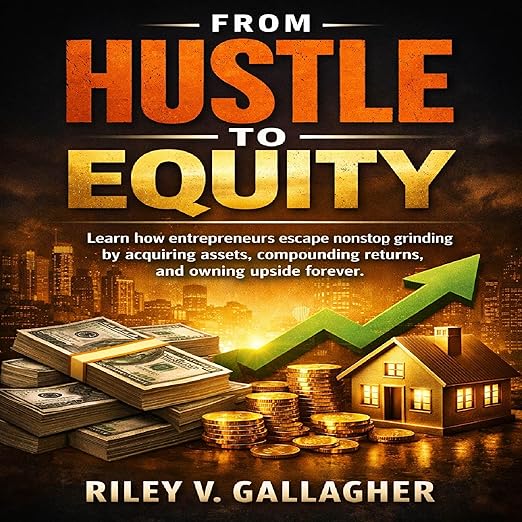
The entrepreneurial self-help genre has a problem with its own metaphors. The language of hustle, grind, and relentless output has embedded itself so thoroughly in business culture that the mere suggestion of doing less can feel transgressive. From Hustle to Equity by Riley V. Gallagher makes this suggestion with some clarity, and it deserves credit for the directness of its central argument: sustained wealth is not produced by effort alone but by ownership, leverage, and disciplined capital allocation. At three hours and three minutes, narrated by Robyn Green, it makes this case concisely rather than comprehensively, which is an honest choice given the runtime.
No listener reviews exist at the time of writing, and the publisher, identified as Evaldas Rimkunas, is not a recognised imprint in the mainstream business publishing space. These are relevant considerations for a genre where credibility and track record matter considerably.
About the Audiobook
The book’s framing is its strongest quality. The distinction between income, what you earn by working, assets, what you own that produces value, and true wealth, the compound accumulation of assets over time, is not a new observation, but it is one that many ambitious people intellectually accept while emotionally remaining committed to the income-generating treadmill. Gallagher’s argument is that this is not a character flaw but a structural misunderstanding: most entrepreneurial education trains people to be better operators when what they should be learning is how to become owners.
The seven principles covered follow a logical progression from diagnosis to application. Identifying the difference between income and true wealth comes first, establishing the framework. Escaping perpetual busyness follows, which addresses the psychological addiction to activity that keeps many entrepreneurs from building leverage. The later principles, acquiring recurring cash-flow assets, building scalable systems, managing downside risk, and compounding small wins, move progressively from mindset to mechanics.
The audio format suits this material reasonably well. The principles are conceptual enough to benefit from explanation rather than diagrams, and at three hours the core argument is delivered without significant padding. The limitation is specificity: three hours is not enough to cover seven substantial principles with real depth, which means the treatment is necessarily introductory. Listeners who have spent time with Robert Kiyosaki’s Rich Dad Poor Dad, itself essentially the same argument with different examples, or with Morgan Housel’s The Psychology of Money, will recognise the intellectual territory. What Gallagher adds, if the synopsis is accurate, is specific application to entrepreneurs rather than employees or investors, which narrows the relevance usefully for the target audience.
A note on provenance: the publisher name here is a personal name rather than an imprint, and Gallagher does not appear to have an established public profile as a business thinker or practitioner. The book’s claims therefore rest on the quality of the argument rather than the authority of the author’s background, and listeners should assess the opening chapters for themselves before committing fully.
The Narration
Robyn Green delivers the material in a clean, business-appropriate register. The tone is confident without being bombastic, an important quality for content about wealth-building, which can easily tip into aspirational sales-speak if the narrator over-pitches it. Green maintains a reasonable pace that allows the principles to land without rushing past the implications of each one. At three hours, consistency is not a challenge; Green maintains it throughout and the listening experience is smooth.
What Readers Say
No listener reviews have been published at time of writing. The January 2026 release date is recent enough that the review profile has not yet developed. Listeners are advised to sample the first chapter before purchasing, particularly given the independent publication context. The synopsis is coherent and the argument clearly structured; the execution remains to be confirmed by a developing audience response.
The UK context is worth flagging briefly: some of the specific vehicles Gallagher references for building equity, business structures, investment accounts, and cash-flow assets, will be US-specific in their legal and tax framing. The conceptual argument is universally applicable, but listeners in the UK who want to act on the principles will need to translate the specific implementation guidance into UK-equivalent structures, whether that is limited companies, ISAs, or property investment frameworks rather than whatever American equivalents are described.
Who Should Listen?
Best suited to early-stage entrepreneurs who feel trapped in an income-for-time exchange and want an accessible audio case for thinking differently about their business structure. Also useful for those who want a short, direct argument for the ownership mindset before exploring the topic in more depth with longer, more rigorous texts. Less suited to established investors or experienced business owners, for whom the principles covered will be familiar ground. If this sparks genuine interest, pair it with Morgan Housel’s The Psychology of Money for more rigorous treatment of the underlying ideas about wealth accumulation and compounding.