Clara’s Verdict
I first encountered the Harry Potter series as a commissioning editor in my mid-twenties, when it was already too large a cultural phenomenon to assess at any kind of critical distance. By the time Deathly Hallows arrived in 2007 the books had become something that transcended the usual parameters of literary evaluation: they were infrastructure. An entire generation had grown up inside this world, and the final volume carried a weight of expectation that would have buckled most novels. Rowling did not buckle. The book she delivered is not perfect – no novel that ambitious at that scale is – but it is entirely worthy of the series it concludes.
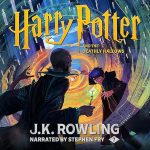
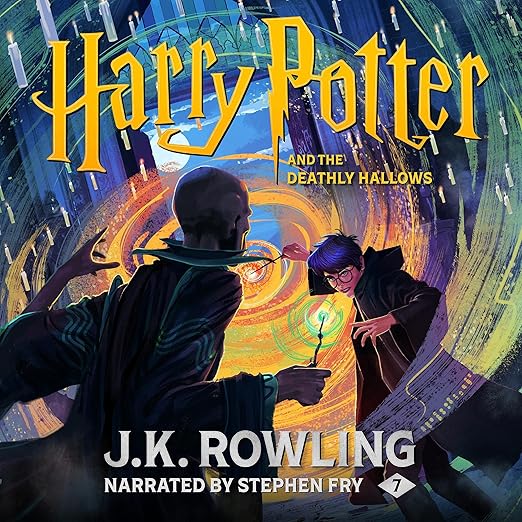
More than fifteen years on, this Audible edition – Stephen Fry reading for Pottermore Publishing, released in November 2015 – is the version that a large portion of the UK’s listening population will call the definitive one. Fry’s narration of the series has become so closely associated with the text that it is genuinely difficult, as a British listener of a certain age, to read Rowling’s prose without hearing his voice. That is not a small achievement. It is, in fact, one of the great narrator-text relationships in the history of audiobooks.
About the Audiobook
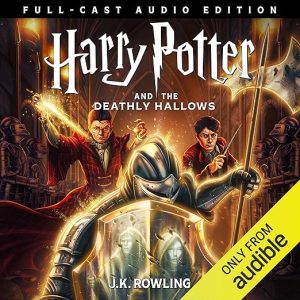
Harry Potter and the Deathly Hallows is the seventh and final volume in the Harry Potter series, at 23 hours and 59 minutes the longest instalment in the Fry recordings. The story picks up as the protective enchantments that have kept Harry safe at Privet Drive expire for the final time. Voldemort and the Death Eaters are closing in. What follows is a year of hunting Horcruxes outside the safety of Hogwarts, the revelation of the three Deathly Hallows, the gradual loss of people Harry loves, and the final confrontation at the school that has been the world’s centre of gravity since page one of book one.
The book is structurally the most demanding of the seven: it spends far more time in the field, away from Hogwarts, than any of its predecessors, which was a deliberate and initially disorienting choice. The forest sections and the long search for the remaining Horcruxes push the characters into a rawer, lonelier kind of survival than the school-year structure of the earlier books allowed. Many readers struggled with this on first reading; on return, the isolation of those chapters reads as essential – Rowling is stripping Harry of every institutional support before the final act, and the effect is earned.
The epilogue has always been contested – the flash-forward nineteen years is simultaneously satisfying and slightly too tidy for the dark register the book has maintained – but it is a minor quibble at the end of seven very long, very well-written books.
The Narration
Stephen Fry narrating Harry Potter is, by this point, a cultural fact rather than a performance to be evaluated. What can be said is that over twenty-four hours, the characterisation is extraordinary: Fry’s Hagrid, Dumbledore, Voldemort, Umbridge, Luna Lovegood, Hermione, and Ron are so fully realised that they exist as a parallel cast to the film versions in many listeners’ imaginations. The emotional range required in this final volume – from the comedy of the early Burrow sequences to the deaths of characters the reader has known for seven books – is formidable, and Fry meets it throughout. The theme music, composed by James Hannigan, bookends the experience in a way that reinforces the sense of occasion the final volume deserves.
What Readers Say
With 4.8 stars from 98 listeners, this edition sits at the upper end of the series’ already strong Audible ratings. George Hill summarised the plot with particular enthusiasm for the Horcrux mechanics, concluding that against Harry with his soul intact, Voldemort has no chance even if Harry did not have the Elder Wand, which is the kind of engaged plot analysis that this series has always generated. Sam, reviewing in 2011, called it moving, action-packed, epic, entertaining, and unbelievably fast-paced, concluding that this book could not be any better. David P., reviewing in 2007 – the year of original publication – recalled the pleasure of receiving his copy on the day of release and confirmed that the Harry Potter series is the best books I’ve ever read. Margaret Brammer, in 2026, loved the ending but wanted more of Luna’s story, which is a reasonable and widely shared position.
Who Should Listen?
This is, by definition, for listeners who have read or heard books one through six. It is emphatically not a series entry point, and attempting it without the accumulated emotional context of the preceding volumes would be a significant loss. For series veterans: this Fry edition is the correct version for audio. If you have previously read the books in print and not heard the Fry recordings, beginning at The Philosopher’s Stone and listening through to this one is an experience that rewards the investment. Few series end as well as this one does.