Clara’s Verdict
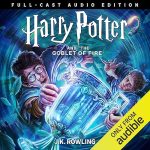
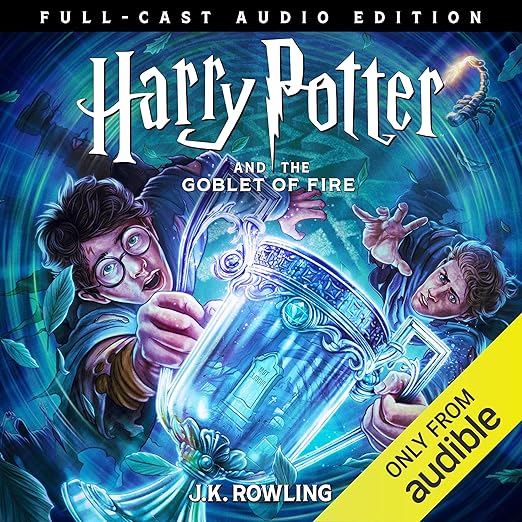
I was in the middle of something entirely different on a Tuesday evening when I pressed play on this and then spent the next twenty minutes simply not stopping. That is not my usual relationship with audiobooks I review as a professional obligation. The Full-Cast Edition of Harry Potter and the Goblet of Fire is not an audiobook in the conventional sense – it is closer to a cinematic audio event, and that distinction matters practically for anyone deciding whether to listen. Pottermore Publishing and Audible Studios have produced something that fundamentally changes what it means to spend time with the fourth Harry Potter book, and I say that as someone who has listened to Stephen Fry’s classic recording more times than I can honestly count.
The key facts: Book 4 of the Harry Potter series, 20 hours and 13 minutes, released February 2026, available in Dolby Atmos on compatible devices. Rated 4.8 stars from 97 Audible UK listeners – a remarkably high average for a debut recording on a title with a deeply established existing version. And a cast that reads, quite genuinely, like a carefully assembled piece of cultural theatre.
About the Audiobook
The Triwizard Tournament arrives at Hogwarts, and with it the first real sustained confrontation with mortality in the series. Harry, mysteriously entered into the competition despite being underage, must face three tasks – a dragon, underwater peril, and a labyrinthine maze – while the shadows around Voldemort begin to gather in earnest. This is the book where Rowling’s world pivots from adventure story to something genuinely darker and more consequential, where the deaths are real rather than implied, and where the tonal shift that carries through the final three books begins in earnest. The Goblet of Fire has always been the hinge on which the series turns, and it is the right book for this kind of treatment.
The Full-Cast Edition brings hundreds of unique voices to that world, with immersive sound design that places you inside the story in a way that solo narration, however skilled, cannot replicate. The Dolby Atmos mix means that the Golden Snitch darts past your ears during Quidditch sequences, footsteps echo through stone corridors with genuine spatial depth, and crowd scenes have a density and movement that conventional stereo recordings simply cannot reproduce. An entirely new musical score accompanies the production. The cast assembled is extraordinary: Hugh Laurie as Dumbledore, Riz Ahmed as Snape, Matthew Macfadyen as Voldemort, Ruth Wilson as Bellatrix, Michelle Gomez as McGonagall, Simon Pegg as Arthur Weasley, and James McAvoy as Mad-Eye Moody. Cush Jumbo serves as narrator. The three children at the centre – Jaxon Knopf, Rhys Mulligan, and Nina Barker-Francis – take Harry, Ron, and Hermione respectively.
The Narration
The ensemble format means that no single narrator carries the weight of the production, but Cush Jumbo’s narration provides the connective tissue that holds everything together – warm, intelligent, and never overwhelmed by the spectacle around her. James McAvoy’s Mad-Eye Moody is a particularly memorable characterisation, bringing a gravel and controlled volatility to the role that the text demands. Hugh Laurie’s Dumbledore is a genuine surprise: more melancholy and human than the benevolently omniscient figure some readers carry from childhood, which feels true to Rowling’s later, more complex portrait of him. The sound design throughout is exceptional – this is an audiobook that genuinely rewards good headphones or a quality speaker system. Listening through phone speakers is not the intended experience and somewhat misses the point of the production.
What Readers Say
The 97 Audible UK ratings already averaging 4.8 stars, accumulated in the weeks following the February 2026 release, suggest an immediate and enthusiastic reception. UK listeners describe the production as transporting, with particular praise for both the casting decisions and the immersive sound design. One reviewer described returning to a book they knew well and finding the experience genuinely new – the spatial audio and hundreds of distinct voices created something closer to watching a film than reading, or even conventional listening. Others praised the production’s particular value for family listening, where the event quality of the recording keeps younger and older audiences equally engaged without either feeling they are watching something aimed at the other. The handful of lower ratings reflect comparisons to Fry’s recording rather than any failure of this one – these are different experiences, and both are valid.
Who Should Listen?
This edition is for anyone who wants to experience the Harry Potter series as a genuine audio production rather than an enhanced reading. It is ideal for families listening together, for long car journeys where the cinematic quality of the production rewards sustained immersion, and for fans of the series who want a genuinely fresh encounter with a book they know by heart. Those devoted to Stephen Fry’s recordings will find this not a replacement but a companion – the two versions offer different kinds of pleasure. New listeners to the series should begin with Book 1, though this fourth instalment contains enough narrative context to function as an entry point for determined newcomers. Listen on Audible UK