Clara’s Verdict
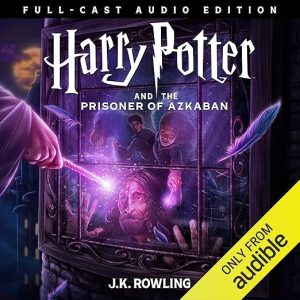
There is a moment in the third Harry Potter book, somewhere around the first appearance of the Dementors on the Hogwarts Express, when J.K. Rowling’s series shifts into a register it has not quite reached before. The first two books are wonderful, but they are, at heart, adventure stories with a clear moral architecture: good is here, evil is there, and courage is what bridges the distance. The Prisoner of Azkaban is the first book in the series where things are not what they appear, where the apparent villain is not the villain and the apparent heroes carry shadows, and where the resolution requires something more morally complex than courage alone. It is, for many readers who grew up with the series, the turning point.
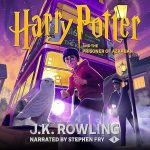
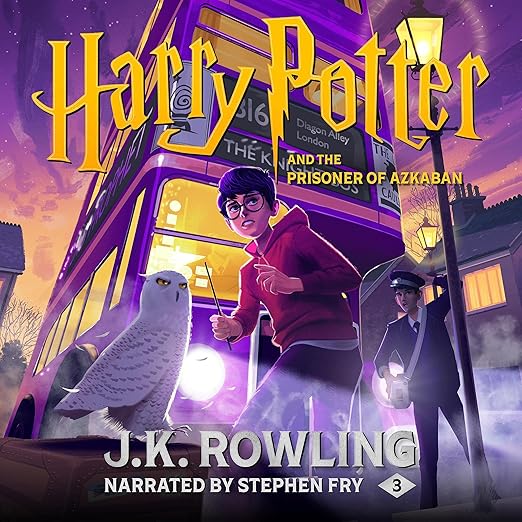
Stephen Fry’s narration of the British editions is, for a great many British listeners of a certain generation, the voice of the books. To listen to him read this one is to revisit something that feels, improbably, like memory. The twelve hours pass without effort, which is the highest compliment available to a listening experience.
About the Audiobook
Harry Potter’s third year at Hogwarts is shadowed from the outset. Sirius Black, a supposed mass-murderer and follower of Voldemort, has escaped from Azkaban, and the widespread assumption is that he is coming for Harry. Meanwhile the Dementors, one of Rowling’s most genuinely unsettling creations, have been deployed to guard the school, with their soul-extracting Kiss as the ultimate sanction. Professor Trelawney’s Divination classes promise doom. A new Defence Against the Dark Arts teacher, Remus Lupin, proves to be one of the most important characters in the entire series.
The plot’s central mystery, the truth about Sirius Black and about what actually happened the night Harry’s parents died, is constructed with a precision that rewards both first-time and returning listeners. The introduction of the Time-Turner and the double-timeline resolution is one of the most satisfying structural gambits in children’s fiction of its era, and it holds up considerably better on re-listening than many such mechanisms tend to manage.
Running to just over twelve hours, this is the perfect length for the story Rowling is telling. The pacing is tighter than the early books and looser than the later volumes, occupying the sweet spot where the series’ charm and its ambition are in most productive tension. Published by Pottermore Publishing in its definitive audiobook edition in November 2015, with theme music composed by James Hannigan, this is the canonical listening version for British audiences. The production values are exceptional and entirely befitting a series that has shaped the reading lives of multiple generations.
Rowling introduces several elements in this book that will become architecturally important to the later instalments: the Marauder’s Map, the history of the Marauders themselves, and the nature of the relationship between Sirius Black, Remus Lupin, Peter Pettigrew, and Harry’s father James. These threads are laid with enough care that even listeners already familiar with the full series will find new texture in them on return.
The Narration
Stephen Fry’s performance is one of the great achievements of British audiobook production. His characterisation is comprehensive and joyful: the comic condescension of Professor Trelawney, the warm authority of Dumbledore, the rat-like anxiety that suffuses certain characters in retrospect, the warmth of Hagrid, the silky menace of Snape. Fry brings a storyteller’s intelligence to the pacing, understanding where to linger and where to drive forward. The Dementor sequences benefit particularly from his ability to modulate register downward into something genuinely unnerving without overplaying the effect.
What Readers Say
Harry Potter and the Prisoner of Azkaban carries a 4.8 rating from 99 UK listeners, a figure that reflects both the quality of the production and the extraordinary loyalty of the series’ readership. UK reviewer boiled_elephant made the series’ most thoughtful structural case in their review, arguing that Book 3 is precisely the inflection point: “Book three is where it all comes together,” they wrote, and traced how the first two books set the stage for a narrative complexity that this volume delivers for the first time. Kelly observed simply that the books are “way better than the movies because they have so much more detail.” That the audiobook still carries near-perfect ratings after a decade in this edition speaks to both the enduring quality of the source material and the exceptional standard of Fry’s performance.
Who Should Listen?
For anyone who has read the Harry Potter books in print but never listened to Fry’s narration, the audiobook is a genuinely different and enhanced experience. For new listeners coming to the series for the first time, start with Book 1, but know that Book 3 is where the series becomes something more than it initially promised. For those introducing younger listeners to the series, this edition, with its theme music and Fry’s warmly calibrated performance, is the ideal format. The Dementor content means it is best suited to listeners aged nine and above.