Clara’s Verdict
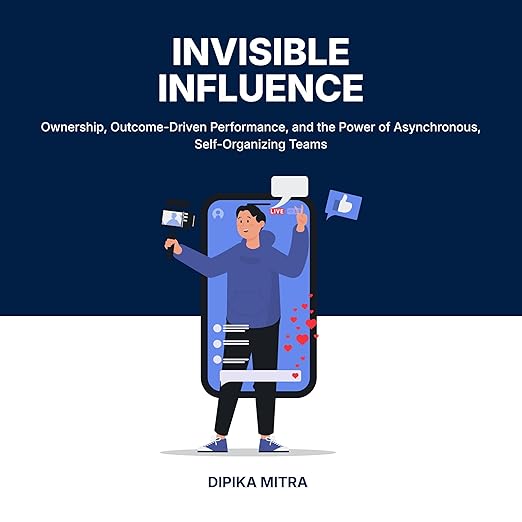
I came to Invisible Influence on a Tuesday afternoon when I was wrestling with a particularly demoralising Teams call in which three managers spent forty-five minutes discussing whether people were “visible enough.” Dipika Mitra’s opening argument, that the most effective leaders design environments where excellence emerges naturally rather than monitoring whether anyone looks busy, felt less like a business proposition and more like a direct reply to my afternoon. At just over an hour, this is a concentrated argument rather than a sprawling framework, and it is better for it.
Released in March 2026, Invisible Influence arrives in the thick of a corporate conversation about surveillance software, return-to-office mandates, and the metrics that confuse activity with output. Mitra positions herself firmly against the dashboard culture, and she does so with the kind of practical clarity that distinguishes a genuine practitioner from a thought-leadership tourist. The self-published format signals an independent voice, and that independence comes through in the directness of the argument.
About the Audiobook
The central argument of Invisible Influence is deceptively simple: leadership that relies on constant oversight quietly destroys the very things it seeks to produce. Motivation, creativity, and genuine accountability all require a degree of autonomy that micromanagement makes structurally impossible. What workers learn under surveillance, Mitra argues, is not how to perform, it is how to perform performing. The resulting culture of busyness masquerades as productivity while hollowing out the organisation from within. This is not a new argument, but Mitra makes it with a contemporary specificity, activity trackers, digital dashboards, always-on communication platforms, that grounds the philosophy in current organisational reality rather than abstract management theory.
Mitra’s framework pivots around outcome-driven performance: redefining success not by hours logged or activity tracked, but by value delivered and impact sustained. She offers practical guidance on building shared metrics and designing feedback loops that allow individuals to self-correct without waiting for managerial intervention. The word “ownership” recurs throughout, and Mitra is careful to distinguish genuine ownership, where people have the autonomy to make meaningful decisions, from the hollow deployment of the word in cultures that actually tolerate none.
A substantial section is devoted to asynchronous communication, which Mitra presents not as a remote-work accommodation but as a structural condition for deep work. Reducing real-time interruptions, protecting focused time, and building documentation-first workflows are not, in her telling, pandemic-era workarounds, they are the conditions under which better thinking reliably happens. The treatment here is not exhaustive (the runtime barely permits that), but it is pointed and actionable. Self-published by Mitra and running to just 73 minutes, this is a manifesto rather than a manual, useful for priming a team discussion or challenging your own management assumptions, less suited to those seeking granular implementation guides with case studies and supporting data.
What gives the book its particular usefulness is the consistency of its internal logic. The argument about monitoring eroding accountability is not presented in isolation; it is connected to a broader vision of what leadership actually is when stripped of its surveillance scaffolding. Culture, systems, intentional design, these are Mitra’s instruments, and she is clear about why each one matters and how they interact. For a 73-minute listen, that coherence is impressive.
The Narration
Gordon Webster narrates, and he brings a measured, unhurried quality to Mitra’s arguments that suits the material well. Webster has a clear, professional delivery that keeps the listener moving through what could otherwise feel like a series of talking points. He does not inject theatrical energy where the text does not call for it, which is exactly the right call for a business argument that wants to be taken seriously rather than performed. The pacing is slightly measured in places, at 73 minutes, there is not much room for the listener’s attention to drift, but a marginally brisker pace would have sharpened the sense that this is a tightly coiled argument. Overall, a capable and appropriate match for the material.
What Readers Say
This title was newly released in March 2026 and carries no listener reviews at the time of writing. That is not unusual for a self-published business audiobook without a pre-existing audience or publicist. What I can say is that the core proposition, that trust-driven leadership outperforms surveillance, is well-evidenced in the broader management literature, from research on psychological safety through to decades of evidence around intrinsic motivation and self-determination theory. Mitra’s contribution is to make that case accessibly and practically for an audience that may need a compelling argument to take back to a meeting rather than a 400-page literature review. The ideas here are not fringe; they are the direction serious organisational research has been pointing for some time.
Who Should Listen?
This is worth your time if you manage a team and suspect your organisation confuses oversight with accountability, or if you are making the case internally for asynchronous working practices and want a crisp philosophical and practical framework to support it. It is also useful for anyone recently promoted into a management role who wants to think clearly about the kind of leader they intend to be before habit and institutional pressure set the default. It is less suited to senior executives looking for structural change management frameworks, or to anyone who needs empirical depth and referenced research rather than argued principles. At 73 minutes, the cost of trying it is genuinely low, and the ideas are worth an hour of your attention.