Clara’s Verdict
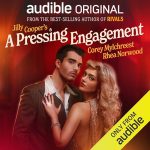
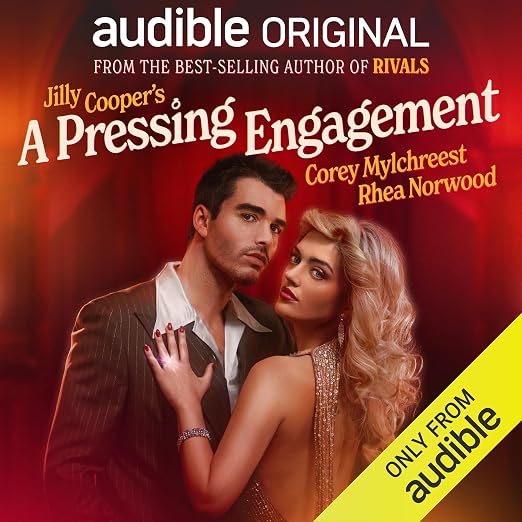
Two hours and forty three minutes. I want to lead with the runtime, because it is the single most important fact about this release and the one most likely to catch people out. A Pressing Engagement is not a Jilly Cooper novel. It is an Audible Original multi-cast drama, adapted by Dare Aiyegbayo from one of Cooper’s short stories, and it plays a great deal closer to a Radio 4 afternoon play than to an audiobook.
Once you have adjusted your expectations, it is a delight. The premise is pure Cooper. Hester is stuck in the same secretarial job she has held for years, her older boyfriend Julian will not commit, and when a job with an exciting film producer appears she cannot bear to wound the boss she would be leaving. So she tells him she is getting married, names her childhood friend Nico on the spot, and then has to keep the fiction running in front of colleagues, friends and eventually family. You know where this ends. You are meant to. The pleasure is entirely in the execution.
It is a current fixture in the Audible UK charts, and the small number of listeners who have rated it so far have rated it warmly. I would not lean on that score, because the pool is tiny, but the two written responses are unusually specific about what works.
About the Audiobook
The production credentials are the story here. This was made in collaboration with the Estate of Jilly Cooper, with Felicity Blunt and Happy Prince, and the listing is explicit that this is the team behind the television version of Rivals. That lineage shows in the casting, which is considerably starrier than a two and a half hour drama usually attracts.
Rhea Norwood, from Heartstopper, and Corey Mylchreest, from Bridgerton, head the cast, though the listing stops short of saying which of them plays Hester and which plays Nico. Around them the description names Hannah Waddingham and Richard Ayoade, and then, in a slightly comic piece of catalogue housekeeping, the cast list on the entry itself runs out mid name. I mention that only because you should not assume the four names above are the whole company. They are not, and the production has more in it than the visible credits suggest.
The period setting does more than decorate. London in 1978 supplies the plot with its entire logic: a woman years into the same post, whose escape route requires the one excuse a man of that era will accept without argument. Cooper understood exactly how much a fake engagement cost a woman in that decade and exactly how little it cost anybody else, and the adaptation keeps that edge underneath the comedy. The question the story finally asks, whether Hester wants the engagement to stay fake, only carries weight because the trap she is escaping is real.
The Narration
This section needs a small adjustment, because there is no narrator in the ordinary sense. Rhea Norwood is the credited lead, but what you are listening to is a company performing a script, with the scene transitions and sound design that implies rather than a single reader carrying description.
The part of Hester asks for one very particular thing: a woman improvising a lie faster than she can think about it, and then discovering she rather likes living inside it. Played too broadly that becomes farce and the romance stops mattering. Played too anxiously it becomes uncomfortable to sit with. This production keeps it light, and the shift from performance to genuine feeling arrives gradually enough that it never announces itself. One listener singled out the casting directly: “Nico, Hester and the other characters were perfectly cast.”
The trade off with dramatisation is that you lose Cooper’s narrative voice. Her prose is a large part of why people love her, and here it has largely dissolved into dialogue. If what you want is Cooper’s own sentences in your ear, this format cannot give you that. If what you want is her world made audible with actors inside it, the production delivers handsomely, and the compression that a short story permits means nothing sags.
What Readers Say
The number of ratings is very small so far, so I would treat the average as an early indication rather than a settled judgment. What the written responses lack in quantity they make up for in usefulness, because one comes from a reader who knows the source material and the other from somebody who simply gave it an afternoon.
“Just spent the afternoon listening to this enchanting Jilly Cooper adaptation.”
That is the reviewer posting as slush puppy, who goes on to praise how quickly the characters come alive and to wish aloud that more Jilly Cooper audiobooks existed. The other review is headed “First class recording” and confirms the point purists will want confirmed: allowing for some small departures, the production sticks closely to the original short story. That reviewer also notes, cheerfully, that it served as a stopgap while waiting for the next run of Rivals on television.
I will add one caveat about that second review. As posted it is riddled with run-together words and one phrase that is simply unreadable. The sense of it comes through, and I have quoted only the parts that survive intact, but I would not want to build an argument on prose in that state.
Who Should Listen?
Think of this as an afternoon rather than a commitment. It fits a long bath, a train to Manchester, or an evening of ironing, and it is designed to leave you cheerful. Existing Cooper readers will find the tone faithful. Newcomers who arrived through the television Rivals will find it an easy, low-risk way to test whether the books are for them.
The people I would warn off are those expecting a novel. Under three hours of dramatised short story is a fundamentally different product from a full-length Cooper novel, and anyone who buys it hoping for the latter will feel short-changed through no fault of the production. Go in wanting a play and you will get a very good one.
Listen to Jilly Cooper’s A Pressing Engagement free with an Audible trial