Clara’s Verdict
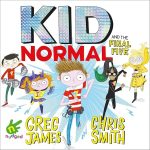
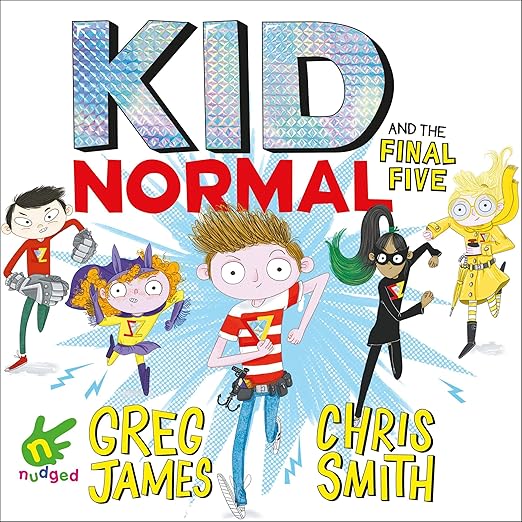
My niece is seven years old and has been working through the Kid Normal series for several months. When she finished Kid Normal and the Final Five, her verdict was delivered with the particular conviction of a child who has found exactly the right words: Murph Cooper is ‘more realistic than most superheroes because he can’t actually do anything.’ She had identified the engine. Greg James and Chris Smith built this series around a genuinely radical proposition for the superhero genre – that a person with no special powers, no genetic inheritance, no accident of origin or chemical exposure, can legitimately stand at the centre of an extraordinary story – and they do not wink at the reader about it. They argue their thesis straight-faced, with conviction, and the cumulative effect across four books is a series of real emotional depth and lasting resonance.
Rated 4.8 out of 5 from 743 Audible listeners. That rating is not inflated by an enthusiastic fringe; it reflects a broad and consistent audience response across a book that has been available for nearly five years. The series has found its readers and kept them.
About the Audiobook
Published by W. F. Howes Ltd in August 2020, the audiobook runs to 6 hours and 35 minutes – a length appropriate for the series’ middle-grade audience and generous enough to give the conclusion proper space. This is the fourth and final book in the Kid Normal series, and it functions as a genuine ending: the stakes are existential, the threat to the entire world of superheroes is real and carefully constructed across the preceding three books, and the resolution rewards the emotional investment of having followed Murph and his friends from the beginning. Villain Nicholas Knox’s campaign to frame superheroes as dangerous and have them imprisoned carries an undertone about how public opinion and institutional power can be turned against those they should protect – an allegory that operates at different levels depending on how old the listener is. James and Smith do not press the point; they trust the story to carry the argument, which is the right instinct for children’s fiction that wants to be remembered rather than merely consumed.
The series’ quiet commitment to representation – four strong female characters across the central group, a protagonist from a single-parent household – has been noted repeatedly by reviewers and parents as genuinely meaningful rather than token. These are characters with distinct personalities, individual arcs, and consistent development across the full run of the series.
The Narration
Chris Smith narrates his own series, and this is the right choice across the full run. His voice is warm, energetic, and calibrated precisely for the middle-grade audience without ever talking down to it – a balance that sounds straightforward and is, in practice, genuinely difficult to achieve consistently across multiple volumes. Smith has a comedian’s sense of timing that serves the humour throughout the series without undermining the moments of genuine emotional weight. The differentiation between the four strong female leads alongside Murph is handled with enough consistency that younger listeners following closely can track each character reliably across six and a half hours. The pacing is confident and brisk without rushing the moments of rest that the narrative needs.
What Readers Say
Reviewer Lela, a single parent, wrote with particular feeling about the series’ diversity – four strong girl characters alongside a protagonist from a household like her own – noting that her seven-year-old had listened to the complete series twice already and was about to start again. The depth of that re-engagement says more about the series’ quality than any critical assessment can. Reviewer HP1983 praised the moral architecture directly: ‘the underlying message that every act of bravery and kindness is important’ delivered through story rather than instruction, which is the only honest way to give children a genuine moral framework. Reviewer AvidReader2007’s response was brief and completely sufficient: ‘I loved it from start to end and I hated it when the book finished.’ Reviewer Naz reported that her son had been waiting specifically for this conclusion and was happy to add it to his collection – which is the particular satisfaction of a series that has built the right reader loyalty.
Who Should Listen?
For children roughly between seven and twelve who want an adventure series with genuine wit, emotional stakes that feel real rather than manufactured, and a message about heroism that does not require special powers to make sense. Start at Book 1 – not because the conclusion is incomprehensible without it, but because the emotional weight of the ending depends on the journey. Adults who listen alongside younger children will find considerably more here than they expect. The series does not condescend to its audience, and the questions it asks about courage, loyalty, and what it means to be ordinary in an extraordinary world are worth asking at any age. Listen on Audible UK.