Clara’s Verdict
I have attempted to learn German three times in my adult life. Twice with evening classes that petered out after half a term, once with a university language module that taught me the grammar rules for the dative case but left me unable to order a coffee. Paul Noble’s course came to me via a recommendation from a colleague who had completed the Italian version and arrived in Milan two months later able to actually hold a conversation in the language. That detail stuck with me. The question with language audio courses is always whether the method holds up over twelve hours, or whether it collapses into a drilling exercise that the brain learns to slide off without retaining anything. Noble’s method does not collapse.
This is a serious course disguised as something relaxed, and that combination is precisely why it works when other approaches do not. Noble has been refining this method for years, and the result is a structure that serves the audio format in a way that most language courses, designed originally for classroom or printed use, simply do not.
The Method Behind the Calm
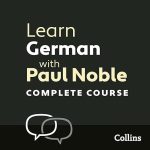
Published by Collins in 2016, the Complete Course for Beginners delivers twelve hours and fourteen minutes of guided instruction. It contains all three parts of the beginner programme in a single download, which represents genuine value by the standards of language learning audio. Noble’s method is built on a core principle: start from what English speakers already know, because German and English share considerably more vocabulary than most learners realise, and exploit that shared foundation immediately. Words ending in -tion work almost identically across both languages. Verb structures follow patterns that, once identified and internalised, unlock large swaths of vocabulary without requiring any deliberate memorisation.
The course avoids grammar tables and conjugation drills almost entirely. Instead, Noble introduces structures in context, through everyday scenarios like ordering food, asking for directions, booking hotels, and talking about yourself and your life. A native German speaker is woven throughout to model pronunciation, and Noble consistently circles back to material already covered rather than assuming it is retained from a single encounter. The accompanying downloadable booklet functions as a reference and revision tool rather than the primary learning vehicle, and it is worth using alongside the audio rather than treating as optional supplementary material.
The course is designed for absolute beginners but also functions well for lapsed learners who retain scattered fragments of earlier study. It stops short of intermediate proficiency, and Noble himself recommends continuing with his Next Steps course once this is completed. That honesty about the limits of the course is worth noting; he is not overselling a twelve-hour listen as a path to fluency, but as a path to basic conversational competence in real-world situations, which it delivers.
Noble’s Pacing as a Teaching Tool
Noble narrates his own course, and this matters enormously. The method is inseparable from his particular pacing: slow without condescension, warm without becoming casual, patient in a way that makes repetition feel like reassurance rather than tedium. There is a reason this approach has reached almost a million learners. The interplay between Noble’s explanatory voice and the native German speaker’s pronunciation demonstrations is calibrated carefully. You never feel rushed, and you never feel talked down to. For a twelve-hour listen, the ability to sustain that tonal consistency across the full course is genuinely difficult to achieve, and Noble has clearly refined it through many years of practice. The format lends itself naturally to commute listening, since the chapter structure in twenty-minute segments allows for natural pauses and re-engagement without losing the thread.
What Readers Say
The course carries a 4.6 rating from 199 listeners, which is a meaningful and well-distributed sample for a language course requiring this level of commitment. Carosand described it as the only course that has ever worked, noting the twenty-minute chapter structure and the way material actually sinks into the brain rather than evaporating by the following morning. A reviewer using the username whatsup, who had tried numerous approaches over the years, said that twelve hours of Noble delivered more measurable progress than weeks of expensive classroom instruction, with the repeated vocabulary genuinely embedding itself in long-term memory rather than surviving only short-term. Baz P gave four stars, praising the absence of sudden difficulty jumps and the real-world scenario focus, while noting that some learners may find the pace leisurely by the later stages. Pip highlighted the way similarities to English were explicitly drawn out from the start, describing the approach as clever and the grammar as kept manageable throughout.
Who Should Listen?
This course is best suited to absolute beginners or lapsed learners who want German for travel, social situations, or a general sense of the language rather than academic or professional purposes. It works particularly well during commutes, walks, or any regular activity where your hands are occupied but your ears are free. It is not suitable for someone who needs technical or business German at any depth, or who is already at intermediate level. If you want to be able to hold a basic conversation in Germany within a few months of consistent listening, this will get you there. If you already have intermediate German, begin with the Next Steps course instead and save yourself the repetition.