Clara’s Verdict
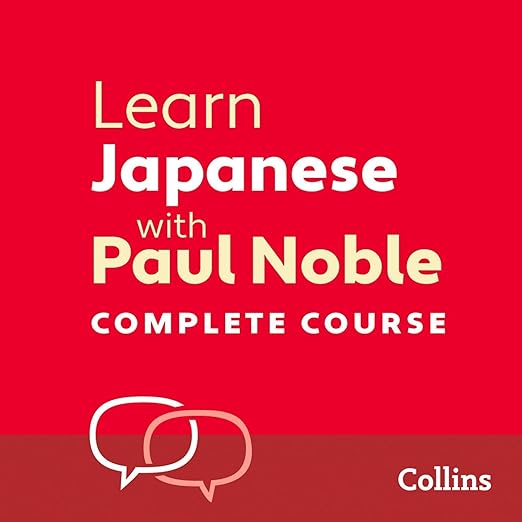
I have a weakness for Paul Noble’s language courses, and I will admit it openly. There is something about the particular warmth of his approach, the insistence that failure is a system problem rather than a personal one, the patient repetition, the refusal to treat grammar as a precondition of speaking rather than a consequence of it, that I find genuinely encouraging, even as someone who knows the limitations of audio-only language learning. The Japanese course tests that method more severely than the European courses do, and the results are instructive about both the method’s strengths and its honest limits.
About the Audiobook
Noble’s method rests on a specific and important insight: that the reason most people fail to learn languages is not lack of aptitude but poor teaching design. The standard approach, here is vocabulary, here is grammar, now combine them correctly, asks students to operate at a level of abstraction that produces anxiety rather than fluency. Noble’s courses eliminate long vocabulary lists, written exercises, and grammatical abstraction in favour of natural pattern-building through use. You are constructing and adapting sentences almost from the first session. The feeling of making something rather than memorising something is motivationally significant.
For European languages, where English shares significant structural DNA and a substantial vocabulary overlap through Latin and French roots, this works with remarkable efficiency. Noble’s Spanish and French courses are among the most effective audio-only language introductions available. For Japanese, the challenge is considerably greater, and Noble confronts it directly rather than papering over it.
Japanese has a fundamentally different sentence structure: subject-object-verb rather than English’s subject-verb-object. Noble teaches word order as the foundational skill before anything else. One UK reviewer captures this precisely: “I went to the bar for a drink with Paul” becomes “With Paul to the bar for a drink went I” in Japanese structure. Noble makes this difference feel manageable rather than insurmountable, which is genuinely impressive pedagogy. A native Japanese expert assists with pronunciation throughout, which is essential, Japanese pronunciation has features, particularly the mora timing system, that English speakers consistently get wrong without correction from a native speaker.
The complete course runs to 12 hours and 8 minutes and covers Parts 1, 2, and 3, practical everyday scenarios from asking directions to managing tenses to talking about yourself and your life. A downloadable booklet is included as a reference and revision tool, and accessing this is strongly recommended rather than treating the audio as a fully self-contained course. One honest caveat: a reviewer with prior Japanese study experience notes that this course contains fewer scenarios and less vocabulary breadth than Noble’s European language offerings. This is a reflection of the genuine difficulty of building equivalent coverage in a structurally and lexically distant language, not a lack of effort. Beginners will find it more than sufficient; those with existing Japanese knowledge will outgrow it relatively quickly.
The Narration
Noble narrates his own course, which is the only sensible arrangement for a method this closely associated with a specific teaching personality and philosophy. His voice is patient, friendly, and consistently encouraging, described by one UK listener as “like a good friend is teaching you,” which captures something real about the tone he achieves. Crucially, Noble paces the exercises correctly: listeners are given adequate time to construct their own responses before he provides the answer, which is functionally different from most audio language content and considerably more effective for actual retention. This pause-and-respond structure is a design choice that turns passive listening into active practice, and it is where much of the course’s value resides.
What Readers Say
The 12 Audible UK reviews average 4.3 stars, reflecting both real enthusiasm and one or two honest reservations. Multiple UK listeners report genuine progress in basic Japanese sentence construction after consistent use, not fluency, but the ability to make and adapt sentences, which is precisely what Noble promises and a meaningful achievement for audio-only study. Common praise focuses on the low-pressure structure, the surprising speed at which sentence construction becomes intuitive, and the confidence the course builds in beginners. The main reservation, insufficient breadth compared to Noble’s European language courses, comes from someone with existing Japanese knowledge and is both accurate and not really the target audience’s concern. For absolute beginners, this is a very solid starting point.
Who Should Listen?
Complete beginners to Japanese who want a low-stress, audio-first entry into the language that prioritises speaking practice over grammatical theory will find this an effective starting point. It works particularly well for people who have tried app-based learning like Duolingo and found it insufficient, Noble offers something those tools cannot, specifically the systematic building of sentence construction habits through pattern-building rather than discrete vocabulary items. Those with existing Japanese knowledge, or who need wide vocabulary coverage and scenario breadth from the outset, should look elsewhere or use this as a supplementary foundation. Access the downloadable booklet from collinsdictionary.com, it is a companion piece, not a nicety.