Clara’s Verdict
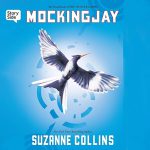
Mockingjay is the volume in which the series stops being a contest and becomes a war, and the description makes no attempt to soften that. It opens with Katniss speaking for herself: “My name is Katniss Everdeen. Why am I not dead? I should be dead.” Everything after that is about what she is asked to carry once the arena is behind her.
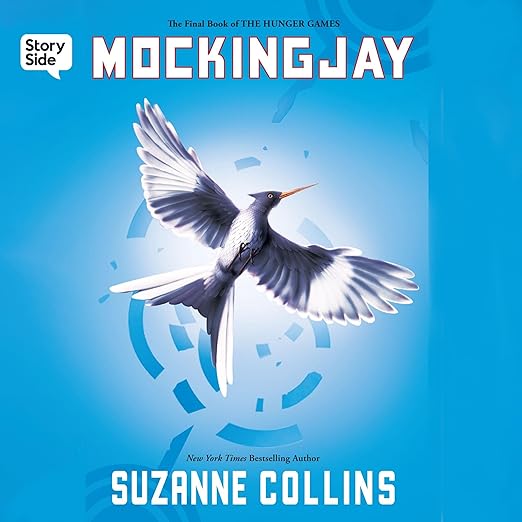
Tatiana Maslany reads this Scholastic Audio Books edition, dated 19 June 2019 and running eleven hours and nineteen minutes. It is the third book in the Hunger Games sequence and carries 87,517 ratings at an average of 4.6. One thing about those dates. The three reviews shown here were posted in 2011 and 2012, seven years or more before this recording was made, so nothing in the visible commentary is a verdict on Maslany. Treat the average as a verdict on Suzanne Collins until you have heard the thing for yourself.
About the Audiobook
This is a book about being used, and the copy lays the situation out in a run of flat declaratives: “Gale has escaped. Katniss’ family is safe. Peeta has been captured by the Capitol. District 13 really does exist.” The turn of the screw comes immediately afterwards. Her rescue from the “cruel and haunting Quarter Quell” was not luck, and “it is by design that she has long been part of the revolution without knowing it”.
The plans, the copy notes drily, were laid by everyone except Katniss herself. The rebellion then “hinges on Katniss’ willingness to be a pawn, to accept responsibility for countless lives”, and on her becoming the rebels’ Mockingjay whatever the personal cost to her. That last clause is the honest one. This is the volume in which the cost gets itemised, and anyone who came for the arena spectacle of the first book will find that spectacle replaced by strategy, obligation and grief.
The reviewers themselves settle the reading order. One of them names the trilogy’s first two volumes, The Hunger Games followed by Catching Fire, and this is the third. Nothing about it works if you arrive cold: the opening assumes you already know what the Quarter Quell was and why Peeta’s capture is unbearable, and the copy is written for readers who do.
The Narration
Tatiana Maslany has one of the harder assignments in young adult audio, because Katniss is a character built on a split. Katniss performs for a rebellion that needs a symbol, and thinks in an entirely different register underneath. A narrator has to keep those two levels distinguishable without signposting the difference, which means resisting the obvious solution of a bright public voice and a dark private one.
The particular danger in this third book is numbness. One reviewer here notes that Katniss is concussed and struggling to focus, and a performer who takes that literally will produce eleven hours of monotone. The trauma has to be audible as suppression and not as absence, which is a fine distinction to sustain across a long recording and the main thing I would listen for in the opening minutes.
One more thing about the date. This recording is dated 19 June 2019, years after the reviews on this listing were written, which means it was commissioned for a book whose readership was already enormous rather than made to launch one. That is a considered decision and not a routine one, and it is the best structural argument for taking the casting seriously.
Not one of the three reviews mentions the narration. One of them, Mark Barlow, was reading digital editions.
What Readers Say
The five-star reviews are not uncritical, which is exactly what makes them worth reading. Hazzzzz gives it five stars under a heading that hedges immediately, “Moving, action-packed novel with slight lack of characterisation perhaps”, and then explains: the first two books were exceptionally written with an exciting execution, whereas this one “starts off to be quite slow, boring and generally uninteresting”. The review is cut off partway through, so I cannot tell you where it finally lands, but the shape of the objection is clear enough, and the five stars suggest a recovery.
The most vivid summary of the three comes from lankylil, also at five stars: “This book starts one month after the last one finishes. Katniss is displaced. Her home is obliterated.” The same review describes the survivors of her district as “refugees somewhere that they believed no longer existed”, living in a place that is “regimented, strict and confining” and set against everything in her nature. That is a good account of why this book feels so different from the two before it.
The four-star review takes the long view. Mark Barlow read all three straight through without a break and “enjoyed them immensely”, but ranks the opening volume highest, calling it “the first in the series, and the best of the lot”. That is a common enough verdict on trilogies of this shape, and it is fair warning to anybody expecting the third book to be the biggest.
Two of the three temper their enthusiasm with a real objection: a slow opening in one case, a preference for the first book in the other. Both are objections to the shape of this third volume rather than to the way it is told aloud. If you have read the first two and want to know whether the third earns its place, the answer from this set is yes, with reservations.
Who Should Listen?
This is the third book and it depends entirely on the two before it for its weight. If you have done those, this recording is a serious proposition, because a novel tied this closely to one character’s interior state lives or dies on its narrator, and Maslany is a serious piece of casting for a heroine who spends the whole book being packaged by other people.
It suits listeners who want the darkest and least comfortable book of the three, people coming back to the series after a long gap, and anyone who found the arena premise of the first book thrilling but has since wanted something with more politics in it. Be careful buying it for a younger listener. The copy itself promises responsibility for countless lives and a personal cost, and it is not overselling either. Thirteen is my floor, and I would not put it on in the car with a mixed-age back seat.