Clara’s Verdict
I should confess that I have a complicated relationship with language-learning audiobooks. As someone who spent a year in Paris in my twenties nominally improving my French and actually spending most of my time in bookshops and cafes constructing sentences about things I wanted to eat, I arrived at Paul Noble’s Next Steps in French with a suspicion that no audio course could replicate the productive messiness of genuine immersion. I was, in the way that useful surprises tend to be, partly wrong.
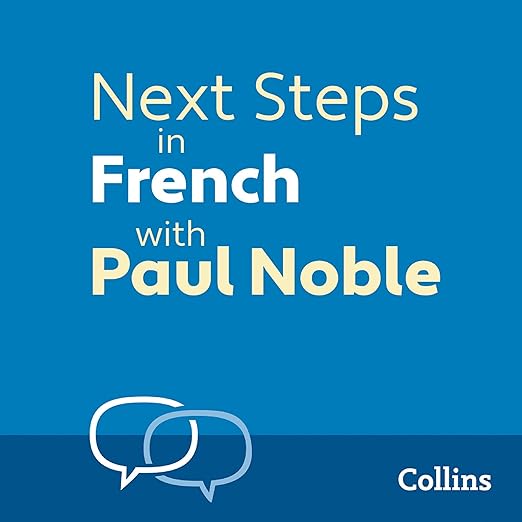
Noble’s method, whether you are coming to it for the first time at the beginner level or returning at this intermediate stage, is built on a principle that sounds obvious but is surprisingly rare in language pedagogy: that speaking a language from the very first lesson, making mistakes in a low-stakes environment, and revisiting material with consistent repetition, is more effective than accumulating grammar rules before attempting production. The seven-hour fifty-seven-minute intermediate course is designed for those who have either completed Noble’s beginner course or have some existing French – an A-level studied two decades ago, perhaps, or a few years of school French that has gone rusty but not entirely silent.
About the Audiobook
Published by Collins in January 2019, Next Steps in French with Paul Noble for Intermediate Learners is the follow-up to Noble’s complete beginner’s course, and it continues the method that has reportedly been used by almost a million people. The course follows a listen-and-respond format: Noble introduces structures, explains how they work, and invites the listener to produce the French themselves before he provides the answer. This active recall component is the mechanism through which the method earns its claims – you are not passively absorbing French but being constantly required to retrieve and produce it, which is how long-term retention actually works.
The intermediate level assumes that listeners can handle a French sentence but are not yet confident constructing them independently across a variety of scenarios. The course aims to close that gap through confident, varied practice rather than formal grammar instruction – Noble explains grammatical structures when they arise, but in the context of use rather than in the abstract. A downloadable booklet accompanies the course at collinsdictionary.com/resources, which provides a written reference to complement the audio work.
The course runs just under eight hours and covers enough conversational territory to make a genuine difference to a listener’s confidence in everyday French. It is not, and does not claim to be, a substitute for extended immersion, and those hoping to reach professional or academic proficiency through audio alone will need substantially more support. But as a revival and extension of dormant French, it is one of the most effective audio tools available.
The Narration
Noble himself delivers the course, which is precisely the point. The method depends on his specific manner of explanation – patient, unhurried, genuinely encouraging without being condescending – and the familiarity of his voice for those coming from the beginner’s course creates a sense of continuity and trust that matters in language learning. He is not performing; he is teaching, and the distinction is audible. The pacing is generous enough that listeners can respond before the answer arrives without feeling rushed.
What Readers Say
With a rating of 4.3 from 51 Audible UK reviews, the course has found a steady, appreciative audience. UK reviewer B. Murphy described it as "perfect" for someone with rusty A-level French, noting specifically that the constant repetition and revision prevents the sense of having forgotten everything between sessions. HP1983 echoed this, pointing to the course’s ability to accommodate dipping in and out as one of its practical strengths. "Rhan," who reviewed on the first day of the course’s release in January 2019, was already on chapter seven by the time they posted – which tells you something about the engagement the format generates. The one negative review in the sample was a technical complaint about DRM restrictions preventing transfer to a Walkman, which is a format issue rather than a content one and does not reflect the course’s quality.
Who Should Listen?
This course is the right choice for listeners who have some French already – whether from school, a previous attempt at the beginner course, or time spent in France – and want to rebuild and extend it in a format that fits around a busy life. It is particularly strong for those who want to speak French rather than simply read or understand it, because the active production component is central to the method. Those who are complete beginners should start with Noble’s beginners’ course; those hoping to reach advanced or professional competency will need this as a stepping stone rather than a destination. For everyone in between, it is an exceptionally well-designed audio learning experience.