Clara’s Verdict
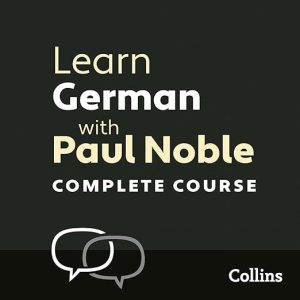
I want to be honest about my own relationship with language learning audio: I have started and abandoned more courses than I care to count. Duolingo streaks broken after a fortnight, Michel Thomas CDs left in the car and eventually donated, Pimsleur programmes that seemed to require a kind of mechanical repetition I could not sustain beyond the first few sessions. Paul Noble’s method landed differently. I first encountered the beginners’ French course during a long drive and found myself, unexpectedly, constructing sentences rather than retrieving memorised phrases from storage. Next Steps in German is the intermediate continuation of that same methodology applied to German, and the core approach is unchanged: no grammar tests, no conjugation tables, no chance of failure.
The reason the method works is that it trusts the listener’s existing cognitive ability rather than asking them to perform a different kind of cognition. Noble builds sentences from components the learner already has, adding complexity gradually and in a sequence that feels logical rather than arbitrary. The result is that German starts to feel like something you are generating rather than something you are remembering, which is a genuinely different experience from most language instruction.
About the Audiobook
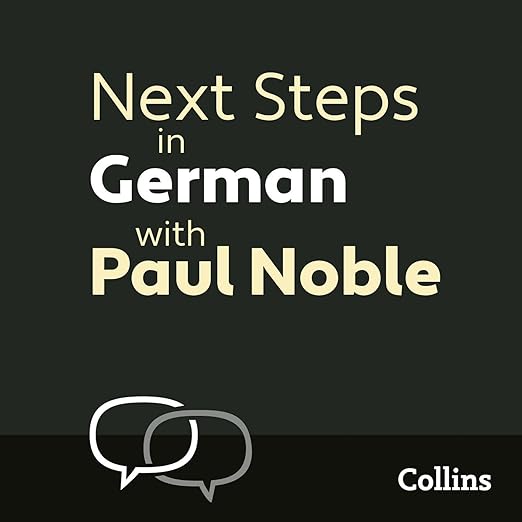
Published by Collins in March 2019, Next Steps in German runs to 8 hours and 26 minutes and holds a 4.4-star rating from 15 Audible UK reviews – a meaningful count for a language learning course. It is designed as a follow-on to Learn German with Paul Noble for Beginners and assumes you have completed, or are broadly familiar with, that course. A downloadable companion booklet is available from the Collins website, and reviewers who mention using it alongside the audio find it helpful as a reference and reinforcement tool.
Noble narrates himself throughout, which is non-negotiable for this series – his method is delivered conversationally, and the voice is part of the instruction rather than incidental to it. The course focuses on spoken fluency across social and travel scenarios: how to express yourself in simple conversations, ask questions, and navigate everyday German-speaking situations. It is not a preparation for written German or formal register, and it does not pretend to be.
The Narration
Paul Noble is the method. His voice is patient, slightly conspiratorial, and consistently reassuring – the pedagogical equivalent of a good teacher who has told you twenty times that you are doing better than you think and actually means it. The pacing is deliberate, with pauses built in for the listener to attempt sentences before Noble provides them. This is interactive audio in a real sense, and it requires a different kind of listening than narrative audiobooks – you should not be walking the dog or chopping vegetables when you use this; you need to be actively speaking along. The German is delivered clearly and at a pace that makes it usable rather than merely audible.
What Readers Say
Fifteen UK reviews averaging 4.4 stars is a solid result for a language learning course, where reviewer expectations tend to be specific and practical rather than impressionistic, and where a course that fails to deliver on its method is usually called out quickly. Steve compared the Noble method favourably to a live teacher, the Memrise app, and several other courses he had tried, calling it by far the best he had encountered and expressing particular hope for a further advanced German instalment. An anonymous reviewer described the course as genuinely helping German flow rather than stalling in isolated vocabulary retrieval – exactly the transition Noble designs for, and the one that distinguishes his approach from more conventional language instruction. JG, who awarded four stars, offered useful context on scope: good for travel and social situations but not designed for formal or advanced proficiency. That is an accurate description rather than a criticism, and it is worth taking seriously as a guide to the course’s appropriate use. Multiple reviewers specifically mentioned wanting Noble to extend the German series beyond intermediate level.
Who Should Listen?
You should have completed the Paul Noble beginners’ German course before starting this, or have an equivalent foundation in German that approximates its coverage. The method is explicitly designed to build on prior knowledge, and starting here without that base will leave gaps that Noble’s construction depends on filling. If you have basic German but find it does not flow when you try to say anything more complex than a simple present-tense sentence, this is precisely the right intervention.
Download the companion booklet from Collins before you begin – it is a genuine supplement rather than an afterthought, and reviewers who use it report better retention. This is not recommended as your only resource if you need German for professional or academic purposes; pair it with a grammar reference for anything requiring formal register or written proficiency. But as a spoken fluency course for social and travel German, it is among the best audio options available.