Clara’s Verdict
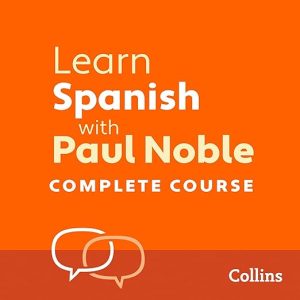
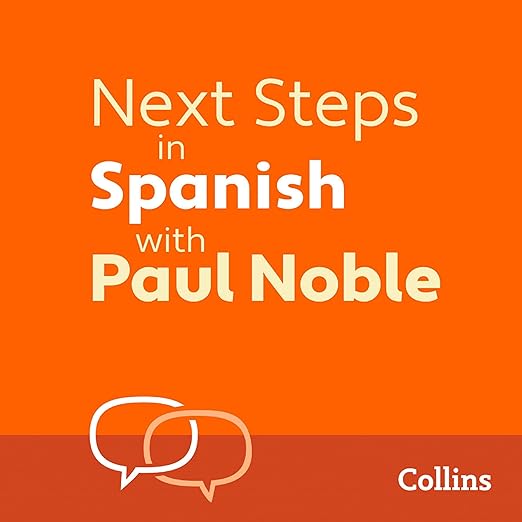
I have a particular soft spot for Paul Noble’s language courses because they are stubbornly, almost aggressively anti-academic in an era when language learning apps reach instinctively for gamification and when formal courses still reach for conjugation tables. Noble’s method has no exercises to mark, no grammar drills, no formal tests. Just his patient, slightly conspiratorial voice guiding you toward functional speech in a way that feels more like being taught to ride a bike by someone calm than being made to memorise the Highway Code. Next Steps in Spanish is the intermediate follow-up to his beginner course, and it delivers exactly what it promises: more of what already works, applied to more complex material.
Paul Noble has built an unusual position in language learning. His courses, published through Collins and used by close to a million people, occupy the territory between casual app-based learning and serious academic study, offering the accessibility of the former with more genuine communicative depth than the latter often provides. This intermediate course, released in January 2019, builds directly on the foundation of the beginner series.
The Method and Its Logic
The Paul Noble method works by building language from what learners already know, combining and recombining elements iteratively rather than presenting grammar as a system of abstract rules to be memorised and then applied. The result is that learners often acquire quite sophisticated grammatical structures without ever feeling they have been formally taught them. The intermediate course applies this to the past tense and a wider range of conversational scenarios, covering both European and Latin American Spanish throughout.
At seven hours and 41 minutes, the course is shorter than many language programmes, but Noble’s approach strongly encourages active repetition: returning to chapters multiple times, listening at reduced speed or pausing to construct responses, treating the audio as an interactive session rather than something to absorb passively. A downloadable PDF booklet is available through Collins’s resources page and is worth obtaining before you begin, as it reinforces vocabulary from each session and provides written reference for key phrases. The booklet is not essential to the listening experience, but it extends the value of the course considerably.
The course positions itself as a natural continuation for listeners who have completed the beginner course. Noble himself says clearly in the recording that this is not for absolute beginners, and that is accurate. If you are new to Spanish, the beginner course is the correct starting point.
Paul Noble at the Microphone
Noble narrates all of his own courses, and this is not incidental to the method but constitutive of it. The warm, measured, deliberately reassuring quality of his voice is part of the pedagogical design: he acknowledges moments of learner confusion before they happen and talks listeners through them. His pacing is slow enough that you can engage actively and construct responses in real time if you choose to. A different narrator reading the same transcript would not be delivering the Paul Noble method; they would be reading a description of it without the felt quality that makes it work.
Several reviewers note that the repetitive structure can feel slow at a continuous sitting, and they are right. The course is not designed for marathon listening sessions. Adjusting playback speed slightly upward, or committing to two or three chapters per session with genuine active engagement, transforms the experience. A.Mac, one of the UK reviewers, makes this point clearly and usefully.
What Readers Say
Forty-five Audible UK reviews averaging 4.7 stars is unusually high for a language course, a genre where learner frustration tends to suppress ratings. A.Mac, reviewing in December 2024, praised it strongly as a follow-up and specifically highlighted the past tense coverage: “without any grief to the listener,” a genuine achievement. WGCReviewer described returning to individual chapters multiple times before moving on, which is exactly the approach Noble’s method intends. Duncan was straightforward: “for me this is the easiest and best way to learn Spanish.” Earthling called it a “great learning aid.” The only note of caution in the reviews is the familiar one about repetition feeling slow at normal pace, which is a feature of the method rather than a flaw in the course.
Who Should Listen?
This course is for anyone who has completed the Paul Noble beginner Spanish course, or who has equivalent beginner-level Spanish and wants to build communicative confidence through listening rather than traditional study. It works particularly well for people who have found grammar-focused approaches demotivating or who want to consolidate basic Spanish into genuinely usable fluency rather than theoretical knowledge. It covers European and Latin American Spanish equally, which gives it broad practical application.
This is not an academic course and will not prepare you for formal GCSE or A-Level examination. But for confident, relaxed, functional communication in Spanish, it is among the most accessible and effective audio-only options available in English.