Clara’s Verdict
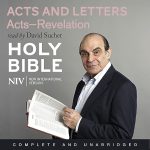
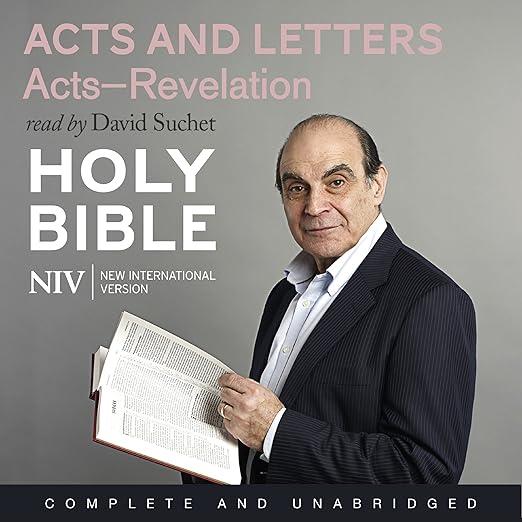
When David Suchet agreed to read the NIV Bible, the project felt like an inspired piece of casting – and the result entirely justifies the faith placed in him. Suchet, of course, is best known for embodying Poirot’s neat Belgian certainties, but here he brings something altogether more expansive: a deep, measured authority that never tips into performance. Listening to Acts in his voice, I found myself genuinely moved in a way that reading the same passage silently never quite managed. That is the peculiar alchemy of great audiobook narration, and Suchet demonstrates it here at full stretch.
This recording accompanied Suchet’s BBC1 documentary series In the Footsteps of St Paul, and whether or not you have seen that series, the audio stands entirely on its own. For anyone who finds the Bible remote or impenetrable, hearing it spoken aloud – by a voice this considered – is genuinely revelatory.
About the Audiobook
This recording covers the Book of Acts and the letters of St Paul, drawn from the 2011 translation of the New International Version. Acts functions as the sequel to the Gospel of Luke, tracing the early church’s explosive growth from Jerusalem outward across the Mediterranean world. It is history and theology, adventure and catastrophe, all compressed into a narrative that moves at an extraordinary pace – shipwrecks, imprisonments, riots, miraculous escapes.
Paul’s letters – to the Romans, to the Corinthians, to the Galatians and beyond – are something quite different: intimate, argumentative, urgent. They are the first-century equivalent of a very urgent email fired off under duress, and they read as such. The NIV translation renders them in accessible modern English without flattening the rhetorical force of the originals. Running at just over eleven hours, this is an immersive encounter with some of the most consequential writing in Western history.
The Narration
David Suchet narrates, and that is really the whole story of why this recording works. His voice carries the weight of conviction without tipping into the kind of reverential hushed-tones approach that can make scripture feel like a museum exhibit. He reads with natural emphasis – pausing where the text demands, allowing the drama of Paul’s predicaments to breathe – and never imposes an interpretation that isn’t already there on the page.
The production notes mention that the BBC documentary context informed Suchet’s preparation, and you can hear it: there is an archaeological grounding to his delivery, as though he genuinely understands the physical and cultural landscape these letters were written from. For a recording tied to a television series, it stands up remarkably well as a standalone listen. Running to eleven hours, it is precisely the right length for repeated listening over a week or two.
What Readers Say
Listeners consistently reach for the word clarity when describing this recording. Susan Hancock, reviewing from the UK, called it “a wonderful reading of scriptures – David Suchet reads it clearly and with all the emphasis in the right places.” She noted that even checking against the Authorised Version occasionally, she found the NIV rendering sound. Another reviewer, writing under the name ‘manley’, wrote that “the joy of the new Christians is palpable” in Suchet’s delivery of Luke’s descriptions – catching both the matter-of-fact historian’s voice and the genuine astonishment beneath it.
Derek Dobbs offered a particularly well-chosen image: “Using the audio whilst following the text is like having a heavy curtain opened to let in the daylight.” One listener described it as an “intense experience” that brought Paul’s urgency through in a way that church readings in isolation rarely achieve. The recording holds a rating of 4.5/5 from 45 listener ratings on Audible.
Who Should Listen?
There is also a particular pleasure in listening to the epistolary sections – Paul’s letters to the various early churches – as audio rather than text. The letters were written to be read aloud to congregations; they are oral documents at heart, composed for the voice rather than the eye. Hearing them delivered by Suchet restores something of their original register, making arguments that can seem abstract on the page feel urgent and immediate. The accompanying PDF, available alongside the audio on Audible, provides the written text for listeners who want to follow along or refer back.
This recording is an obvious recommendation for practising Christians who want to engage with the New Testament in a fresh way – but I’d argue it reaches further than that. Anyone with an interest in the roots of Western civilisation, in first-century Mediterranean history, or simply in how the most translated text in human history holds up when read aloud by a genuinely skilled performer, will find much here. Students of theology or religious history will appreciate the 2011 NIV translation’s clarity without sacrificing accuracy.
It also makes for meditative listening during long commutes or walks – the episodic structure of Acts and the self-contained nature of individual letters mean you can dip in and out without losing the thread. If you want to hear Suchet at his most quietly authoritative, listen on Audible UK.