Clara’s Verdict
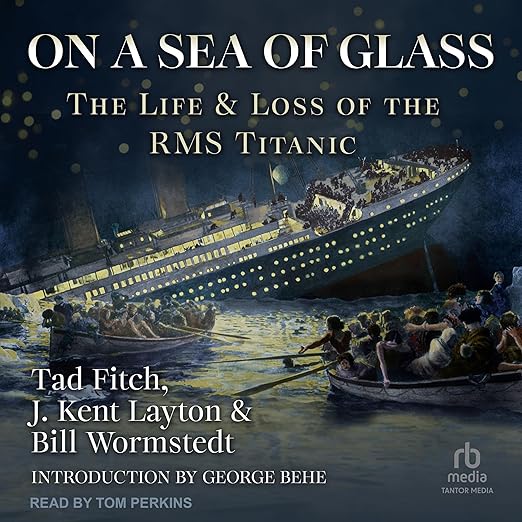
The Titanic has generated more books than almost any other single event in modern history, and a certain fatigue with the subject is understandable. But On a Sea of Glass by Tad Fitch, J. Kent Layton, and Bill Wormstedt occupies a different category from most of the genre. This is not a narrative driven by mythology or sentiment but by research – exhaustive, meticulous, and deeply humane research that brings individual passengers and crew members back into focus as people rather than statistics or symbols. Over thirty-two hours, it is one of the most thorough and compelling accounts of the disaster that audio has to offer, and one of the few genuinely definitive books on any subject I have encountered in years of reading non-fiction.
Tom Perkins narrates a book that is genuinely long – the physical edition runs to well over sixteen hundred pages – and manages to sustain attention throughout. For anyone seriously interested in the Titanic, this is essential.
About the Audiobook
The central achievement of On a Sea of Glass is its use of survivor accounts that have rarely appeared in print before. The authors spent years tracking down testimony from passengers and crew across all classes – first-class socialites, third-class emigrants, stokers, stewards, officers – and weave these individual voices into a chronological account that covers the ship’s design, construction, and the night itself in extraordinary detail.
The book opens with the White Star Line’s ambitions and the technical decisions made during Titanic’s construction – decisions that would later prove significant. It moves through the maiden voyage with the same granularity, following specific individuals as they board at Southampton, dine in the first-class saloon, or find their berths in steerage. When the iceberg is struck, the book becomes almost unbearably immediate: the choices made in those first critical minutes, the loading of the lifeboats, the extraordinary range of individual responses to an impossible situation, and the sounds that survivors described hearing as the ship went under.
The aftermath – the Carpathia’s rescue operation, the inquiries on both sides of the Atlantic, the regulatory changes in maritime law that followed – is handled with the same meticulous care. The authors’ argument throughout is that the Titanic disaster was not inevitable, and that understanding exactly what went wrong, and why, is both a historical obligation and a practical lesson about institutional complacency. Published by Tantor Audio, running 32 hours and 22 minutes.
The Narration
Tom Perkins has the composure and authority that a thirty-two-hour history demands. His voice carries the weight of the material without ever feeling sepulchral – there is a clarity to his delivery that serves the book’s documentary purpose well. The sheer volume of names, facts, and testimonies requires a narrator with exceptional consistency, and Perkins provides it. The emotional passages – the letters from those who did not survive, the testimony of those who did – are handled with restraint that makes them more affecting, not less.
What Readers Say
On a Sea of Glass holds an exceptional 4.8 out of 5 on Audible UK from 682 ratings. UK listeners have been unusually effusive. One reader, who began it at the end of 2025 expecting it to take months, found themselves “galloping through it” and predicted it would be one of their books of the year – extraordinary for a book of this length. Another described it as “without a doubt, possibly the best account of the first and last voyage of the Titanic,” praising the depth of research and the way historical detail brings the ship and her complement to life as individuals rather than names on a list. A third praised it simply as “excellent” for its “very comprehensive information, photos, maps and good analysis.” The consensus across hundreds of reviews is consistent: this is the definitive Titanic audiobook, and its length is a feature rather than a limitation.
Who Should Listen?
This is essential listening for anyone with a serious interest in the Titanic, maritime history, or the social history of the Edwardian era. It will also appeal to listeners drawn to deep-dive historical non-fiction – the kind that builds a complete picture from the ground up rather than skimming for highlights. Given its substantial length, it pairs particularly well with long commutes, exercise routines, or any sustained activity that benefits from immersive company. If you have watched the films, read the popular accounts, and feel you already know the story – this book will show you with some precision how much you do not yet know. Available on Audible UK, Kobo, Scribd, and Storytel.