Clara’s Verdict
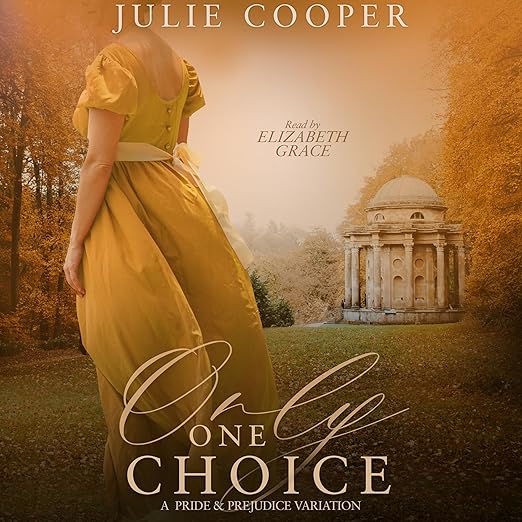
The Pride and Prejudice variation genre is enormous, relentlessly productive, and wildly variable in quality. Julie Cooper sits near the top of it. I came to Only One Choice having read a couple of Cooper’s earlier variations and found, as with those, that she takes the source material seriously enough to do something genuinely new with it rather than simply redistributing Austen’s furniture into a slightly different arrangement. The premise here is stark: a sixteen-year-old Elizabeth makes an almost unthinkable sacrifice, marrying a sixty-year-old neighbour to honour her dying father’s wish and protect her sister Jane. By the time we meet Elizabeth properly, she is twenty, widowed, impoverished, and estranged from Jane – a very different young woman from Austen’s sparkling original.
That darkness is the book’s greatest strength and its most demanding feature. Cooper is not interested in comfort retelling. She is interested in what it costs a person to be good in circumstances that punish goodness, and the Darcy who eventually enters this Elizabeth’s life must earn her trust in ways that Austen’s Darcy, for all his flaws, never had to contemplate.
About the Audiobook
The novel’s central conceit is well-executed. An Elizabeth who has been a wife, a widow, and a person of genuine hardship carries herself differently from Austen’s original, and Cooper charts this with care. Her pride has been refined by suffering rather than merely inherited; her resistance to Darcy is rooted not in misreading but in a hard-won understanding of what she stands to lose. The dream of Venice – of an independent life beyond the reach of obligation – functions as both a practical goal and a symbol of the self-determination that her youth denied her.
Darcy, meanwhile, is constrained by a promise made to his own dying father: not to pursue any woman until he is ready to commit to marriage, partly to protect the feelings of his cousin Anne, who believes herself to be his intended. Anne de Bourgh’s role here is considerably expanded and darkened compared to Austen’s figure of gentle mockery, and Cooper handles the escalation of her obsession with a real sense of threat. The novel earns its tension because the obstacles are not merely social or misunderstanding-based – they carry genuine consequence.
The romance at the centre is beautifully constructed. Reviewers consistently note the swoon-worthy quality of this Darcy, and Cooper deserves credit for creating a hero who is both constrained and actively choosing to be better than his constraints require. The series, published by Quills & Quartos, is titled The Gentleman Mr Darcy, and this instalment sits at approximately eight and three-quarter hours – a satisfying length for a variation of this complexity.
The Narration
Elizabeth Grace reads the audiobook, and the casting feels appropriate. She brings a restraint to Elizabeth that honours the character’s emotional guardedness without making her cold, and her Darcy has the quiet authority the character requires. The Regency register is handled naturally – no affectation, no over-pronunciation – and the distinction between the novel’s gentler early scenes and its more urgent later passages is well-managed throughout.
What Readers Say
The book holds a 4.4-star rating from 283 reviews – a strong showing that reflects both the quality of the writing and the loyalty of the Austen variation readership. HW, reviewing from the UK, writes that Cooper "never disappoints" and praises the multiple redemptions woven through the story. Craftyhj gives it four and a half stars, noting that both Elizabeth and Darcy are shaped by the choices of others in ways that distinguish this from more conventional variations. Marie, reviewing from Canada, calls the romance "the true highlight" and describes being pulled immediately into the story by the prologue’s quiet devastation. A Pedant’s description – "a perfect palliative in trying times" – is perhaps the most succinct endorsement the book could receive.
Who Should Listen?
Fans of Austen variations who want something with genuine emotional weight rather than gentle repackaging. Readers who enjoyed Cooper’s previous work will find everything they value here: character fidelity, a willingness to complicate Austen’s world, and a central romance that takes its time and earns its resolution. New listeners to the variation genre could reasonably start here, though a familiarity with Pride and Prejudice itself will deepen the experience considerably. Those who prefer their Austen lighter and sweeter should know that Cooper is reaching for something darker. Listen on Audible UK